
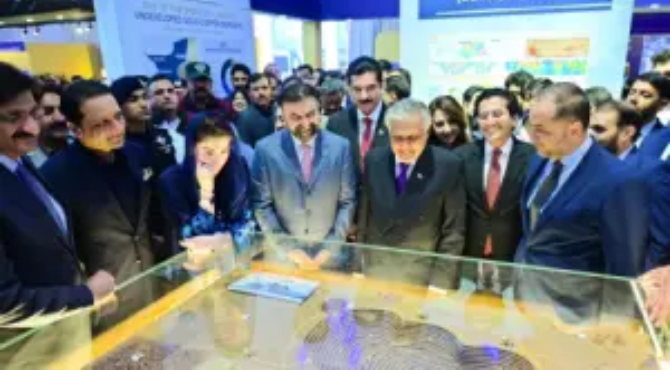
Web Desk(National Times)- Ivanhoe Mines signed a memorandum of understanding (MoU) with Mari Energies on Thursday, the Canadian company’s chairman Robert Friedland said on the sidelines of the Pakistan Minerals Investment Forum.
Friedland said Ivanhoe is in the early stages of setting up a local office in Pakistan and will sign another MoU on Friday.
Mari Energies’ mining unit, Mari Minerals, has multiple mineral exploration projects, including copper and gold in Pakistan.
The partnership marks the Canadian miner’s entry into South Asia, expanding its presence beyond its major mineral projects in southern Africa.
“We’re excited to be here in Pakistan,” Friedland said.
‘Significant evidence’ of placer gold in Punjab rivers, says CM Maryam
At the forum, Punjab Chief Minister Maryam Nawaz said that there was “significant evidence” of “sufficient quantities” of placer gold flowing in the province’s five rivers.
Maryam said Punjab was the land of five rivers and that gold was “literally flowing” in all five, particularly in the areas of Mianwali and Attock.
Describing Pakistan as a “pot of gold”, she said its wealth lay both above and beneath the ground and needed to be explored and converted into tangible wealth.
“The wealth beneath Punjab was never a problem, never a problem, just like the whole of Pakistan, just like all four provinces and the federating units. The chaos above ground was the actual problem,” she said.
Maryam said the provincial mines and minerals department’s revenue stood at around Rs10 billion two and a half years ago but had since increased to Rs40bn.
“And it is just the beginning,” she added.
She also highlighted the province’s iron ore reserves, saying Chiniot had 261.5 million tonnes of iron ore.
She said the provincial government was taking steps to facilitate investment in the mining sector and create an enabling environment for investors.
The Punjab chief minister said her role as chief executive of the country’s most populous province was to facilitate investors and create an enabling environment by eliminating red tape, bureaucratic delays and unnecessary hurdles.
The provincial government was offering one-window facilitation to ensure investors did not have to run from pillar to post to complete the necessary procedures, she added.
Maryam said the government was also making substantial capital investments to reduce investors’ capital expenditure and prevent them from having to tie up funds in purchasing expensive land.
Additionally, the government was offering concessional financing of up to Rs5 billion and would provide solar-powered energy solutions to investors to help offset high energy and fuel costs.
Dar says provincial partnership vital for mineral development
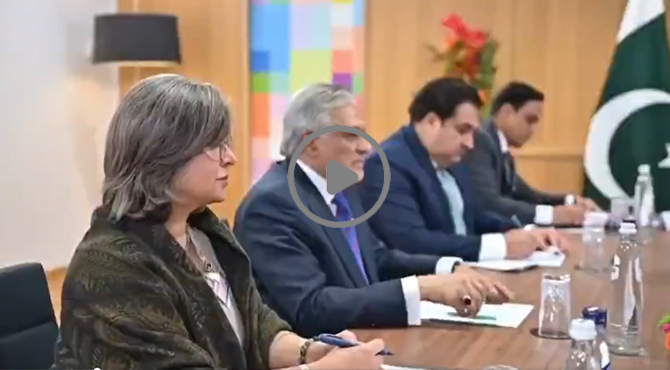
Dar said Pakistan’s constitutional framework made provincial partnership indispensable, adding that the provinces were essential partners in the national undertaking and that their constitutional authority and ownership of mineral resources must be respected.
Addressing the event, he said the federal government was working alongside provincial governments and their leadership through national coordination, investment facilitation, policy alignment and international engagement.
Dar said Pakistan’s mineral resources were central to the next phase of the country’s economic transformation, stressing the need to diversify exports, strengthen the industrial base and attract long-term investment.
He said Pakistan possessed substantial and diverse mineral resources, including significant copper and gold potential along the Tethyan metallogenic belt in the west of the country. The country also had deposits of iron ore, chromite, lead, zinc, coal, rock salt, marble, gypsum, gemstones and other industrial minerals.
The deputy PM said the Reko Diq copper-gold project in Balochistan demonstrated the potential of international expertise, national participation and provincial ownership in attracting major long-term investment.
He stressed that Pakistan’s ambition should extend beyond extracting minerals and exporting them in raw form, saying the country needed to develop the capacity to process and refine them, as well as manufacture mineral-based products domestically.
Dar said Balochistan was central to Pakistan’s mineral future, adding that the development of its resources should contribute meaningfully to the provincial economy and the well-being of its people.
He also emphasised the importance of local employment, skills development and the participation of Pakistani companies, saying local communities must be active participants in and beneficiaries of mineral development.
The deputy prime minister further stated that environmental protection, workers’ safety and the rehabilitation of mining sites were essential to a successful minerals industry.
The Reko Diq copper-gold project in Balochistan is one of Pakistan’s most ambitious mining ventures, with significant potential to boost the country’s mineral wealth through the extraction of gold and copper.
Designed as an open-pit mining and processing operation, the project will initially process 45 million tonnes of ore annually, with capacity expected to double to 90m tonnes after the completion of Phase 2.
The mine has an estimated operational life of 37 years, which could potentially extend to 80 years through further exploration and resource development.