
LAHORE(National Times)- The Punjab government insisted on Wednesday that there should be no politics over smog, environmental protection and public health, as these issues concern the lives, health and future of millions of people.
“Smog is not a political issue. It is a scientific, environmental and public health challenge,” senior minister Marriyum Aurangzeb told a press conference on Wednesday, even as Lahore, Multan and other major cities and towns in the province remained blanketed under a thick layer of smog.
On Wednesday night, Lahore remained on top of the global ranking of major polluted cities, recording an air quality index (AQI) reading of 358.
Meanwhile, the toxic smog in second-placed New Delhi — with an AQI reading of 248 on Wednesday — was so severe this week that air pollution monitors in the country were overwhelmed after pollutant concentrations exceeded the upper measurement limits on their instruments.
This meant that official data failed to capture the full extent of the smog for several hours overnight Sunday into Monday, just as pollution surged with a barrage of fireworks for Diwali.
A few days ago, Ms Aurangzeb had blamed Diwali fireworks in India for the smog persisting over Punjab. On Wednesday, the Punjab Environment Protection Agency (EPA) — in its assessment for the Diwali period — found that pollution-laden air from India travelled deep into Punjab, contributing to increased particulate matter (PM) concentrations.
According to the agency, around 50pc of Punjab was affected by the air originating in India during the preceding 24 hours. Forward-trajectory modelling indicated that air released across the border on Diwali night could reach Lahore from Amritsar in approximately two hours, Faisalabad in 12 hours and Multan in around 11 hours, demonstrating the potential for trans-boundary pollution to affect cities located far inland from the international boundary.
Readings from Punjab’s air quality monitoring network showed a marked geographical variation in particulate pollution across Lahore. The Wagah Border monitoring station recorded a 275pc increase in PM2.5 concentrations, reaching its peak between 3am and 4am. In comparison, Safari Park, situated on the western side of the city, recorded an increase of only 15pc.
The EPA says the east-to-west variation in particulate matter concentrations was consistent with the movement of pollution carried by easterly winds from across the border.
During this time, Lahore’s overall AQI increased from 366 on Nov 8 to 440 on Nov 9, reaching its highest recorded value at 9am, the agency’s analysis showed.
The findings suggest that cross-border pollution contributed significantly to the deterioration in air quality during the period. However, they do not establish it as the sole source of pollution, as local emissions and meteorological conditions also influence air quality across the province.
The heavy smog had also forced motorway closures earlier this week. On Tuesday evening, the section from Shamkot to Abdul Hakeem was closed to all traffic, while heavy traffic on the Sher Shah-Multan section towards Khanewal was also suspended, a motorway police spokesperson told Dawn.
The India Gate monument is hardly visible through the toxic smog hanging over New Delhi
‘Visible improvement’
In her remarks, Ms Aurangzeb pointed out that before 2024, there was no integrated system for smog mitigation, monitoring, management and enforcement.
“Today, under Chief Minister Maryam Nawaz, Punjab has established an evidence-based, technology-driven system that identifies pollution sources, monitors emissions, predicts environmental conditions and ensures immediate enforcement action,” she said.
She insisted that environmental protection had been institutionalised for the first time in the province through 24/7 monitoring, scientific forecasting, technology-enabled surveillance, rapid response mechanisms and coordinated action across industries, transport, agriculture, brick kilns and other major pollution sources.
She said that the results of this transformation were becoming visible in improved air quality indicators across Lahore and other parts of Punjab.
“On November 11, 2024, Lahore’s Air Quality Index had exceeded 2,000 and reached alarming levels of approximately 2,400. On November 11, 2026, the AQI is below 450. This significant improvement reflects the impact of scientific planning, sustained mitigation measures, modern monitoring systems and strict enforcement,” she claimed.
She said that Punjab had introduced an advanced air quality forecasting system capable of predicting pollution trends five to seven days in advance, enabling authorities to take preventive action before conditions deteriorate.
The senior minister said that air pollution indicators across different areas had improved by 23 to 64 per cent, reflecting the impact of sustained government interventions.
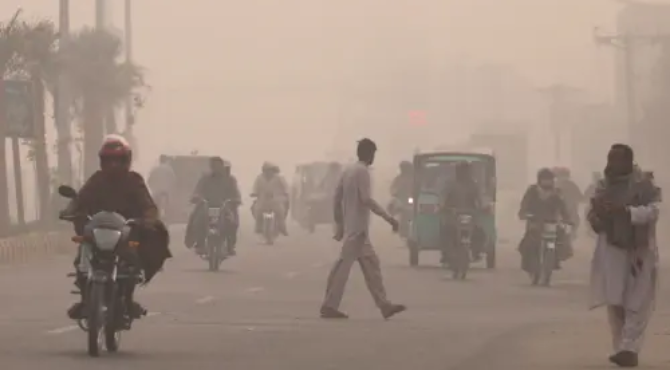
pedestrians walk down a street in Lahore on a smoggy morning
Breaking the equipment
Meanwhile in India, toxic smog concentrations were so high — equivalent to 66 times the World Health Organisation’s recommended daily maximum — that they could not be captured by air pollution monitoring equipment.
Particulate matter analysers, installed when the National Air Quality Index (NAQI) was introduced in 2015, were calibrated to measure concentrations of up to 1,000 micrograms per cubic metre.
The WHO recommends a daily maximum of 15 micrograms per cubic metre for PM2.5, fine particles small enough to penetrate deep into the lungs and linked to cancer.
Consequently, opposition politicians accused the BJP-led government of deliberately deactivating monitoring around Diwali to hide the full extent of the issue.
“The government which shuts down air quality monitoring stations on the night of Diwali, the government that does data fraud, how will you trust such a government?” Aam Aadmi Party (AAP) Delhi president Saurabh Bharadwaj said in a video posted on X.
“If Diwali night’s PM2.5 (toxic particulates) is not in the record, who will answer for that air?” senior Congress party lawmaker Ajay Maken said in a social media post.
However, the Central Pollution Control Board (CPCB) rejected accusations of deliberate under-reporting.
“The designed system of automated data validation treats hourly readings beyond the calibrated range as outside range, and such readings are not used in the computation,” it said in a statement late Tuesday.
Although choking clouds filled the streets early Monday, the scale of the pollution was only captured when monitors resumed reporting, around eight hours after the fireworks peaked.
Readings then hit 879 micrograms per cubic metre in the Mandir Marg locality, according to monitoring organisation IQAir, which cited data from a city government station. That is more than 58 times the WHO daily limits.