
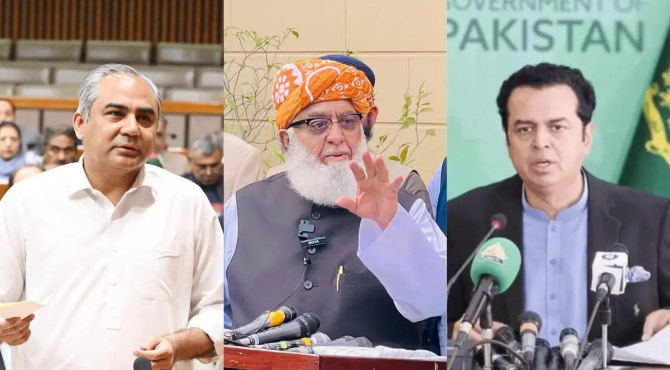
ISLAMABAD(National Times)- Jamiat Ulema-i-Islam-Fazl (JUI-F) chief Maulana Fazlur Rehman on Saturday clarified that his party’s remarks regarding the country’s security situation were directed at policies, not institutions, and termed the allegations levelled against him by federal ministers as character assassination.
A day earlier, Interior Minister Mohsin Naqvi, without naming anyone, had claimed that a “head of a party” was “extremely upset” about not being appointed the governor of Khyber Pakhtunkhwa. The remarks came after Fazl accused the Centre of depriving the provinces of their rights and raised doubts over its reasoning behind imposing governor’s rule that there was a lack of cooperation on counterterrorism.
Earlier on Saturday, State Minister for Interior Tallal Chaudhry also rebuked the JUI-F chief for reportedly seeking his “share” in KP’s governance following the imposition of governor’s rule and an emergency in the province. Other federal ministers have also taken exception to Fazl’s remarks.
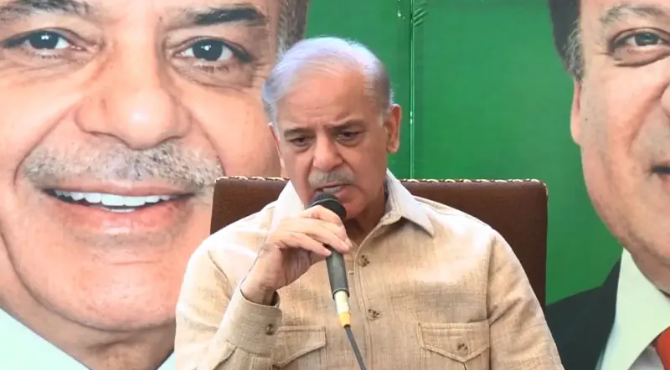
Addressing a press conference in Lahore on Saturday, Fazl stressed that his party’s criticism was directed at policies, not institutions, and was intended to bring about corrective action rather than undermine the sacrifices made in the fight against terrorism.
The senior politician called for an in-camera session of Parliament to review the country’s security situation and formulate a consensus-based policy to combat terrorism.
“Our only question is why the country has failed to eliminate terrorism. Let us sit together and find out why. Parliament is the most appropriate forum to discuss the issue and make decisions. Instead of ridiculing politicians, the government should take them on board in this fight so that we can move forward together,” he said.
“If Parliament is supreme, why are decisions taken in Rawalpindi while Parliament is simply told to follow them?” he remarked. “The issue is that this government is powerless. Decisions are taken somewhere else, and it implements them obediently,” he alleged.
The JUI-F maintained that Parliament should review the security situation and that the nation should be taken into confidence. If the public was expected to support the fight against terrorism and those engaged in it, he argued, the government should explain its decisions rather than impose “unilateral measures”.
Fazl reiterated his objection to the imposition of emergency rule in KP or any other part of the country. Recalling his family’s opposition to emergency rule in Balochistan during the 1970s, he said his father had resigned when the government of Zulfikar Ali Bhutto imposed it in the province.
He described the recurrence of such measures as unfortunate, pointing out that the PP had repeatedly been associated with their imposition.
Questioning the rationale behind the emergency, governor’s rule and deployment of troops in KP, Fazl asked why the province should face such treatment when Balochistan was also grappling with the same level of terrorist violence, if not more.
The JUI-F chief urged the government to develop a shared national narrative and a consensus-based counterterrorism strategy instead of questioning his party’s position.
He went on to ask why the government engaged in negotiations with the PTI, which had been in power in KP, if the party was accused of supporting terrorists. “On top of it, both (the PTI and the government) say that they had reached a consensus on all points.”
Fazl then highlighted that around 250 of his party workers had lost their lives in terrorist violence, arguing that their sacrifices should not be ridiculed or overlooked. “How can a party whose members have laid their lives be accused of supporting terrorists?” he asked.
He also questioned why he was being singled out for criticism when political leaders, including former prime minister Nawaz Sharif, had at various times disagreed with the military leadership.
Ministers assail Fazl
Earlier on Saturday, addressing the media in Jaranwala, Chaudhry said, “I am upset. We did not expect Maulana sahab […] to consider this as spoils of war and seek his share in the absence of a PTI government in the province.”
He emphasised that the imposition of an emergency and governor’s rule in KP was not a political move aimed at strengthening the PML-N’s presence in the province by dismissing the PTI-led government.
“This was an administrative setup,” he said, adding that it had been formed with a “one-point agenda: combating terrorism”, rather than with an intention of establishing a political setup.
“This is not spoils of war,” he reiterated, adding that the imposition of an emergency and governor’s rule in KP was an “immensely responsible” decision taken after every other option had been considered.
“I am unable to understand why Maulana sahab says that he was forced to accept defeat [in elections],” he said, arguing that Fazl’s party had been defeated by the PTI in KP and the Pashtunkhwa Milli Awami Party in Balochistan.
Chaudhry said the JUI-F was worthy of respect only if it stood by Pakistan’s interests.
The state minister also rejected the impression that the imposition of an emergency and governor’s rule was aimed at taking control of KP’s natural resources.
He also criticised Fazl for bringing up the 1971 separation of East Pakistan — now Bangladesh — from Pakistan in his recent statements.
“You bring up 1971 after losing the 2024 elections,” Chaudhry said.
“This KP setup is not about distributing shares, forming coalitions and governments, or engaging in politics,” he stressed, clarifying that only one member of the KP Advisory Council has a political background, as she represents the families of martyrs.
Chaudhry again offered to implement the National Action Plan and combat terrorism jointly with all stakeholders. “Politics is possible only where there is peace,” he said.
At the outset of his address, Chaudhry alleged that there must be “a relationship or a mutual interest arrangement between the Tehreek-i-Taliban Pakistan (TTP) and the PTI”.
“Since 2015, no PTI leader, gathering or member has been targeted by terrorists,” Chaudhry said. “On the other hand, over the past 11 years, no political or religious party, security force, public office, funeral or wedding has been spared terrorist attacks.”
He said the federal government had exhausted all avenues to bring together stakeholders and urge them to condemn terrorism by naming those involved, whether the TTP, the Balochistan Liberation Army (BLA), or groups funded by India or Afghanistan.
The state minister claimed that in 2013, when the government decided to hold talks with the TTP and representatives were proposed by both sides, the TTP had nominated PTI founder Imran Khan to its committee.
He also alleged that the PTI founder had allowed the TTP to open offices in Peshawar.
During his address, Chaudhry also criticised the PTI, showing a press release issued by the TTP that condemned the dismissal of the party’s government.
Meanwhile, speaking at a press conference in Sialkot, Defence Minister Khawaja Asif criticised the JUI-F chief for constantly “targeting” the country’s security forces.
He declared that the sacrifices made by the security forces, officers, and the public in the fight against terrorism were “matchless”.
The defence minister referred to Fazl’s accusations that the emergency and governor’s rule were imposed to capture KP’s mineral resources, saying that he had shared a full list of people who had the mining contracts in KP.
Asif maintained that the whole PTI and opposition leadership was engaged by the government before the imposition of emergency and governor’s rule.
“But it was fruitless,” he said.
“The situation will improve in KP […] parliament can roll back the decision of imposing the emergency only if the improvement of the situation in the province is guaranteed,” the defence minister said.
He said that some individuals in KP were expecting to get a share in the administrative changes in the province.
“We will ensure free and fair elections. Whenever the time comes, everybody can take part in it,” he said.
Fazl’s remarks also prompted a response from KP Governor Faisal Karim Kundi, who has now been tasked with running the province under governor’s rule.
Kundi, referring to the JUI-F chief, asked whether “your land in the land belonging to martyrs in DI Khan is halal”.
“What you get is halal, what the other gets is haram,” he remarked.
The governor reaffirmed that the new KP administration would continue to function properly.
‘Extremely upset’
Fazl, who was involved in reducing tensions between the Centre and the KP government, has been critical of the federal government over the imposition of governor’s rule in KP. He also accused the Centre of reneging on its commitments amid his efforts to mediate between the two parties.
Addressing a rally in Multan on Thursday, Fazl further recalled that his party had expressed reservations over the merger of tribal areas into KP after the 25th Constitutional Amendment in 2018.
“We were not against the merger, but we said that it was an issue of the political future of the people of tribal areas,” he said, alleging that the people of those areas were not consulted on the merger.
He alleged governor’s rule was not imposed in Balochistan because the province’s chief minister “praises you”.
The next day, during an interaction with journalists, the interior minister said, “The head of a party is extremely upset over being denied a role in the new setup in KP and not getting the governorship.”
This politician, Naqvi alleged, had remained “dependent on the establishment for decades to advance his political career”.
“These are the same politicians who remained in politics for decades with the support of the establishment, and this politician even relied on the establishment to arrange air tickets for the members of his party,” he further alleged.
He said such politicians had little justification for criticising others now, particularly after having benefitted from the same system they currently denounced.
The same day, Punjab Chief Minister Maryam Nawaz also railed against Fazl in a post on X.
She said it was not expected of a senior politician such as him to support those who facilitate terrorism — an apparent reference to the PTI, which the Centre accuses of backing terrorism.
She also criticised Fazl for his remarks about Chief of Defence Forces and Chief of Army Staff Field Marshal Asim Munir, seemingly referring to his comments during the Multan address about the centralisation of power.
The Centre imposed governor’s rule and emergency in KP on Oct 11, citing the provincial government’s “deliberate disengagement” from the fight against terrorism.
The move has drawn criticism from the opposition, including Fazl, as well as Mehmood Khan Achakzai and Raja Nasir Abbas of the Tehreek-i-Tahafuz-i-Ayin-i-Pakistan.
In the days preceding the imposition of governor’s rule in KP, political tensions between the Centre and the opposition — including the PTI which was in power in KP — had remained high since jailed former prime minister Imran Khan’s party announced a protest march to Islamabad to demand his release.
Intense negotiations between the two sides a week before the imposition of governor’s rule had failed to yield any results, while Fazl was cast as the man who could defuse heightening tensions between the Centre and the PTI. Both sides had held separate meetings with Fazl, reportedly for his intervention to help break the deadlock in the negotiations.