
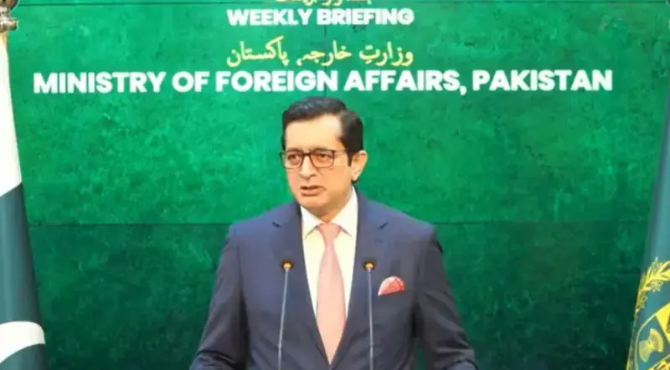
ISLAMABAD(National Times)- The Foreign Office on Friday said that talks with Afghanistan could not be unconditional, while rejecting suggestions that Islamabad was unwilling to engage with its neighbour and saying it would welcome sincere efforts by friendly countries to help resolve the dispute.
“Pakistan is not shying away from discussions or dialogue, including with representatives of Afghanistan. Pakistan would welcome any sincere efforts by friendly countries that could help address our legitimate security concerns and promoting regional peace and stability,” Foreign Office spokesperson Sajjad Haider Khan said at the weekly media briefing.
The statement came as Russia recently renewed its readiness to mediate between the two countries, although Islamabad denied the existence of any such initiative.
“At present, I am not aware of any separate, formal Russian mediation initiative being under discussion,” Mr Khan said, adding that Pakistan remained open to engagement that produced tangible results.
Russia, the only country to have formally recognised the Taliban government, has recently renewed its offer to facilitate a settlement if both sides request its involvement.
Moscow’s special envoy for Afghanistan, Zamir Kabulov, had earlier this month made this suggestion after the latest round of the Moscow Format consultations on Oct 5 ended without a joint communiqué because of differences between Pakistan and the Afghan Taliban delegations over references to terrorist networks operating from Afghanistan.
Mr Khan said the absence of an agreed statement at the Moscow Format meeting reflected the Afghan delegation’s unwillingness to accept language on terrorist networks that had been agreed in the previous year’s document.
“The fact that no joint communiqué was issued after the Moscow Format is self-evident that Afghanistan did not accept the formulation which had been acceptable until last year particularly about presence of terrorist network in Afghanistan. This shows that there is reluctance on the part of Afghanistan that terrorism is originating from its soil,” he said.
The failure to get a joint communique highlighted the central obstacle to normalising relations, which is Pakistan’s demand for action against the Tehreek-i-Taliban Pakistan (TTP) and other terrorist groups it says are using Afghan territory to launch attacks across the border.
The Taliban authorities have avoided taking a categorical position on the TTP and other groups, while rejecting Islamabad’s allegations that Afghanistan is being used as a base for attacks against Pakistan.
The dispute has frustrated international efforts to reduce tensions. Qatar and Turkiye last October helped broker a ceasefire, but subsequent round of talks failed to reach a lasting settlement. Saudi Arabia separately hosted discussions, while China held talks between the two sides in Urumqi in April. None of these efforts could resolve the disagreement over terrorist groups and the measures needed to prevent cross border attacks.
Pakistan’s position, Mr Khan said, was that dialogue would need to be backed by an arrangement that could verify whether terrorist activity against the country had stopped.
“The talks will not be unconditional. Pakistan has been raising the issue of terrorism emanating from Afghanistan at different forums. Unfortunately, the Taliban regime has been taking one step forward and one step backward,” Mr Khan emphasised.
“Pakistan has only one demand that there should be a verifiable mechanism to ensure complete cessation of terrorist activities emanating from Afghan soil against Pakistan,” he said.
‘Stronger response’
Mr Khan reminded India of the response it faced during last year’s military confrontation and warned that any future aggression would be met with an even stronger response.
FO reaction came after Indian Defence Minister Rajnath Singh a day earlier threatened a bigger strike in the event of any future terrorist attacks.
Singh, while speaking at National Defence Conclave 2026 in Delhi, recalled Operation Sindoor and said that it marked a decisive response to terrorism. He also referred to earlier Indian military operations.
“We reject and condemn the Indian Defence Minister’s provocative remarks entailing a threat of Indian aggression against Pakistan. Such reckless statements reflect India’s hegemonistic mindset and the risks its belligerent posture poses to regional peace and stability in South Asia,” Mr Khan said.
“We wish to remind India of the consequences of its military aggression in May last year, when Pakistan demonstrated both its capability and resolve to defend its sovereignty and territorial integrity and gave a fitting reply to Indian aggression,” the FO spokesperson said.
Mr Khan urged New Delhi to draw lessons from the previous confrontation and avoid further escalation.
“India should draw an appropriate lesson from the last year’s experience and abandon its belligerent posture and dangerous rhetoric and act with responsibility for lasting peace in the region,” he said.