
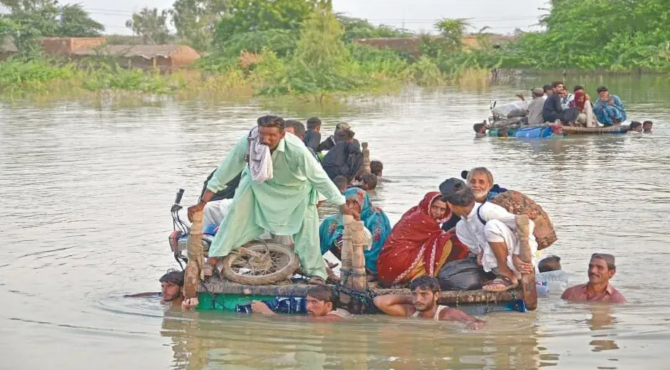
ISLAMABAD(National Times)- The World Bank has formally downgraded implementation progress on a $245 million flood rehabilitation project in Balochistan to ‘moderately unsatisfactory’, mainly after the government decided to cap beneficiary coverage for resilient housing.
“Progress remains uneven and continues to affect implementation,” said the Washington-based multilateral lending agency in its public disclosure, dated Aug 12, on the Integrated Flood Resilience & Adaptation Project (IFRAP), while downgrading implementation from ‘moderately satisfactory’ to ‘moderately unsatisfactory’ just six months earlier.
“Over 74,000 households have received the first tranche of housing support; however, the Project Steering Committee’s decision to cap beneficiary coverage, a financing gap for remaining eligible households, unresolved grievances, and communication challenges pose risks to implementation mentation progress and achievement of the project development objective,” it added.
Earlier, World Bank’s country director Boloromaa Amgaabazar had expressed concern over the decision to cap housing support to 62,966 first-tranche beneficiaries, and subsidy support to 97,000 people.
Under Component 1 of the project, covering irrigation, roads and bridges, the bank noted that a dedicated project director had been appointed, the project implementation unit (PIU) strengthened, detailed designs and bidding documents were nearly complete, and procurement had commenced. “However, all three project development objective (PDO)-linked output indicators have yet to be achieved.”
Under Component 2, relating to the early warning system (EWS) and hydro-met services, the bank said implementation momentum was improving following the appointment of a new deputy project director and the award of the automatic weather station (AWS) contract. However, onboarding of the system integrator and several critical procurements remained pending.
The bank noted that, in light of recent developments under Component 3, relating to resilient housing, the ‘Sector Strategies and Policies’ risk and the ‘Technical Design of Project or Programme’ risk had been revised to ‘High’ from ‘Substantial’.
While political and governance-related operational risks remained unchanged at ‘High’, risks relating to sector strategies and policies, technical programme design, and institutional capacity for implementation and sustainability had been revised to ‘High’ from ‘Moderate’ in December 2025.
A technical mission of the bank also reported that, as of July 6, the project was ‘non-compliant’ with environmental and social standards relating to stakeholder engagement and disclosures, as its scope had been considerably changed without engaging directly affected parties and vulnerable people.
It said the World Bank loan agreement required the government to submit a revised Project Implementation Manual (PIM) within 45 days of the effective date, reflecting detailed implementation arrangements and procedures under the amended Financing Agreement.
“The revised PIM has not yet been submitted to reflect changes in project operations. Accordingly, the status of the relevant Legal Covenant is declared as ‘Not Complied With’,” the technical mission reported.
The financing agreement also required the project to submit annual work plans and budgets (AWPBs) for the World Bank’s review and approval. This requirement was met for FY2025-26, but AWPBs for FY2026-27 for most PIUs, except early warning and hydro-met services, remain pending. “Delayed submission of AWPBs may call into question the eligibility of expenditures incurred during the current fiscal year,” it said.
Given these shortfalls, the project management and institutional strengthening rating was downgraded to ‘Moderately Unsatisfactory’. The rating will be reassessed during the next review mission, planned for October.
Ministry ‘in contact’ with WB
Meanwhile, in a statement, the Ministry of Planning and Development said it was “in constant conversation with the World Bank on the execution of key development projects as approved by the Executive Committee of the National Economic Council (Ecnec) on the recommendation of the Government of Balochistan in this case”.
“As the primary borrower and custodian of national development goals, our priority is to ensure that international financial support directly serves the critical needs of the citizens of Balochistan. We appreciate the Bank’s ongoing partnership and hope for smooth delivery of work through the approved mechanisms and processes,” the planning ministry said.