
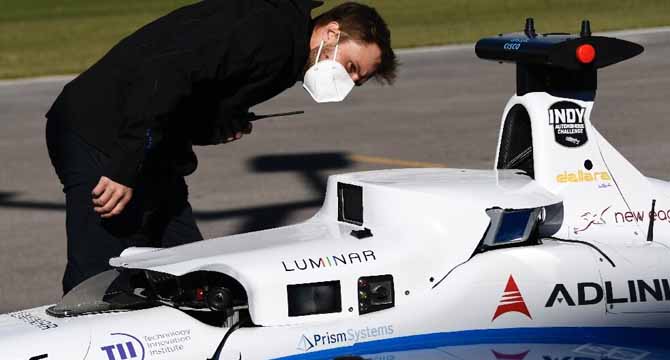
LAS VEGAS (National Times) – A racecar with nobody at the wheel snaked around another to snatch the lead on an oval track at the Consumer Electronics Show in Las Vegas Friday in an unprecedented high-speed match between self-driving vehicles.
Members of Italian-American team PoliMOVE cheered as their racecar, nicknamed “Minerva,” repeatedly passed a rival entered by South Korean team Kaist.
Minerva was doing nearly 115 miles per hour (185 kilometers per hour) when it blew past the Kaist car.
Every racer was deemed a winner by organizers who saw the real victory as the fact that self-driving algorithms could handle the high-speed competition.
“It’s a success,” Indy Autonomous Challenge (IAC) co-organizer Paul Mitchell said to AFP before the checkered flag was waved.
The race pitted teams of students from around the world against one another to rev up the capabilities of self-driving cars, improving the technology for use anywhere.
In October, the IAC put the brakes on self-driving cars racing together to allow more time to ready technology for the challenge, opting instead to let them do laps individually to see which had the best time.
“This almost holds the world record for speed of an autonomous car,” PoliMOVE engineer Davide Rigamonti boasted as he gazed lovingly at the white-and-black beauty.
The single seat usually reserved for a driver was during this race instead packed with electronics.
PoliMOVE had a shot at victory at another race in October in Indianapolis, clocking some 155 miles per hour (250 kilometers per hour) before skidding out on a curve, according to Rigamonti.
Friday, it was the South Korean entry that spun out after overtaking a car fielded by a team from the University of Auburn in the southern US state of Alabama.
“The students who program these cars are not mechanics; most of them knew nothing about racing,” said IndyCar specialist Lee Anne Patterson.
“We taught them about racing.”
The students program the software that pilots the car by quickly analyzing data from sophisticated sensors.
The software piloting the cars has to anticipate how other vehicles on the course will behave, then maneuver accordingly, according to Markus Lienkamp, a professor at Munich, TUM, which won the October competition.
Nearby, Lienkamp’s students are glued to screens.
“It plays out in milliseconds,” said Mitchell.
“The computer has to make the same decisions as a human driver, despite the speed.”
The IAC plans to organize other races on the model of Friday’s — pitting two cars against each other, with the hope of reaching a level sufficient to one day launch all the vehicles together.