
ISLAMABAD (National Times): Experts from academia, trade and diplomacy have agreed that Kyrgyzstan’s Vision 2030 places people and human development at the centre of the country’s national development agenda, with economic transformation, institutional reforms, financial development and regional connectivity serving as key drivers of progress.
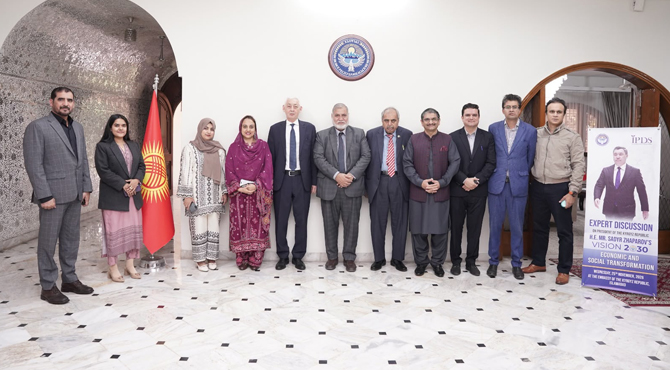
The consensus emerged during an expert discussion titled “President of the Kyrgyz Republic H.E. Mr. Sadyr Zhaparov’s Vision 2030: Economic and Social Transformation,” jointly organised by the Embassy of the Kyrgyz Republic in Pakistan and the Institute of Peace and Diplomatic Studies (IPDS) at the Embassy in Islamabad on Wednesday.
The discussion focused on the National Development Program of the Kyrgyz Republic until 2030, a policy framework outlining the country’s development priorities for the next five years. The programme was presented by Kyrgyz President H.E. Mr. Sadyr Zhaparov on October 21, 2026.
In his opening remarks, Chargé d’Affaires and Minister-Counsellor of the Embassy of the Kyrgyz Republic, Mr. Aibek Tilebaliev, highlighted the significant progress achieved by Kyrgyzstan over the past five years. He described the resolution of border issues with neighbouring Uzbekistan and Tajikistan as a major diplomatic breakthrough.
He also underscored the historic relations between Pakistan and Kyrgyzstan, rooted in longstanding political, economic and cultural ties. Highlighting the administrative reforms introduced under President Sadyr Zhaparov, he noted that Kyrgyzstan had recorded threefold GDP growth between 2021 and 2024.
Dr. Farhat Asif, Founder and President of the Institute of Peace and Diplomatic Studies (IPDS) and moderator of the discussion, described the gathering as an important platform for examining Kyrgyzstan’s evolving development priorities.
She observed that Vision 2030 places economic transformation at the centre of the national agenda while recognising connectivity as an integral part of broader development rather than an isolated objective. She further emphasised that human development constitutes a fundamental pillar of the vision, while the financial system serves as an important enabler of sustainable progress.
Sharing his perspective on trade and financial cooperation, Dr. Shahid Hassan, President of the Kyrgyzstan Trade House in Pakistan, highlighted Kyrgyzstan’s notable progress in establishing small-scale industries over recent years. He said this development reflected the country’s growing emphasis on a people-centred approach to economic growth.
Discussing the socio-economic dimensions of the vision, Professor Dr. Muhammad Munir, Dean of the Faculty of Social Sciences and Humanities at Muslim Youth University, said that after focusing on institution-building in previous years, Kyrgyzstan was now placing greater emphasis on human capital development.
Referring to the healthcare sector, he explained that Vision 2030 views investment in health as an investment in human capital rather than merely a national expenditure.
On transport logistics and tourism, Mr. Ramiz Ali Rabbani, Managing Director of Best Trans (Pvt.) Ltd., highlighted the potential benefits of a Free Trade Agreement (FTA) between Pakistan and Kyrgyzstan. He noted that such an agreement could strengthen bilateral economic cooperation and reduce costs for Kyrgyz companies seeking to utilise Pakistani seaports for cargo transportation.
In her concluding remarks, Dr. Farhat Asif reiterated the central message emerging from the discussion, observing that people and human development remain at the heart of the priorities outlined by President Sadyr Zhaparov in his Vision 2030 address.