
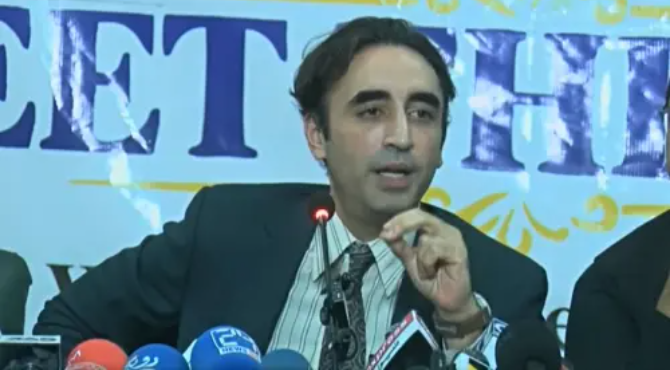
MULTAN(National Times)- PPP Chairman Bilawal Bhutto-Zardari on Thursday asserted that PTI was a “political reality” whose trust in the “system” needs to be restored for a political reset to take place.
Bilawal, who is on a visit to Punjab for the past few days, made the remarks while speaking at the Multan Press Club. He has made stops in Multan, Dera Ghazi Khan and Muzaffargarh so far.
Responding to a query about him calling former premier Imran Khan a “political prisoner”, Bilawal explained that he made the “controversial” statement in a polarised political environment, where those terming him a political prisoner could not be convinced otherwise and those declaring him a convict and corrupt could not be convinced otherwise.
Bilawal stressed that in his speech, not the press queries, he made an observation that was not about Imran, but rather about Pakistan’s political history wherein elected premiers often end up going to jail later on or come to power after being imprisoned.
“Whatever opinion you may hold about Khan sahib, even if you think he is not a political prisoner, there is no denying the fact that PTI is a political reality,” the PPP chairman stressed.
He emphasised that even if Imran was considered a “convicted felon or terrorist or whatever”, prisoners in a respectable society were entitled to their rights.
Bilawal said that although the PTI founder “tried to deny my family those rights”, he would not want to continue the cycle of “repeating the same mistakes” in vengeance.
“Khan sahib is a convict, he is in jail, but PTI is a political reality. Until PTI’s trust is restored in this system […] and they are able to play their role in the Parliament, the reset that is being discussed cannot take place in that manner,” he maintained.
The PPP chairman’s latest remarks come amid a growing debate over a “system reset” in the country. In July, Interior Minister Mohsin Naqvi stirred a political storm by calling for the creation of new administrative units, arguing that the current system of governance had “collapsed” and needed a “reset”.
On Nov 17, in a hard-hitting speech, Bilawal had asserted that the governance system had not collapsed, but was rather “made to collapse”.
In a similar vein, the Bhutto scion on Monday had called for restoring the supremacy of Parliament as well as trust in the judiciary and the electoral system.
During Thursday’s address, Bilawal reiterated his call to regain the opposition’s “lost trust” in the system and for the government to undertake confidence-building measures to convince it that institutions such as the Parliament, the Election Commission, the courts, and the accountability system could be trusted again.
At the same time, the PPP chairman highlighted a similar “lack of trust” in the opposition on the government’s part and urged the opposition to view its role as a responsibility rather than a choice.
“They should sit in our finance committee in the Parliament. When the government presents the budget, [they should give their] input,” he said, adding that the opposition’s role was essential to tackling unemployment, inflation and poverty.
“But they haven’t been doing it for quite some time. They come for the judiciary, but there is also a committee for the judiciary, they do not sit in that either. They are not present in all committees of the Parliament,” Bilawal pointed out.
He called on the opposition to review if they benefitted from their boycott of such parliamentary initiatives, urging that it take part in the recently proposed electoral reforms committee.
“Until there are free and fair elections, until our country, our nation, all provinces, and all parties have confidence in this electoral system, there will be no trust, and the governments formed or referendums held as a result of that electoral system will lack legitimacy and strength,” Bilawal asserted.
The PPP chairman reiterated his stance that any “reset or reboot of our system” should be democratic and political, with all political stakeholders, including the opposition, made part of the conversation.
“If we want to make the Parliament functional, then all decisions have to be made in the Parliament alone,” he said, adding that decisions taken “outside the Parliament” would leave the system incapable of overcoming challenges.
Bilawal regretted that ongoing discussions in the Parliament, the federal cabinet, seminars, or even television talk shows did not pay attention to the fundamental issues faced by the public.
“People are distressed about managing two square meals. They’re worried whether they should educate their children or arrange medicines for their elders,” Bilawal said.
Bilawal noted there was “restlessness and distress” among Pakistan’s youth, who faced unemployment and, even if employed, their salaries were spent on just commuting to and from work.
“In my opinion, if we truly want this system to serve the public, if we truly want our country, our Pakistan, to be capable of facing every problem, whether they are economic hardships or foreign difficulties, then we will have to take steps as soon as possible so we can establish unity, political stability, and restore trust in all institutions,” Bilawal stated.
‘Non-existent press freedom’
During his address, the PPP chairman also highlighted the importance of a free press, adding that he wanted to restore the “power” previously held by press clubs across the country.
“With your voice, your columns, you used to make and topple governments,” the Bhutto scion remarked.
“I don’t want to topple any government, nor do I want to form another one. But I believe your role is to hold up a mirror to those sitting in power,” he added.
Bilawal said he was not denying “mistakes” made by him over time, insisting that his party’s intention was not to weaken the press.
He referred to the Prevention of Electronic Crimes Act (Peca), which was amended in January 2025 despite countrywide protests by journalists’ bodies.
He remarked that regardless of the PPP’s intention, the country had now arrived at a point where press freedom was non-existent.
The PPP chairman noted that if the media was given space only to regurgitate what those in power talked about among themselves, then issues related to economic crises and difficulties faced by the people at the grassroots level would not come to the forefront.
Bilawal also elaborated on his earlier remarks about the 26th and 27th Constitutional Amendments, insisting that an impression was being given as if he was backing away from them or criticising them.
In his Nov 17 remark, the PPP chairman, who had strongly advocated for the amendments at the time of their passage, had said the 27th Amendment was “passed neither through political consensus nor bilateral agreement; it was passed with brute majority”.
He had also questioned the current status of the judiciary, particularly in the wake of the 27th Amendment, noting that resignations of senior judges followed the legislation.
The next day, the PPP chairman clarified that he was “not disowning” the 27th Amendment, but rather noting that it did not enjoy the same “unanimous consensus” as the 18th Amendment and the 1973 Constitution.
“It’s not black and white,” Bilawal said today, stressing that the 1973 Constitution and the 18th Amendment were passed through mutual consensus.
He defended that the 26th Amendment was passed with as much consensus as could be developed, while the 27th