
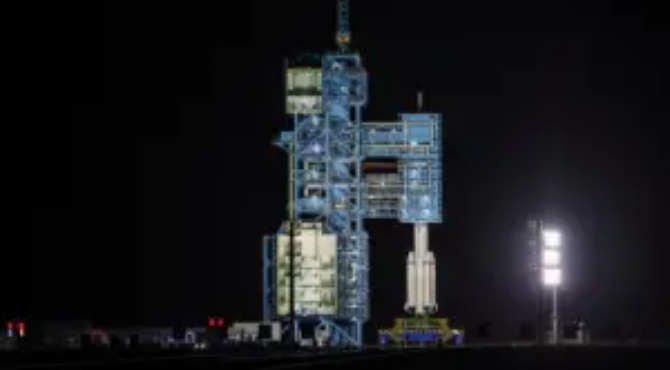
Web Desk(National Times)- A Pakistani astronaut will travel to China’s Tiangong space station aboard the Shenzhou-24 mission, becoming the first foreigner to visit the orbiting outpost, Beijing’s manned space agency said on Saturday.
Pakistan and China are close diplomatic and strategic partners, and signed a deal in February 2025 setting up a Chinese government training programme for Pakistani astronauts.
The statement by the China National Space Administration (CNSA) did not give a date of departure, but the mission is expected to take place by the end of the year.
However, earlier in October, Planning Minister Ahsan Iqbal said the space mission would take place on Nov 25 while addressing a ceremony.
The Pakistani astronaut, a payload specialist, will join a short orbital flight before returning with the Shenzhou-23 spaceship, which docked at the Tiangong space station in May, according to the CMSA.
The agency did not name the Pakistani crew member, but said in April that astronauts Muhammad Zeeshan Ali and Khurram Daud had been chosen to start training in China.
Prime Minister Shehbaz Sharif met the two in April, and congratulated them on their selection. He said the space mission was a “matter of pride for the entire nation” and further commended their “round-the-clock efforts” in achieving the milestone.
PM Shehbaz hoped that the space mission would “add new dimensions to the brotherly relationship between Pakistan and China”.
Beijing has invested heavily in its space programme in recent years — catching up with its main rival the United States — and aims to land astronauts on the Moon by 2030.
Pakistan is a natural partner, given the countries decades-long, “all-weather” friendship. China is Pakistan’s largest trading partner and a major foreign investor.
In February 2025, Suparco and CMSA had signed a cooperation agreement. Under the pact, two Pakistanis were to train in China, with one joining a mission on the Tiangong space station operated by Beijing.
China has been barred from participating in the International Space Station since 2011, when the US prohibited Nasa from collaborating with Chinese space agencies. Since then, Beijing has sought to build partnerships with other countries — including Pakistan — in its expanding space programme.