
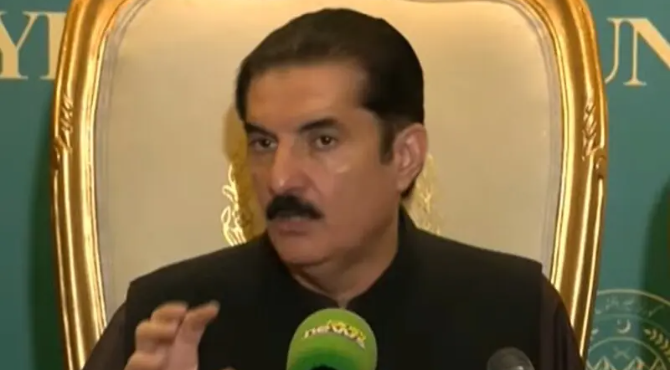
PESHAWER(National Times)- Khyber Pakhtunkhwa Governor Faisal Karim Kundi said on Monday that gone were the days when there would be no coordination between the Centre and the province, adding that “our policies will now come from Islamabad, not Kabul”.
“Gone are the days when there was no coordination between the Centre and the province. Gone are the days when we used to fight needlessly with another province … We will have coordination with the Centre; our policies will come from Islamabad … not Kabul, Jalalabad or Kahandar. It is clear,” Kundi said at a press conference in Peshawar a day after taking the helm in KP.
Kundi assumed executive control of the province after the Centre imposed governor’s rule in KP and emergency in 12 of its districts, citing security situation and alleged non-cooperation of the now non-functional provincial government.
In days preceding the Centre’s move, tensions between the federal government and the PTI-led KP government had remained high, initially just over the party’s planned march to Islamabad to demand the release of its founder, Imran Khan, and later over the Centre’s accusation that its provincial government was not cooperating on counterterrorism. Federal ministers also accused the PTI’s KP government of facilitating terrorists and not taking action against them — allegations seemingly behind Kundi’s Kabul reference as Pakistan continues to raise the issue of cross-border terrorism from Afghanistan.
The KP governor’s these remarks and those about about ending the lack of coordination between the province and the Centre came as he pledged enhanced support for the province’s law enforcers, who are on the frontline in the fight against terrorism.
He said the new setup in the province would “not compromise on police”, pledging enhanced support and a pay raise for its law enforcers.
The governor further stated that he called a meeting on security the previous day and that of the provincial apex committee earlier today. He said the Centre had “shown confidence in us” and to meet its expectations, “our first priority is the fight against terrorism”.
Kundi issued a message to the army, police, Frontier Constabulary (FC) and security institutions, saying: “Our committee, this government, is standing side by side with you and will support you fully.”
He said that all members of the newly-formed advisory council had today taken charge of departments assigned to them, and would share future plans.
He added that during Sunday’s high-level security meeting, it had been decided that development would be the second priority of the new setup while the first would be giving whatever resources were asked for to the police and the Crime Terrorism Department.
“I want to say on behalf of this government that we are by your side,” he said addressing law enforcers, adding, “Whatever weapons you want, whatever you need, we will get them to you.”
Kundi stressed, “We will not compromise on our police officers and personnel. We will equip them well.”
He added that yesterday, he spoke to the inspector general of police (IGP) and chief secretary, ordering that from now on, the KP police would no longer have the lowest salaries in the country.
“If they are not the highest, they will at least be equal [to those of the personnel in other areas].”
The governor also said that disbursements under the martyrs’ package would be increased, and the children of martyrs would be given free education.
Kundi also thanked the KP public for “rejecting the circus” that had been ongoing for a few days, referring to the PTI’s long march that began on Oct 4. “I thank KP’s public that they have rejected this 13-year nuisance,” he said, referring to the PTI’s rule in the province.
The governor also said that Interior Minister Mohsin Naqvi had provided the provincial police 10 armoured personnel carriers (APCs) on behalf of the Centre. He noted that in his earlier meeting with the minister, Naqvi had assured him and the apex committee that police and security forces would be granted as much in funds as they required.
“Our priority, our focus, is peace plus development,” the governor stressed. “We will work 24/7, we will deliver hope to people, to our young people, to the business community … that this is not your fight now, it is ours.”
Kundi also called on young doctors who had been striking in the province, urging them to end their strike and assuring that their issues would be solved. He also addressed university staff that were protesting over salaries and employment.
Additionally, he called on the business community, saying that he would work with them to solve their issues.
“When there is peace here, people will come to do business and investment … and the youth will have employment,” he added.
Kundi also criticised the PTI and accused it of to “fight their case” to the Centre, adding, “We will fight our case with arguments, not with abusive language.”
Responding to a question, he said that work was being done on restoring internet services, and that the roads would also be opened up again in a day or two and life would return to normal.
Separately, the interior minister posted about the provision of APCs on X, saying that Prime Minister Shehbaz Sharif had directed the immediate transfer of the vehicles in view of the prevailing security situation in the province.
“The fight against terrorism is our collective responsibility,” Naqvi said. “The federal government stands firmly with KP police and will extend every possible support to defeat terrorism and protect our people.”
Earlier in the day, Naqvi held a meeting of the newly established Area Development Secretariat in KP.
The ADS has established in KP districts placed under emergency to “restore law and order, safeguard the security of the citizens of Pakistan and ensure good governance and development”, according to an Oct 11 government order.
In his meeting, Naqvi said that consulting the tribal elders was the “most important” at this point in the fight against the terrorism in KP.
“We need to ask these (tribal) representatives about what their issues are so we can resolve them,” he said, reiterating the need to empower the KP police and law enforcement.
“If we are spending Re1 in other parts of KP, we need to spend Rs3 here,” Naqvi said.
Commenting on ADS, he emphasised that the federal government had established a separate secretariat to specifically deal with the problems of the 12 districts under emergency.
“KP is a single province,” he clarified, rejecting the impression that the establishment of ADS was an attempt to dissociate the merged districts from the province. “We will work collectively in these 12 regions,” Naqvi said, adding that the PM was also overseeing the developments.
Kundi, Naqvi chair apex committee meeting
Earlier in the day, Kundi and Naqvi co-chaired a meeting of the provincial apex committee, a day after the imposition of governor’s rule and an emergency in the province.
Addressing the meeting, Kundi — who is now in charge of running the province — asserted that under the new set-up, tackling terrorism would be the priority.
“We can sacrifice our development, but never security,” Kundi vowed as he noted a “lack of synergy” in counterterrorism efforts in the province.
“Now it will show that there is (synergy),” he said, adding that the administration will “fulfil the demands of the Counter-Terrorism Department and police”. He stressed that the administration will “work 24/7” as the federal government and the “people had put their faith in us”.
“We have to show the difference,” Kundi said, adding that there was no time for holidays or weekends. He stressed that the administration was moving towards “result-oriented” actions, rather than cosmetic measures.
Noting the scourge of terrorism in the province, the governor said that the “people have no freedom to live, travel and do other things” in districts such as Dera Ismail Khan, Tank and Waziristan.
He called for working towards restoring freedom of movement for people in terrorism-affected districts.
“People from our province also want peace, prosperity and development,” he said. Kundi expressed the hope that the new administration be remembered well.
“It should be written in history that these people came and restored peace in the province,” he said. The governor added that he will hold apex committee meetings regularly.
Co-chairing the meeting alongside Kundi, Naqvi remarked: “Today is the first time I can proudly say that the federal and the provincial governments are on the same page.
“In the past 2.5 years, we have seen many ups and downs,” Naqvi said. The minister stated that the most difficult work was that the war against terrorism was being fought with “no backend support”.
Criticising the PTI-led government, he said: “It was the [provincial] government’s job to lead the war against terrorism, but they did not do it. They kept bowing their heads only because they did not want to compromise.
“But any war, no matter how many resources you have, cannot be won until the government leads it,” he stressed.
“Not once, not twice; we requested them to work with us dozens of times,“ Naqvi emphasised.
“One thing I will ask you to note is that this is the same force, these are the same people, but the only difference you will see is that … the same people will show you results.”
He further said: “It’s not like things will change in a day; there will be difficult times. But all of us, including the governor, police, administration, and the federal government.
“We have to face and defeat them together. Our intentions are pure; God will help us produce results.“
According to an official handout, the forum directed relevant institutions to ensure “coordinated, effective and decisive” steps for eradicating terrorism and establishing sustainable peace.
“The forum made it clear that intelligence-based operations against terrorist activities would continue and all available resources would be utilised to improve the law and order situation,” it said, adding that the need to improve the operational capability of police and the CTD was also stressed.
The body decided to provide these departments with modern equipment, necessary vehicles, effective weapons, required personnel and all other necessary resources.
It was also agreed during the meeting that the resolution of problems being faced by the people, provision of basic facilities and service delivery at people’s doorstep would be ensured, the handout said.
For this purpose, suggestions from the public, their needs and priorities of the local population would be considered during policymaking, it added.
Kundi meets chief secretary, police chief
Earlier in the day, Kundi chaired a high-level security meeting with the new chief secretary, Dr Muhammad Fakhr Alam Irfan, newly appointed Home Affairs Adviser Kifayatullah Khan, and Inspector General Zulfiqar Hameed.
In a post on X, Kundi said the meeting reviewed the security situation and counterterrorism efforts in KP.
“Our police officers stand on the front lines of this fight, making immense sacrifices to protect our people. Their welfare, fair compensation and the future of their families must remain a priority.”
He expressed his administration’s commitment to “strengthening the police and CTD and ensuring our personnel receive the support they deserve”.
“Khyber Pakhtunkhwa has sacrificed enough. Our priority is to protect our people and restore lasting peace,” the governor declared.
Kundi also met Minister for States and Frontier Regions Amir Muqam, who called on him at the Governor House, state-run APP reported.
The two leaders exchanged views on the prevailing situation in the province, with particular focus on maintaining peace, strengthening security and addressing issues affecting the lives of the people.
They emphasised the need for effective measures and close cooperation to improve the law and order situation and eliminate terrorism.
Kundi and Muqam contended that the people of KP had rejected the politics of chaos and confrontation, stressing that peace, stability and public welfare should remain the top priorities.
They reaffirmed their commitment to extending all possible cooperation and taking practical steps to counter security challenges and promote stability in the province.
A day earlier, Kundi addressed the first meeting of the KP Advisory Council — formed by the federal government after the imposition of emergency and governor’s rule — where he outlined similar directions.
“We have to fast-track things. There will be zero tolerance for corruption. Things should be done in a timely manner,” he said, adding that they would have to demonstrate a clear difference from the work done by their predecessors.
Sunday’s directives came after a meeting of the federal cabinet deliberated on the security situation in PTI-led KP. During the meeting, the cabinet noted the provincial government’s “deliberate disengagement from the fight against terrorism”.
Subsequently, the federal government imposed emergency under Article 232 and governor’s rule under Article 234.
Soon after, it also authorised the deployment of Pakistan Army troops and assets in aid of civil power in the province. On the ground, shipping containers were placed around the city of Peshawar to block several roads, with heavy police deployment.
Meanwhile, federal ministers alleged that the PTI-led government in KP had a “nexus” with terrorist groups, as the Centre sought to explain that the province’s security situation necessitated the imposition of emergency there.
The Centre and the PTI have been at odds over various issues, particularly on the counterterrorism policy, which was one of the main reasons behind the breakdown of their October 3 talks.
The PTI has said it was being left out of security decisions concerning KP, which the Centre has denied. It also calls for reviewing the counterterrorism policy and opposes military operations.
On the other hand, the Centre has been criticising the KP government’s efforts to combat terrorism in the province and objects to its stance on dialogue with the Afghan Taliban.
61 law officers removed; 27 new appointed
Following the proclamation of emergency in KP, the provincial law department de-notified 61 law officers of the advocate general’s office.
These included 26 additional advocates general (AGs), 31 assistant AGs and four advocates-on-record (AORs), according to a notification issued late on Sunday and seen by Dawn.
Another notification, dated Oct 11, was issued to appoint 27 new law officers, including 12 additional AGs, 13 assistant AGs and two AORs.
Out of these, six additional AGs, eight assistant AGs, and one AOR were stationed in Peshawar, along with an assistant AG in the Peshawar Service Tribunal.
One additional AG and one assistant AG were each stationed in DI Khan, Bannu, Swat and Abbottabad. Two additional AGs and an AOR were placed in Islamabad to represent KP.
The government had already de-notified then-AG Shah Faisal Uthmankhel and replaced him with a senior lawyer, Sanaullah, who was earlier serving as an additional AG representing the federal government.