
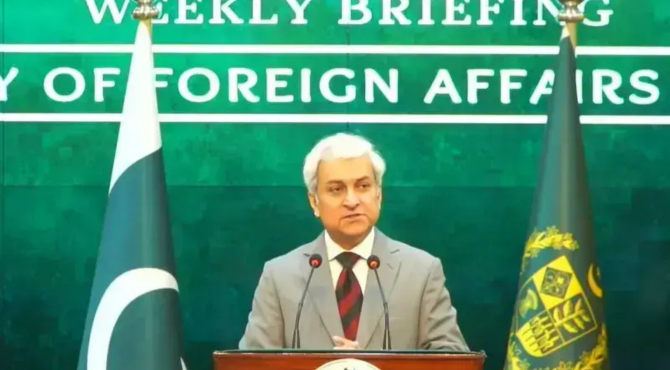
ISLAMABAD(National Times)- Foreign Office spokesperson Tahir Andrabi said on Wednesday that Pakistan remained “hopeful” despite recent escalations between the US and Iran and would continue to strive for dialogue and diplomacy.
Pakistan has been spearheading efforts for an end to the ongoing war that began with US-Israeli attacks on Iran in February.
Besides signing the Islamabad Memorandum of Understanding as the mediator in June, Islamabad had also brokered a ceasefire between the US and Iran in April. The April ceasefire put an end to the most intense fighting, but sporadic attacks, mainly around the Strait of Hormuz, have dimmed the prospects of a final peace agreement.
Recapping Pakistan’s diplomatic efforts in this connection over the week, the FO spokesperson recalled that Prime Minister Shehbaz Sharif had met Iranian President Masoud Pezeshkian on the sidelines of an SCO summit earlier this week and discussed the evolving regional situation.
“The prime minister had reiterated Pakistan’s commitment to peace through restraint, dialogue and diplomacy, while stressing that the Islamabad MoU offered the most viable pathway to lasting peace and stability in the region,” he said.
He said Deputy Prime Minister and Foreign Minister Ishaq Dar also interacted with Iranian Foreign Minister Abbas Araghchi on the sidelines of the SCO summit, while Pakistan and Iran’s leadership had earlier discussed the Middle East and Gulf situation in Istanbul on the sidelines of the Makkah defence pact meeting.
Andrabi added that Chief of Army Staff and Chief of Defence Forces (CDF) Field Marshal Asim Munir had also visited Tehran last week as part of Pakistan’s diplomatic efforts to facilitate an end to the US-Iran conflict, particularly reopening the Strait of Hormuz, a vital passageway for the world’s fuel supply.
“Regional de-escalation, breaking the military stalemate and exploring a negotiated settlement to restore regional peace and stability were the main topics discussed” during the meeting, he said.
The visit, he said, “underscored Islamabad’s sincere and constructive role in bridging differences between Washington and Tehran”. It generated momentum, as evident by the subsequent visits of Oman and Qatar’s leadership to Iran, he added.
Pakistan welcomes Hague court ruling on IWT
During the briefing, the FO also spoke about the Permanent Court of Arbitration’s (PCA) decision on Monday, under which it directed India to uphold the Indus Waters Treaty (IWT) with Pakistan and suspend work on a hydro project in occupied Kashmir.
He said the PCA had reaffirmed that the IWT remained fully enforced and binding, rejecting India’s unilateral attempt to place the treaty in a so-called “abeyance”.
“The unanimous award of the Court of Arbitration constitutes an important reaffirmation of the sanctity of the IWT and the rule of international law,” he said.
Water and the IWT remain a contentious issue between India and Pakistan, following New Delhi’s unilateral abeyance of the accord in April last year — a move that was followed by a brief military conflict between the two sides in May 2025.
Following India’s move, Pakistan termed any attempt to suspend its water share an “act of war”, noting the IWT had no provision for unilateral suspension. It later argued that Delhi’s action was a violation of the 1969 Vienna Convention on the Law of Treaties.
In its order, the PCA backed Pakistan’s stance, declaring that the IWT between the two countries remained fully in force, as India had no justification for ending or suspending the agreement.
The FO spokesperson said, “The court had confirmed that India’s purported decision to place the treaty in abeyance does not relieve it of its obligations under the treaty and the treaty’s dispute settlement mechanism remained operative.”
Moreover, he continued, the court’s interim measure concerning the Ratle hydroelectric power project further affirmed that rights and obligations under the treaty could not be altered or displaced through unilateral action, he added.
“Pakistan welcomes this clear and authoritative announcement, which validates our consistent position that differences concerning the Indus Waters Treaty must be strictly addressed within the framework of the treaty and in accordance with international law,” he said.
Concluding his opening statement, he introduced Ambassador Sajjad Haider Khan to his audience and said the latter would replace him as the FO spokesperson after the briefing.
According to state-run APP, Andrabi will be assuming the role of Pakistan’s permanent representative to the United Nations in Geneva.