
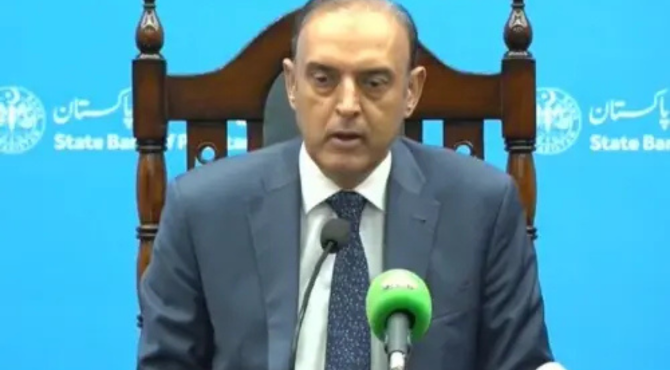
KARACHI(National Times)- The State Bank of Pakistan’s (SBP) Monetary Policy Committee (MPC) on Monday kept the interest rate unchanged at 11.5 per cent.
The decision was announced by SBP Governor Jameel Ahmed during a press conference.
At the outset of the press conference, the governor said, “MPC has decided to keep the policy rate unchanged at 11.5pc”.
“There were several reasons for this, but I would like to explain some background: every time we hold committee meetings in January and July, we also issue projections for the next six months and what would be the level of economic growth, inflation outlook and situation of the external account; I will share that assessment as well.”
The governor explained that in the first half of the previous year, inflation was declining; however, “the fallout from the Middle East crisis impacted our domestic situation”.
“From July to February, our average inflation was 5.5pc,” which he said was within the government’s target range of 5-7pc.
However, due to the Middle East crisis, inflation began to increase, he added. “In June, it was at 11.1pc, and in May, it stood at 11.7pc, and we are hoping that if there is no further escalation, then after one to two months, we will see a decline in inflation,” he said.
“We believe that towards the end of June next year, it will be within the upper band of our target range, either a little over seven or close to seven,” he said, but warned that “there are still risks associated due to the direct impact of the geopolitical situation”.
“Overall, inflation from this (existing) level will see an improvement,” he added.
He also said that food-related inflation such as the recent surge in wheat prices had contributed to overall inflation.
On the external account, he said, “We believe that the current account deficit will remain between 0-1pc” but held that the outcome also depended on the situation in the Middle East.
“We aim to have $20.2 billion in foreign exchange reserves till December 2026,” he said, adding that remittances may see a rise as well. “This year, our remittances were $41.6bn, and we now aim that in this year, the amount will be $44bn”.
Exports, the governor acknowledged, “were under a bit of pressure last year” but expected improvement in the next fiscal year, citing “support measures taken by the government in the export sector”.
“In the Roshan Digital account, inflows have increased in the past four to five months, with average inflows of $300 million,” he said.
He continued: “The target we had set for June for our foreign reserves was $18bn, and we achieved $18.4bn, which is 400m dollars more than our target.”
He further added that the country’s external debt servicing level had been set at $21.5bn.
“In this, $3.5bn will be interest and $17bn will be the principal amount, from which a major chunk is expected to be rolled over [..] Which leaves a little over $10bn and the actual principal we will pay will be around $7bn.”
He further stated that the country had replaced its commercial borrowing with “long-term borrowing”.
“As you know, the government issued euro bonds for a period of three years, and we also replaced some commercial borrowing with multilateral long-term borrowing, so the debt we have to pay back saw a reduction of $4bn,” he said.
“The foreign public sector debt in 2022 was nearly $100bn, and there has been no substantial increase in it, while the federal government’s foreign debt — around $82bn in 2022 — is also the same.”
The governor stated that the SBP’s forward liabilities had declined to $900m from $5bn.
“We will try that by the end of this year; these forward liabilities can be turned into assets for us,” he hoped.
On GDP growth, the governor said, “The Pakistan Bureau of Statistics (PBS) had given an estimate of 3.7pc GPD growth last year, and we hope that the revised estimate will be better than this and will be within the projection given by the SBP”.
He admitted that the growth “may be on the lower side”, citing the Middle East crisis as the reason.
“If you look at the first three quarters — from July 2025 to March 2026 — the average growth was 4pc, and it could have been better in the fourth quarter as our estimate was between 4.1pc and 4.2pc, but the activity slowed down after the Middle East war, after which PBS issued an estimate of 3.9.”
Concluding his address, the governor stated, “We believe GDP growth will improve this year. We have given the range of 3.5 to 4.5pc, and it will stay within the range”.
Analysts had expected the central bank to keep the rate unchanged, saying it would be difficult to maintain macroeconomic stability with sluggish growth.
Surveys conducted by brokerage houses show that more than 90pc of stakeholders expected the SBP to leave the policy rate unchanged, while only a small number foresaw a modest increase.
The SBP cut its policy rate by 50 basis points to 10.5pc in December 2025 before raising it by 100 basis points to 11.5pc in April this year. It has since kept the rate unchanged despite persistent demands from the business community for a substantial reduction to support economic activity.