
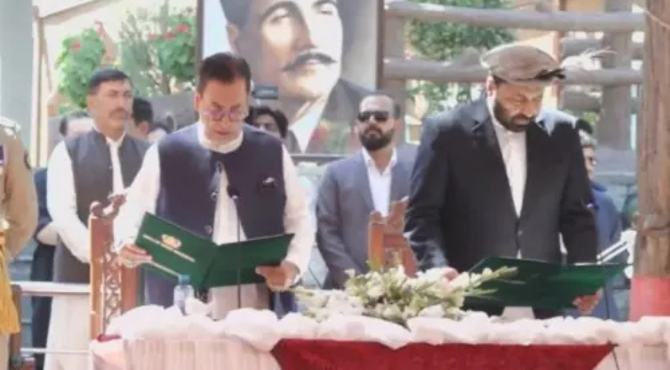
GILGIT(National Times)- PPP’s Amjad Hussain on Monday was sworn in as the chief minister of Gilgit-Baltistan in a ceremony attended by his party chairman Bilawal Bhutto-Zardari.
Advocate Hussain was elected for the role on June 22 following the June 7 elections, in which the PPP emerged as the largest party, with 12 seats in the 24-member GB assembly.
Addressing the ceremony in Gilgit after taking the oath, Hussain said the PPP emerged as the “largest party” in the elections.
He noted that the region’s youth and women “had a huge role” in the polls, in which his party candidates secured several seats.
Hussain particularly thanked the people of Nagar who “gave the PPP 100 per cent results and two seats”, adding that the “heavy mandate” given to his party was an expression of the public confidence in the PPP.
He highlighted that the Gilgit and Baltistan divisions were traditionally considered areas with a mandate for the PPP, thanking the residents there for maintaining that support.
“This mandate is not a new thing,” the newly sworn-in CM said, stressing that the relationship between his party and the people of GB had existed for three generations.
He further pointed out, “The people of GB broke many records. Never had it happened that one party is in [power in] the Centre and another party given the trust in GB.”
Hussain prayed that God may help him fulfil the “most difficult responsibility” given to him as the chief minister, as decided by the PPP leadership.
He appreciated PML-N President Nawaz Sharif, Prime Minister Shehbaz Sharif, GB affairs minister Amir Muqam, and opposition leader Hafeezur Rehman for “adhering to democratic principles and giving the PPP the chance to form the government”.
He also thanked Istehkam-i-Pakistan Party (IPP) chairman Aleem Khan for “helping” the PPP during the entire process that had resulted in the unopposed elections of the chief minister and the assembly speaker.
The PPP had announced that it would form a government in GB with the support of the PML-N. However, they agreed that the PML-N would sit in the opposition.
‘GB can be a prime example of good governance’
In his maiden speech as the GB CM, Hussain shed light on the key attributes of the region.
He highlighted GB’s population and land area, noting that the region was somewhat smaller than Khyber Pakhtunkhwa but housed 1.7 million people.
“GB can be a prime example of good governance for the rest of the country,” he remarked. “We consider transparency our prime subject. We consider it our foundation stone.”
The chief minister also addressed issues in the region, noting that GB had a budgetary right to Rs258 billion whereas it had only received Rs142bn from the federation — a deficiency of over Rs100bn, without which he noted the region’s issues could not be solved.
He also pointed out that GB had received a development budget of Rs23bn rather than the required Rs33bn, and only Rs15bn rather than the Rs29bn required in subsidies, calling this “abuse”.
“We want the federation to fulfil its responsibilities,” he asserted.
Hussain noted that the region’s potential “does not match” its 22 hours of loadshedding.
“This means that somewhere we are unqualified, and somewhere there is a lack of funds,” he said, noting that Gilgit city alone had about 200MW potential and Diamer had about 1,000MW of potential.
He highlighted ongoing power projects and stressed his government’s commitment to focus on these projects on a “day-to-day” basis: “No kind of slowness or laziness will be tolerated on these projects.”
The chief minister also promised that loadshedding in GB would be nearly eliminated by the end of five years, but stressed that this would not happen without the payment of electricity bills and declared there would be no compromise on these.
Last week, protests erupted in different parts of Gilgit and Chilas against extensive power loadshedding amid soaring temperatures. Protesters blocked the Karakoram Highway (KKH) in Jutial, chanting slogans against the government.
GB’s potential in tourism, mining sectors
Speaking on GB’s tourism potential, Hussain noted that it was home to 7,000 glaciers, making it the region with the largest amount of glacial ice outside the polar region.
“This is the third pole massive ice reserve that basically acts as a watershed for Pak. GB’s all 7,000 glaciers feed into the Indus river system […] and fulfil the foundational needs of all provinces’ agriculture.”
He also mentioned the region’s contribution to the supply of drinking water and hydropower generation.
Advocate Hussain underscored GB’s potential as an eco-tourism hub, describing the Karakoram and Hindu Kush-Himalaya ranges as “world-famous”. He noted that the glaciers were also home to rare wildlife species.
“People from around the world want to come to GB […] but to reach here, we could not even end the uncertain travel conditions in 78 years,” he said.
The GB CM called for the ending of highway blockages and for on-arrival visas to harvest the region’s tourism potential.
He also stressed the need to work on international flight operations, launch destination management programmes, as well as protect flora and fauna in national parks.
In terms of the mining and minerals sector, Hussain called GB the “richest region in the world”.
“There are precious metals, base metals, rare earth minerals, critical elements, gold and silver deposits, platinum and lots of gemstones,” he said, but lamented that GB had not benefitted from this potential.
He highlighted the farming potential of the region, including the production of fruit as well as livestock and fisheries. He stated that his government intended to launch a “one village, one product” programme to create reforms in all these areas.
On the geographical significance of GB, the chief minister called the region a “crossroads” between Central, South and East Asia.
Noting that road links had already been developed with East Asia, he underscored the need to establish the same with South and Central Asia.
The swearing-in ceremony at Chinar Bagh, initially set for July 1, had been postponed as Bilawal went to Iran to attend supreme leader Ayatollah Ali Khamenei’s funeral.
Bilawal vows to ‘struggle’ for GB on national level
Bilawal also addressed the ceremony, vowing that he would “fight the struggle” on the national level for the people of GB.
“While a new generation is fighting this struggle here, god-willing, this new generation will take your struggle forward on the level of Pakistan,” the Bhutto scion said, pointing towards himself.
He called for the people of GB to be provided constitutional rights. “I want to see that day when the representatives of GB would be present with me in the National Assembly,” he said, prompting the audience to give applause.
He said those representatives could be termed as “interim” or as “ambassadors” temporarily till the matter was voted upon, but it was important to have them in the NA and the Senate.
The PPP chairman also called for representatives from GB and Azad Jammu and Kashmir (AJK) to be included in the National Finance Commission (NFC), stressing that it would be under a temporary arrangement.
Bilawal asserted that his party got the mandate on “three fundamental rules” that were part of his manifesto.
The PPP had focused on the right of governance, right to property and right to employment in its election campaign, which Bilawal spearheaded with fiery speeches in various cities of GB.
“Now, it is a responsibility on your shoulders and mine that we convince the state and government of Pakistan and bring all political parties on the same page and create consensus to secure the constitutional right of governance.”
He further said that it was the GB government’s responsibility to fulfil the promised right to property and “make the people of GB the owners of their land”.
Acknowledging that there were financial challenges, the PPP chairman affirmed that it was his government’s responsibility to create a conducive environment for greater employment opportunities for the people of GB.
“You gained independence from the Dogra rule, but then slavery under the FCR was imposed upon you,” Bilawal said, referring to the Frontier Crimes Regulation (FCR) that was widely condemned as an oppressive law.
He recalled that his grandfather Zulfikar Ali Bhutto revoked the FCR, and that under his mother, ex-PM Benazir Bhutto, they “got the political space”.
Describing the people of GB as patriotic, Bilawal noted that President Asif Ali Zardari led the efforts for the region to be recognised as Gilgit-Baltistan.
During his speech, Bilawal thanked PM Shehbaz for “accepting” the PPP’s mandate in GB.
“I want to create a new political environment in GB,” he said, expressing his aim to change the view of politics being a “synonym for fights and enmity”.
Bilawal pledged to work for the region’s progress together with all political parties.
“I am also thankful to the candidates of MWM (Majlis Wahdat-i-Muslimeen) and those supported by the PTI. They also had a role in the unopposed election of my chief minister,” he said.
Bilawal, also a former foreign minister, also noted the geostrategic importance of GB.
He hailed soldiers for manning the “toughest borders of the world” along the Kashmir and GB regions, owing to the high altitudes and harsh weather conditions.
Bilawal said, “We want to send India a clear message […] all Pakistanis, the residents of GB and Azad Kashmir are united in the struggle for our rights.”
He contended that “unable to digest the defeat” by Pakistan in May 2025, India’s Prime Minister Narendra Modi has “adopted the Israeli model”.
The ex-foreign minister noted that Israel had attempted to incite the public of Iran against its leadership and topple it, but its “conspiracy failed”.
He asserted: “And today, I want to tell Modi while standing in GB: we know what your conspiracy is. We know what you want to do in Khyber Pakhtunkhwa and Balochistan through Afghanistan.
“We know that your dirty eye is looking towards my beloved Gilgit-Baltistan and Azad Kashmir. But we […] want to tell you that your conspiracy will fail.”
The PPP chairman announced that his party will have the same manifesto based on the rights to governance, property and employment for the upcoming AJK elections.
“I want to tell the future generations that I admit that the way Pakistan has been running GB and Azad Kashmir since 1947, that attitude and status quo cannot continue in 2026,” he said.
Bilawal urged the people of AJK to use their “political weapon of [the right to] vote”.
Referring to the PTI’s decision to boycott the AJK elections, Bilawal said he was “deeply upset that some political parties announced they will not take part in the elections”.