
ISLAMABAD(National Times)- The Pakistan Meteorological Department (PMD) has issued an alert for glacial lake outburst floods (Glofs) for Gilgit-Baltistan and Khyber Pakhtunkhwa, predicting that soaring temperatures are likely to persist until the first week of July.
“This significant warming will substantially accelerate snow and ice melt in the glaciated valleys of these regions,” the Met Office said in the alert issued late on Friday.
It said that consequently, the water level in the river streams was likely to remain high, existing glacial lakes may rapidly expand with an increase in their water levels, and new glacial lakes were likely to form due to the high volume of melted water.
Meanwhile, vulnerable downstream locations and low-lying areas adjacent to riverbeds may face a high risk of sudden inundation with chances of flash flooding in vulnerable locations, it added.
The Met Office further said that the rapid expansion of glacial lakes could destabilise their natural ice or moraine dams, potentially triggering Glof incidents.
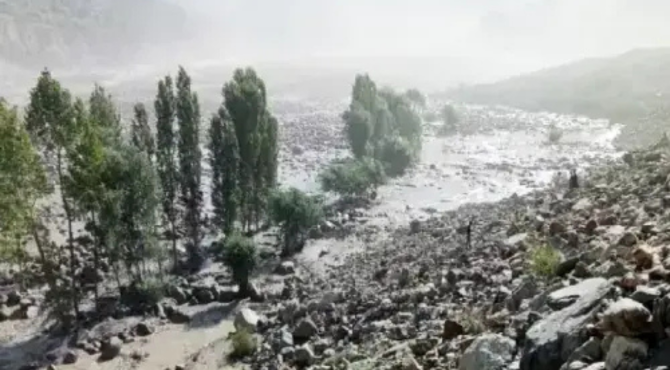
The weather conditions can trigger heavy mud and debris flows down mountain slopes, with an increase in the likelihood of landslides in steep terrains, the PMD said.
It advised residents and visitors: to stay away from riverbanks, stream beds, and local nullahs; to refrain from camping, trekking, or staying near riverbanks, streams, glacial lakes and narrow mountain valleys; and avoid steep slopes and unstable terrain where melting snow could trigger landslides or debris flows.
NDMA issues landslide alert for mountainous areas in north
Separately, the National Disaster Management Authority’s (NDMA) National Emergency Operation Centre (NEOC) issued a landslide alert for GB, upper KP and Azad Jammu and Kashmir (AJK) from June 27 to July 3.
Noting that the current weather conditions were in line with the weather forecast issued by NEOC a few months ago, the NDMA said there was an increase in risk of landslides in mountainous areas due to possible intermittent rains and rapidly melting glaciers.
It warned of the possibility of rockfalls, debris flows and landslides in the aforementioned regions. The authority affirmed it was ensuring prior awareness to all relevant agencies regarding potential hazards.
The NDMA further said temporary closure of the Karakoram Highway (KKH/N-35), Jaglot-Skardu Road (JSR) and adjoining connecting roads was expected from June 27 to July 3.
“Exercise special caution while travelling on mountain streams, valleys and slopes adjacent to glaciers,” it stressed, urging to avoid unnecessary travel as landslides may temporarily affect connecting roads, electricity and communications systems.
It ordered the Provincial Disaster Management Authorities (PDMAs) to prepare for emergency situations and ensure the timely availability of necessary machinery and resources.
It said citizens could get guidance from the “Pak NDMA Disaster Alert” mobile app for weather conditions, potential hazards and safety measures.
The NDMA also issued an alert for increased risk of glacier melting in northern and mountainous regions from June 27 to July 3, Radio Pakistan reported.
It cautioned that rising temperatures and expected rainfall may accelerate glacier melt, resulting in increased water flow in rivers and streams across GB, KP, and Azad Jammu and Kashmir. The situation may also trigger glacial lake outburst floods, flash floods, landslides, and mudslides.
The NDMA advised the public to avoid unnecessary travel near rivers, streams and glacial zones and to strictly follow official weather advisories and safety instructions.
KP PDMA orders DCs to monitor vulnerable sites
In response to the PMD alert, the KP PDMA issued directions for deputy commissioners (DCs) of Upper and Lower Chitral, Dir Upper, Swat, Upper and Lower Kohistan, and Mansehra for precautionary measures.
The local authorities were directed to “undertake proactive monitoring and surveillance” of the vulnerable sites and to conduct evacuation drills in at-risk communities.
The PDMA directed relevant authorities to ensure that evacuation sites were well-stocked and ready for use.
Authorities were also directed to warn the population in low-lying and at-risk areas, as well as conduct mass awareness campaigns regarding Glofs.
Furthermore, PDMA said that tourists should be advised against travelling to at-risk areas while the alert is in effect.
Local authorities were instructed to coordinate with relevant departments, such as the National Highways Authority (NHA), Frontier Works Organisation (FWO) and the Communications and Works Department, to ensure the timely restoration of roads and bridges in case of any closures or damage to infrastructure.
PDMA requested the DCs to “take all necessary precautionary measures to avoid any loss of life/livestock and damages to infrastructure/crops”.
Earlier this month, the Space and Upper Atmosphere Research Commission (Suparco) identified 130 potentially dangerous glacial lakes with possible risks to downstream settlements from Glofs.