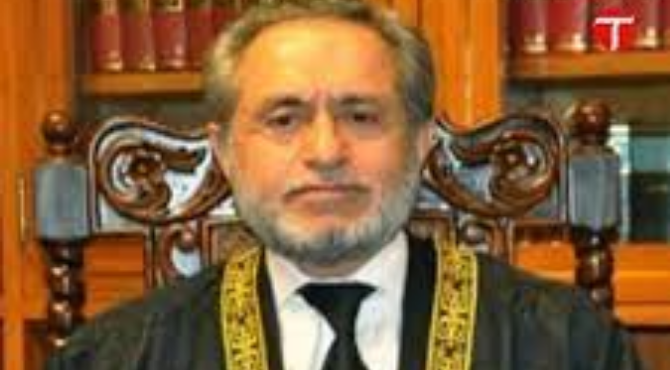

Pakistan(National Times)- Supreme Court’s Justice Jamal Khan Mandokhail has said that a person could not be tried under the Army Act until the charges against them have been framed. The remarks came during a hearing on intra-court appeals against the trial of civilians in military courts, by an apex court constitutional bench on Tuesday. The seven-member bench was headed by Justice Aminuddin Khan and comprised Justice Jamal Mandokhel, Justice Muhammad Ali Mazhar, Justice Hassan Azhar Rizvi, Justice Musarrat Hilali, Justice Naeem Akhtar Afghan, and Justice Shahid Bilal. Defence lawyer Khawaja Haris presented his arguments, explaining the process related to the Army Act and how charges are framed by the police and Federal Investigation Agency (FIA). Haris explained that the commanding officer conducts the inquiry after the charge is framed while responding to Justice Rizvi’s query. At this, Justice Hilali asked about the procedure of inquiry and registration of the first information report (FIR) after the framing of charges. To this, Haris said that the word “charge” represents the allegations against any suspect, and these allegations are the basis of the investigation. At this, Justice Mandokhail remarked that a suspect cannot be tried under the Army Act until the charge is framed. “The framing of charges is necessary,” he added. Justice Hilali then asked if the charges could be framed during the trial. To this, Haris replied that charges as in allegations against the suspect are another thing, while framing of charges or chargesheet during trial is another. The discussion then shifted to military court judges, with the judge asking if military court jurists wore uniforms. Haris replied in affirmation to the query, which was followed by another about the impartiality of an “officer in uniform”. At this, Haris responded by saying that even the judges in this court were wearing a “uniform”, which was responded to with echoes of laughter in the court. “Do you want to imply that there is no difference between a black and khaki uniform,” Justice Hilali snapped back. “The law applies equally to citizens, no matter how strict. Is that correct?” asked Mandokhail. Haris agreed and proceeded to explain how the law applies. Meanwhile, Justice Mazhar asked: “Does the law you refer to always get enforced as you claim?” To this, Haris responded, saying that court-martial decisions are usually made by majority vote. Before the trial, the accused can object to the judge.”This drew a remark from Justice Hilali that the questions were being raised about judges even in civilian courts these days.
Framing of charges necessary before trial under Army Act, says Supreme Court judge