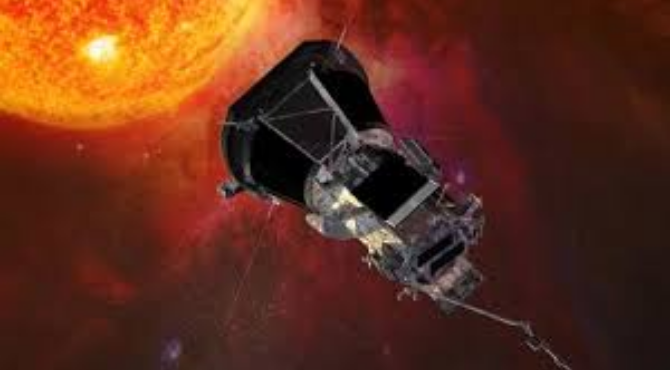

Pakistan(National Times)- WASHINGTON: Nasa’s pioneering Parker Solar Probe is poised to make its closest-ever approach to the Sun on Christmas Eve, a record-setting 3.8 million miles (6.2 million kilometres) from the surface. Launched in August 2018, the spaceship is on a seven-year mission to deepen scientific understanding of our star and help forecast space-weather events that can affect life on Earth. Its closest approach to date will happen on Tuesday, December 24, at 4:53 am local time (11:53 GMT). If the distance between Earth and the Sun is equivalent to the length of an American football field, the spacecraft would be about four yards (meters) from the end zone at that point. “This is one example of Nasa’s bold missions, doing something that no one else has ever done before to answer longstanding questions about our universe,” said Arik Posner, Parker Solar Probe program scientist, in a statement. “We can’t wait to receive that first status update from the spacecraft and start receiving the science data in the coming weeks.” During this closest approach — known as perihelion — mission teams will lose direct contact with Parker, relying on a “beacon tone” this Friday to confirm the spacecraft’s status. Although the heat shield will endure scorching temperatures of about 870 to 930° C, the probe’s internal instruments will remain near room temperature — 29°C — as it explores the Sun’s outer atmosphere, called the corona. Not only will the temperatures be extreme, but Parker will also be moving at a blistering pace of around 690,000 kph, fast enough to fly from the US capital Washington to Tokyo in under a minute. “No human-made object has ever passed this close to a star, so Parker will truly be returning data from uncharted territory,” said Nick Pinkine, Parker Solar Probe mission operations manager at the Johns Hopkins Applied Physics Laboratory (APL) in Laurel, Maryland. “We’re excited to hear back from the spacecraft when it swings back around the Sun.” By venturing into these extreme conditions, Parker has been helping scientists tackle some of the Sun’s biggest mysteries: how the solar wind originates, why the corona is hotter than the surface below, and how coronal mass ejections — massive clouds of plasma that hurl through space — are formed. This Christmas Eve flyby is the first of three record-setting close passes, with the next two — on March 22, 2025, and June 19, 2025 — both expected to bring Parker Solar Probe back to a similarly close distance from the Sun.
Nasa solar probe to make its closest-ever pass of Sun on Christmas Eve