

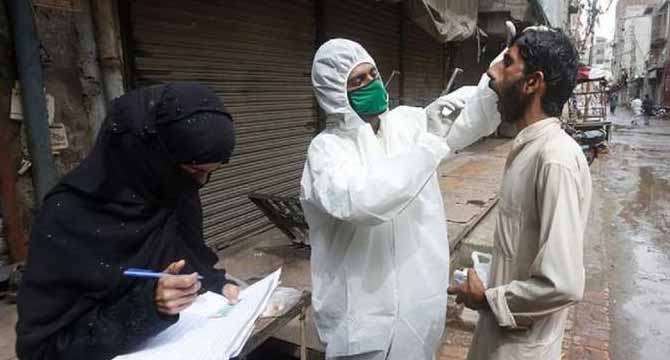
ISLAMABAD (National Times)- Pakistan’s coronavirus positivity ratio has remained high in the past couple of weeks, with the country posting an infection rate of more than 4% in the last 24 hours as well, official data showed Monday morning.
The National Institute of Health (NIH), in the latest statistics, showed that the positivity ratio shot up to 4.61% in the last 24 hours, up from 3.88% a day earlier.
A total of 14,632 tests were recorded and 675 cases were registered, up from 650 infections that were reported yesterday, according to the health authorities.
Meanwhile, the number of COVID-19 patients being treated in critical care units climbed to 153, while two more patients suffering from the infection died overnight.
City-wise statistics showed that Karachi’s positivity ratio jumped to 20.61% and Abbottabad’s infection rate reached 5.88%, while Peshawar posted 4.51%.
Coronavirus ‘fatigue’
As the infection rate rises, government officials blamed a drop in COVID-19 testing for the abysmal rates, according to Daily Dawn, which has noted that the coronavirus “fatigue” has started to kick in — as people have started considering the virus “as a normal disease”.
Yesterday’s city-wise data, according to the publication, was abysmal as it showed that Swabi’s coronavirus positivity ratio was 43% — seven tests were conducted and three came back positive.
Dr Javed Akram, a government advisor on COVID-19, told Daily Dawn that such figures should be ignored, considering Swabi’s population. “It’s unfortunate that we put more emphasis on the positivity rate than the number of tests.”
“The fact is that only Karachi, Lahore and Islamabad have been doing proper testing, but to me, even that is not up to the mark,” the health official said.
“The size of the sample matters rather than the positivity rate. We should not forget that 30% of the people never develop symptoms as they are asymptomatic but they continue to spread the virus,” he said.
Further, he said that the coronavirus’ omicron variant was still dominant in the country — and its transmissibility has decreased.
“We need to understand that while Covid’s virulence has been diminished with the passage of time, its transmissibility has increased. So now we can only control the virus by holding massive testing,” Dr Ikram said.