
SIALKOT / KARACHI(National Times)- As a debate around the possible creation of new administrative units rages in the country, another federal minister on Sunday voiced his support for the proposal, but warned against carving out units on linguistic, ethnic or political lines.
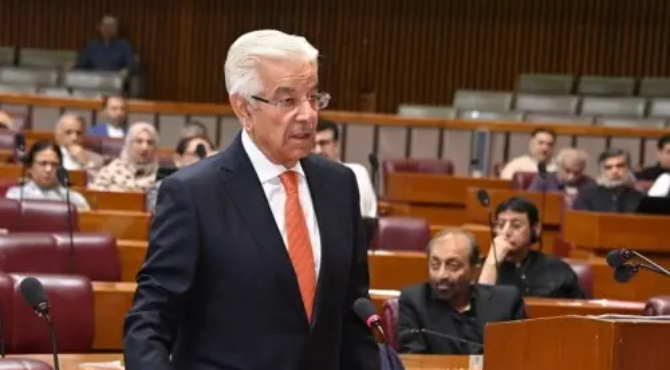
Outspoken Defence Minister Khawaja Asif, who has previously voiced his support for the suggestion — first put forward by his cabinet colleague Mohsin Naqvi — said that the existing concentration of authority in provincial capitals was preventing government services and resources from reaching people at the local level.
Speaking to Geo News, Mr Asif said the idea of creating new provinces had been debated for the past two months, stressing that the country could have as many as 12 if the exercise was driven by administrative needs rather than linguistic, ethnic or political considerations.
He argued that Pakistan’s growing population called for smaller administrative units capable of delivering public services more effectively, adding that decision-making should not be confined to provincial capitals such as Lahore, Karachi, Quetta and Peshawar.
Stressing the need to bring administrative authority closer to the people, Mr Asif also questioned the existing arrangement for distributing financial resources, insisting that funds provided by the federal government remained largely under the control of provincial administrations, instead of reaching local government institutions.
He maintained that local bodies, which were supposed to benefit from these resources, continued to depend on provincial governments for funds and authority.
The minister also urged political leaders to change their attitude towards the exercise of power, saying that as politicians, there was a temptation to exercise all the power themselves.
Public representatives must remember that their authority was entrusted to them by the people, he said.
Referring to past administrative arrangements, Mr Asif recalled the One Unit scheme, under which the provinces of West Pakistan were merged into a single administrative unit before the arrangement was eventually abolished.
He also pointed to Afghanistan, saying the number of its provinces had increased from around eight or 10 to more than 30.
The defence minister’s remarks come amid reports of a plan to divide Pakistan into 12 provinces through a possible 28th Constitutional Amendment, with a nationwide referendum also being contemplated.
Media reports suggested that the proposed restructuring could involve dividing Punjab into four provinces, KP and Balochistan into three each, and Sindh into two.
MQM-P renews demand
Meanwhile, the Muttahida Qaumi Movement-Pakistan (MQM-P) on Sunday vowed to mobilise its entire organisational network and parliamentary leadership for the upcoming local government elections eyeing a “historic win”, while renewing its demand for the creation of new administrative units in Sindh to ensure the devolution of powers and resources to the grassroots level.
The resolve was expressed at a high-level meeting of the party’s political and administrative leadership, chaired by MQM-P Convener and Federal Minister Dr Khalid Maqbool Siddiqui at its Bahadurabad headquarters.
According to a press release, the meeting discussed a strategy to address the long-standing grievances of urban Sindh, accelerate Karachi’s development and prepare for upcoming political and local government contests.
The party leadership stressed that the establishment of new administrative units was essential to empower people at the grassroots level and ensure the equitable provision of basic municipal services.
It maintained that the devolution of authority and resources to lower tiers of government was necessary to address the administrative and civic challenges facing urban centres.
Dr Siddiqui directed parliamentarians and organisational departments to become actively involved at the neighbourhood level and mobilise workers and residents across the city ahead of the local government elections.
Speaking at the meeting, Dr Siddiqui said ending the deprivation of urban Sindh, establishing new administrative units and winning the local government elections were among the party’s foremost priorities.
“The reconstruction and development of Karachi and other major urban centres of Sindh, transparent utilisation of public funds and the protection of citizens’ fundamental rights remained at the heart of the party’s political agenda,” a statement issued after the meeting quoted him as saying.
He added that no political or administrative obstacle would be allowed to stand in the way of public welfare and development.
The meeting also underscored the party’s determination to “restore the rightful representation of urban communities in local governance through electoral success and a stronger grassroots organisational presence”.