
ISLAMABAD(National Times)- Prime Minister Shehbaz Sharif on Tuesday took the allies of the ruling PML-N into confidence on the imposition of governor’s rule in Khyber Pakhtunkhwa, saying that the Centre made every effort to avoid this “extreme step”.
The Centre on Sunday imposed governor’s rule in KP and emergency in 12 of its districts, citing the provincial government’s “deliberate disengagement” from the fight against terrorism.
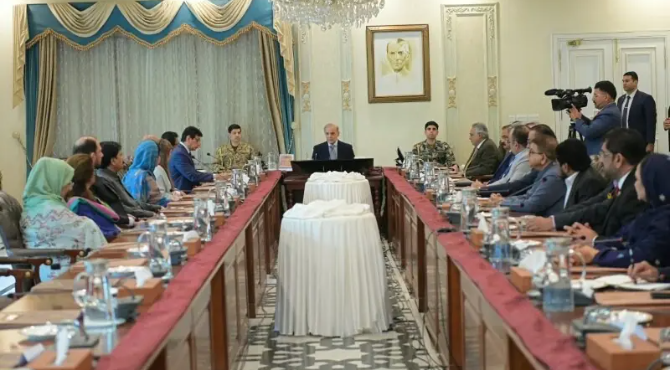
PM Shehbaz held a meeting with leaders of the Muttahida Qaumi Movement-Pakistan (MQM-P), as well as a separate huddle with a parliamentary delegation comprising representatives of PML-Q, Balochistan Awami Party (BAP), Istehkam-i-Pakistan Party (IPP) and PML-Zia.
During the meeting with the MQM-P delegation led by Education Minister Khalid Maqbool Siddiqui, the two sides exchanged views on the country’s overall and political situation, the PM Office (PMO) said.
The prime minister said the government had to take this “most difficult decision” in the interest of the people of KP.
“We made every effort to avoid taking this extreme step in any way. We engaged in negotiations with an open heart, but did not receive a positive response from the other side,” he was quoted as saying.
The premier noted that rising terrorist attacks in KP were targeting ordinary citizens and security forces, while the provincial government “failed to openly raise its voice against terrorist groups”.
PM Shehbaz also termed the PTI’s long march a “conspiracy to destroy the country’s improving economy”.
According to PMO, the MQM-P delegation assured the prime minister of its full support for the government’s decisions regarding KP.
On the MQM’s side, the delegation included Health Minister Mustafa Kamal, Senator Amir Waliuddin Chishti, Senator Khalida Ateeb, MNA Farooq Sattar, Syed Waseem Hussain, Aasia Ishaque Siddiqui, Javed Hanif Khan, Muhammad Moeen Aamir Pirzada, Muhammad Iqbal Khan, Hassan Sabir, Sadiq Iftikhar, Arshad Abdullah Vohra, Syed Hafizuddin, Syed Aminul Haque, Khawaja Azharul Hassan, Ahmad Saleem Siddiqui, Farhan Chishti, Nighat Shakeel Khan, Sabheen Ghoury, Rana Ansar, Sofia Saeed Shah, and Sanjay Perwani.
In the second meeting with other parties, PM Shehbaz explained the reasons behind the federal government’s decision to take constitutional measures, state-run APP reported.
He said the conduct of the PTI-led KP government in the province and its failure to adopt an unequivocal stance against terrorism had posed risks to Pakistan’s growing economy.
The premier highlighted that the federal government had provided more than Rs800 billion to KP under the National Finance Commission (NFC) arrangements to support efforts against terrorism.
However, he said, the provincial government had failed to take effective measures to strengthen the capacity of its Counter-Terrorism Department (CTD) and establish Safe City projects to improve its counterterrorism capabilities.
According to the PM’s Office, the parliamentary delegation expressed its support for the federal government amid the prevailing situation and appreciated the prime minister’s leadership during what it described as difficult circumstances.
The delegation also said the people of KP had remained deprived of adequate development in health, education and infrastructure during the PTI’s tenure in the province.
It expressed confidence that, with the federal government’s cooperation, development and prosperity in KP would advance in line with other parts of the country.
The delegation included BAP President and Science and Technology Minister Khalid Magsi; former Senate chairman Sadiq Sanjrani of BAP, senators Manzoor Kakar, Abdul Qadir Baloch, Dinesh Kumar and Samina Mumtaz Zehri; PML-Q President and Human Resource Development Minister Chaudhry Salik Hussain; and representatives of the IPP and PML-Zia.
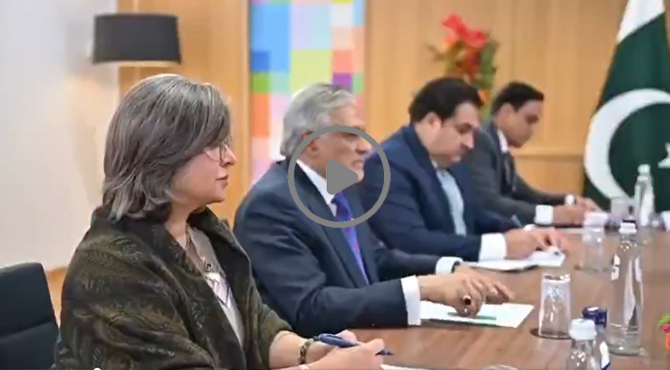
From the government, Deputy Prime Minister and Foreign Minister Ishaq Dar, Defence Minister Khawaja Asif, Law Minister Azam Nazeer Tarar, Parliamentary Affairs Minister Dr Tariq Fazal Chaudhry and PM’s Adviser on Political Affairs Rana Sanaullah attended both meetings.
‘What other path did we have?’
Later, he addressed a parliamentary meeting of his PML-N and said, “When terrorism is spreading, sacrifices are being made day and night, and this party (PTI) is exhausting all its resources and time round the clock to create instability.”
The premier emphasised that the people of KP had been wanting “projects of development and prosperity for the past 13 years”, such as schools, universities, hospitals, better law and order, and an end to corruption.
However, he contended, there was “not zero, but negative attention” towards these matters, and “all attention and resources” were instead diverted towards long marches and protests.
“Can any respectable society tolerate this? Even the question does not arise. So what other path did we have?” he asked, quipping if the Centre should have remained as “silent spectators”.
The prime minister noted that the Centre was “compelled to make this decision” after the Oct 3 talks between the government and the opposition collapsed.
Elaborating on the dialogue process, PM Shehbaz said, “There was a moment when it was set in stone that an agreement was about to be reached, all demands were settled.”
He added that a consensus-based draft was ready, but the PTI team sought some more time to consult Sohail Afridi — the KP chief minister whose role now stands non-functional.
“The rest is history. […] They were ordered that you have to create another May 9, even go beyond it and wreak havoc; you must not accept anything,” the premier added.
He went on to recall his engagement with Jamiat Ulemai-i-Islam–Fazl (JUI-F) chief Maulana Fazlur Rehman to reduce tensions, which was followed by the Oct 11 cabinet meeting.
“After all consultations and arguments, it was decided that this is the moment to save Pakistan. We must not wait any further, else everything will be set on fire and we will be left with regret.”
PM Shehbaz reiterated, “We were compelled to make the decision of imposing emergency. This is no other choice because Pakistan is first.”
He expressed his hope that the newly appointed KP Advisory Council, which will work under the governor, would work to improve the living conditions and safety in the province.
The prime minister asserted that terrorism had been eradicated in most parts of the country several years ago, but had resurged recently.
He lamented that law enforcers were being martyred daily in KP and Balochistan. “If this bloodshed is not brought to an end like it was in 2018, then the journey of development made in the past 2.5 years… this journey is continuing gradually.”
“If one provincial government is not only determined to end that journey […] but that party is determined on destruction and comes to thinking that if they make progress, what will be our value; how regrettable it is.”
The prime minister recalled the November 2024 protest by the PTI in Islamabad, as well as its 2014 rallies at the federal capital’s D-Chowk.
“When someone is bent on ending the country’s progress, they are engaged in sit-ins, verbal abuse and allegations, instead of standing with the Centre and the armed forces and empowering the police and CTD,” he said.
PM Shehbaz said even an enemy would not make the remarks made by Afridi in recent weeks. He criticised the PTI leader for not expressing sympathies with the martyrs’ families and for “not willing to say a single word” against terrorists.
At the outset of his address, the premier highlighted his government’s efforts to cooperate with the PTI-led governments in KP.
He recalled his meeting with former KP chief minister Ali Amin Gandapur, saying, “We told him in every way that we will cooperate with them … combatting terrorism is our shared responsibility.”
He noted that he had also met with Sohail Afridi — whose role as the KP CM is currently non-functional due to governor’s rule — and asserted that the Centre tried its best to work with the KP government.
At one point, the premier said International Monetary Fund (IMF) Managing Director Kristalina Georgieva recently told him, “This is a new Pakistan”, as she praised the country’s economic reforms.
He recalled his meetings last month with international financial institutions and stressed that praise from such independent firms for Pakistan “restored” his faith in the country’s progress.