
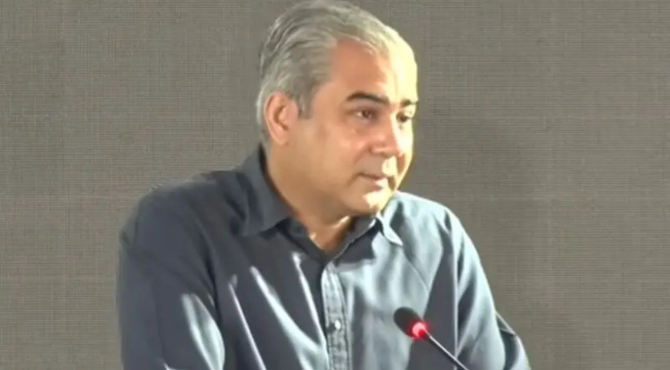
LAHORE(National Times)- Interior Minister Mohsin Naqvi on Saturday said that any new administrative units in the country would only be formed if the people voiced their support for such a move.
Addressing the National Policy Dialogue in Lahore, he said, “Reset does not mean breaking the system. Under no circumstances does it mean breaking the system. It means that whatever is wrong should be changed.”
Naqvi stressed that the changes should be brought through “political consensus” and “according to the will of our people”. He added that if the nation did not want the new administrative units, they would not be created.
He emphasised that such a change could not be brought about only based on the will of an individual, a political party or a government.
“And this would only happen if the people want it and consent to it,” he maintained.
The interior minister called for a dialogue that would consider the positive and negative aspects of new units. “Draft a thing and present it to the people, asking them whether they accept it or not.”
On the question of how many new administrative units should be created with what territorial limits, Naqvi emphasised the need to review their “benefits, methods and financial consequences”.
“Most importantly, our parliament, experts and those people responsible for it should debate on it, and finally, we must seek our public’s opinion.”
The minister clarified that his comments from last month were not about any particular political party, but rather about the “system” that has been in place since the country’s independence.
Naqvi called for undertaking the proposed administrative reforms as per the Constitution. “It has to be done through democratic means.”
“Under no circumstances are we ready to accept that we have become so incapable that we cannot reset this system,” he said, calling for political parties to hold deliberations on the matter.
The interior minister asserted he would not abandon the idea, adding that many “emotional” speeches were being made about the administrative units.
He urged politicians not to get emotional about the topic, adding that the change was not one that would happen overnight.
The minister contended that the country’s administrative system had lost its effectiveness and its “impact is not reaching the public at all”.
Acknowledging administrative issues, Naqvi said, “Even today, four out of every 10 children are not receiving the education they need. Today, only 55 per cent of the population has access to clean drinking water, and there are still two million cases pending in our courts.”
These were the issues that the government was trying to rectify, he contended.
Describing himself as the “biggest supporter of Islamabad province”, Naqvi called for the federal capital to receive its share of the National Finance Commission (NFC) Award.
“Islamabad is the only city that does not get a single rupee from the budget of Pakistan,” he insisted, adding that declaring Islamabad a province would give its citizens their rights.
The minister also highlighted the population factor in the disbursement of the NFC award, saying it remained an “incentive” for provinces. “That incentive is present till today, so are we waiting for that bomb to explode? […] Does this not need to be reset?”
Naqvi further said, “Governments keep changing; policies keep changing; budgets come and go; and we keep making plans. But the biggest issue is how much we are able to deliver in the end.”
He added that if, despite all the potential that Pakistan has, “we are still not getting the results, it is necessary to reset it (the system)”.
Citing New York City Mayor Zohran Mamdani as an example, Naqvi said the politicians who came to power as mayors knew their citizens and their problems the best.
The minister stressed that the proposed reforms would aim to empower the people. He said a Sindhi would remain Sindhi and a Punjabi would remain Punjabi. “No one will be asked to surrender their identity,” he assured the public.
He added that the discussion on the proposed reforms was not supposed to be based on generational, tribal or regional divides. “Its aim is improved governance, a competent system and bringing people closer to the government.”
Concluding his address, Naqvi reiterated: “In no circumstances should we stray from the will of the people. All political parties will have to deliberate on this. It cannot be one person’s issue or one province’s decision.”
He added, “If this is what the public wants, then it will happen no matter what.”
In July, Naqvi had proposed a dialogue among all political parties to bring about reforms to the current governance system, while also calling for new provinces and urgent administrative reforms.
His comments had ignited an animated debate across the country, with the PPP referring the question to its top decision-making forum, the Sindh chief minister flatly rejecting it, Lahore’s lawyers terming it unconstitutional and Sindhi nationalist groups demanding the minister’s resignation.