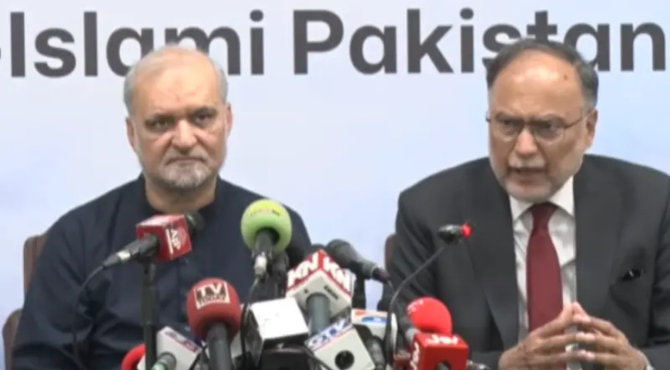

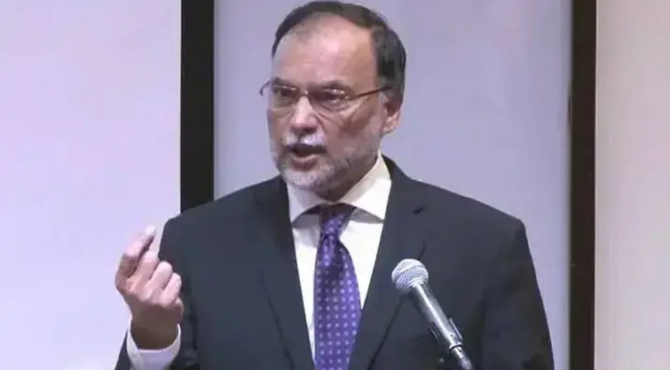
LAHORE(National Times)- Planning Minister Ahsan Iqbal and Punjab Assembly Speaker Malik Muhammad Ahmad Khan on Thursday described the Makkah Pact as an important strategic development, with the minister linking it to Pakistan’s defence and diplomatic gains and the speaker saying it should serve as an instrument for promoting peace through deterrence.
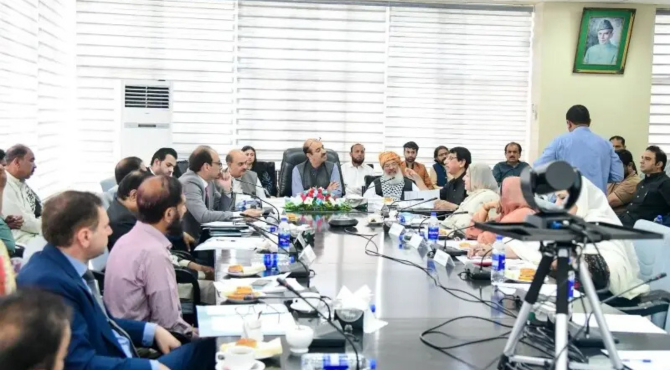
They were speaking at a seminar titled ‘Makkah Pact and New Geometry of Power’, hosted by the University of Lahore.
Mr Iqbal said Pakistan had achieved significant successes on both the defence and diplomatic fronts, but warned that such gains could not be sustained unless the country also strengthened itself economically and put its domestic affairs in order.
“Without economic strength, defence and diplomatic successes begin to lose their effectiveness over time,” the minister said.
Mr Iqbal described Pakistan’s recent defence and diplomatic achievements as historic and remarkable, but said they also placed an equal responsibility on the country to put its internal affairs in order.
“Pakistan now needs to focus completely on its economy,” he said, calling for an “economic reset”.
He said that in a rapidly changing world, the ability to reset and adapt had become essential for survival.
“Even multibillion-dollar companies can face decline if they fail to reinvent themselves,” he said, citing once-dominant technology companies that had failed to adapt to changing times.
“In a changing world, resetting and adapting to new realities is essential for survival,” he added.
Punjab Assembly Speaker Malik Muhammad Ahmad Khan said he hoped the pact would serve as an instrument for promoting peace in the region through deterrence.
He said the agreement conveyed a message of strength and unity among Pakistan, Saudi Arabia and Turkiye.
Former foreign minister Khurshid Mahmood Kasuri said the Makkah Pact reflected the sentiments of the wider Muslim world and ordinary people in Cairo, Jeddah, Lahore, Karachi, Ankara and Istanbul.
He described it as a deterrence arrangement aimed at safeguarding the integrity and sovereignty of Pakistan, Saudi Arabia and Turkiye.
Former national security adviser Nasir Janjua said the global balance of power was shifting, with the influence of Russia, China and the Muslim world rising against a “relative decline of the United States”. He called for greater regional unity as a basis for stability.
Former foreign secretary Jalil Abbas Jilani said the pact reflected Pakistan’s diplomatic achievements and should be viewed in the context of the evolving strategic environment in the Middle East.
University of Lahore Chairman Awais Raoof said the erosion of the global order and human rights in recent years had made the emergence of the Makkah Pact a welcome development for the region.
He said universities had a responsibility to provide a platform for debate on such issues.
Mr Raoof described the agreement as defensive in nature but potentially the beginning of a new regional security structure, adding that several other countries had expressed interest in joining it.
Retired Lt Gen Sikandar Afzal, retired brigadiers Nadir Mir, Imran Malik and Ghazanfar Ali, retired Air Commodore Khalid Chishti, Pildat President Ahmed Bilal Mehboob, former minister Fawad Chaudhry, Senator Ali Zafar and advocate Munir Ahmad Khan also spoke on the occasion.