
KARACHI(National Times)- The final report of the second post-mortem for the Mir Raza Ali murder case on Monday termed its findings “inconsistent” with suicide as the manner of his death.
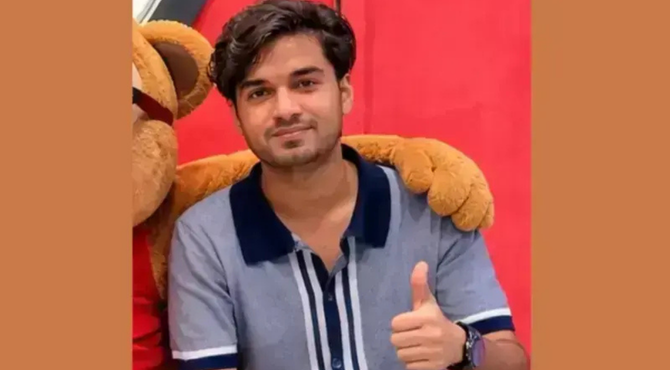
Ali, a 25-year-old Karachi-based businessman, was found dead with a gunshot wound in Gulistan-i-Jauhar last month, a day after he was reported missing on July 28. The case has been a controversial one, as police had initially built the case around the possibility that he died by suicide, but questions were later raised by post-mortem findings.
The report, issued by the office of the police surgeon of Karachi, said that the Exhumation Board was of the unanimous opinion that the death was caused by a gunshot wound to the back.
“Death occurred due to cardiac rupture consequent to perforating firearm injury of the chest,” the report stated, adding that the entry wound was on the posterior thorax (back) and the exit wound on the anterior thorax (front of the chest).
“The findings are inconsistent with suicide as the manner of death,” it confirmed.
A meeting of the exhumation board on Monday was convened by Karachi’s Police Surgeon Dr. Summaiya Syed and comprised six other members: Prof. Dr. Naseem Ahmed of Dow Medical College; Dr. Farah Waseem of Jinnah Sindh Medical University; Additional Police Surgeon Dr. Sirichand; Aamir Hasan Khan of the Citizens Police Liaison Committee; Dr. Muhammad Yaseen from the administrative office of the police surgeon; and Jinnah Postgraduate Medical Centre’s Medico-Legal Officers Dr. Daniyal Mirza and Dr. Kamran Khan.
The post-mortem report provided a summary of the provisional exhumation report issued earlier this month. It also cited a forensic report confirming Ali to be the biological son of Mir Hussain Ali and Marium Hussain, based on DNA analysis.
Additionally, it detailed the findings of reports received from the Industrial Analytical Centre of the Husein Ebrahim Jamal Research Institute of Chemistry, a research institute managed by the University of Karachi, regarding the examination of several articles of evidence retrieved in the case.
Tests performed included a Gas-Chromatography-Mass Spectrometry (GC-MS) for four articles submitted on Aug 6 and a Scanning Electron Microscopy with Energy-Dispersive X-ray Spectroscopy (SEM-EDS) for the fifth article, a shirt. The shirt was also physically examined and Wet Chemistry applied for acid detection, the report said.
The physical examination of the shirt found a “perforation” on the back of approximately 6.99mm in diameter, and a “corresponding larger defect” of approximately 35.37mm in diameter on the front. Traces of acid were also detected on the shirt, which were identified by the analytical centre as hydrochloric acid (HCl), while barium and lead were also detected around the defects — in higher relative concentration around the back defect than the front one.
Additionally, the GC-MS analysis detected traces of bupivacaine — an “amide-type local anaesthetic” — in the victim’s blood.
Thirteen articles were also submitted on Aug 10 for examination, with GC-MS analysis performed on nine. SEM-EDS analysis was performed on swabs taken from the victim’s chest wound, back wound and skin of both hands.
This analysis found “no traces of sedative, psychotropic, narcotic or poisonous substances” in the other nine articles, but found traces of gunshot residue in the swabs, the report noted.
An official statement issued by the office of Sindh’s Inspector General of Police on Monday said that a high level inquiry team was continuing its inquiry into the case. The statement noted that the final report was being shared with the public keeping in view the requirements of public interest and furthering the probe in light of the final report.
SHC reserves order on family’s plea seeking JIT
Separately, the Sindh High Court (SHC) reserved its verdict on a plea seeking the formation of a joint investigation team (JIT) in the case.
Ali’s family, which has raised questions about the case’s investigation and accused authorities of trying to bury the facts, had moved the SHC last week against a decision of the provincial government to form a judicial commission and sought the formation of a JIT instead.
However, authorities proceeded with the commission, with Justice Omar Sial appointed as its head.
A two-member constitutional bench, headed by Justice Adnan Karim Memon, took up the family’s petition on Monday.
The Sindh advocate general (AG), prosecutor general, Karachi police surgeon, police officials, the case’s investigating officer, Ali’s family, and their counsel Jibran Nasir appeared before the court during the hearing.
Nasir reiterated the demand for a JIT, following which the court enquired about the difference between a JIT and a judicial commission.
To that, the state’s lawyer said, “A JIT will investigate the case from various angles while a commission can provide assistance in the investigation”.
Nasir reminded the court that to investigate the Gul Plaza blaze, a JIT and a commission were formed separately.
He further alleged that police personnel had destroyed evidence in the case, adding that this was also mentioned in his plea.
Nasir also accused police of “spreading false news through the media” and added that no statements were recorded several days after the case was registered and that the “crime scene was set on fire”.
“It was set on fire to search for a bullet, just as the crime scene was washed in Rawalpindi,” he said, seemingly referring to the washing of the site of the killing of former prime minister Benazir Bhutto in 2007.
He said no action was taken against the police officers “who destroyed the case and tampered with the evidence”.
“We had demanded departmental action,” Nasir said, adding that it was the investigation team’s job to find the suspects.
The Sindh advocate general informed the court that the “commission’s function was to investigate the negligence (in the investigation)”.
Nasir maintained that “the SC has in the past also granted permission to form a JIT as well in case of administrative sabotage”.
“There is sabotage at the highest level of the police in this case,” he said, recalling that police had declared the case shut “even before Ali’s grave was dug” — a reference to the exhumation of Ali’s body for a second autopsy after the Karachi police surgeon pointed out loopholes in the first post-mortem report.
When the court observed that the government had already formed a commission, Nasir argued that the commission would be supported by the “same team that has failed to trace the suspects even after a month”.
For his part, the Sindh AG clarified that the provincial government was “not against the family”.
Following these arguments, the court reserved its order on the petition.
The case
The case has been mired in controversy since the beginning. While Ali’s family was convinced that he was kidnapped, tortured and murdered, police had initially built the case around the possibility that he died by suicide.
Days after the recovery of Ali’s body, Karachi Police Surgeon Dr Summaiya Syed had told Geo News that the post-mortem findings in the case had raised several questions, as some observations in the report did not appear to match the available photographs.
On August 6, a Karachi court took up an application by Ali’s father, allowed the exhumation of his body, ordered the formation of a medico-legal board for the purpose and directed that a second autopsy of Ali’s body be conducted.
The Sindh health department then constituted an eight-member board, with police surgeon Dr Sumaiyya Syed as the convener. However, in the early hours of August 7, the board was reconstituted through an order issued by the director general of the Sindh health department.
While Dr Syed remained the convener of the new five-member board, its members were changed.
But Ali’s family rejected the new board, which also resulted in the deferment of the planned exhumation on Friday. Meanwhile, the counsel for Ali’s family, Nasir accused the authorities of trying to bury the facts.
The Sindh government then restored the original medical board, following which Ali’s body was exhumed on August 8.
A day later, the Sindh inspector general of police’s (IG) office notified the reconstitution of the investigating team probing Ali’s death while Karachi Additional IG Azad Khan transferred the investigation into Ali’s murder to Zaman Town police station from Ferozabad Police Station, where the case was registered.
The order for the probe team’s reconstitution also showed that a murder charge had been added to the first information report.
The same day, the Sindh government decided to seek a judicial commission for the case’s investigation, only to defer the plan a day later after Ali’s family said they had made no such demand and had faith in the new investigation team.
On Aug 19, Ali’s parents, Mir Hussain and Mariam Hussain, wrote to Sindh Chief Minister Murad Ali Shah, seeking his “direct supervision of the murder investigation”. They also urged the chief minister to order an investigation and departmental inquiry into the previous investigation team and immediately suspend the officers involved.
The provincial government acknowledged the letter and announced the decision on Aug 23 to form a judicial commission to determine whether the investigation in the case was being conducted impartially and to investigate the circumstances surrounding Ali’s death.
However, soon after the announcement, the counsel for Ali’s family raised objections and later approached the SHC.
The petition was filed on August 24 in objection to the provincial government’s decision to form a judicial commission and sought the formation of an independent and multi-agency JIT “comprising officers who have had no previous involvement in the case” in place of the commission.
The commission held the first hearing on Friday, and has summoned medico-legal officer Osama Sheikh, who had performed Ali’s first autopsy. It also issued notices to the deceased’s family, their lawyer and a provincial government focal person.