
Web Desk(National Times)- Nepal’s disaster authority on Friday put the number of people missing after devastating floods at 1,924, two days after the disaster killed at least 579 people in the country.
The number of missing includes 517 foreigners, as well as 933 workers on hydropower projects on the rivers where a wall of water powered down on Wednesday morning, according to the National Disaster Risk Reduction and Management Authority.
Rescue teams on Friday used heavy machinery to dig through mud and debris in Nepalese towns devastated by a flash flood two days ago, as hopes of finding survivors faded and officials worked to reduce the risk of further catastrophic flooding.
The flood ripped through villages and valleys, destroying power stations, roads and bridges along a route that links Kathmandu with Lhasa in Tibet and is popular with trekkers and pilgrims.
Authorities in Nepal used helicopters to search for survivors and drop emergency supplies to thousands cut off in towns and valleys while emergency services, some using sniffer dogs, recovered dozens of bodies swept down into the plains.
Around 320 Indian nationals are still missing in the aftermath of the devastating flash flood, a spokesperson for India’s foreign ministry said, adding that at least 400 were stranded but safe on the Chinese side, while another 96 had crossed into Nepal by land.
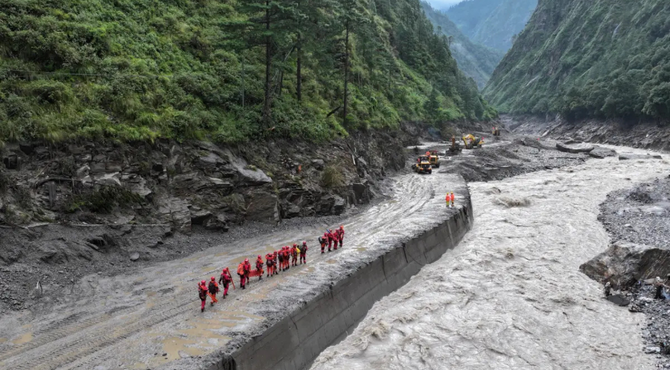
Rescuer help women to move through a muddy road following flash floods and a mudslide in Trishuli, Nuwakot district, Nepal on August 28, 2026. —Reuters
Dibga Tamang was among the last people rescued from the hard-hit town of Rasuwa on Thursday, airlifted along with three others to an army camp in Nuwakot.
“All of our people have gone. They are dead,” Tamang said. “I have no one left waiting for me. Everything and everyone is gone. The end.”
The sheer amount of water and debris stirred up now risks triggering a further disaster.
Nepal’s disaster management authority warned that a lake formed by debris blocking the Bhotekoshi River was rising and at risk of bursting, while on the other side of the border China said that some three million cubic metres of water, the equivalent of about 1,200 Olympic-sized swimming pools, was expected to flow into an already dammed lake over the next three days.
There is a high risk the lake could breach, with peak flow expected around September 1, Chinese state media said, citing the water resources ministry.
Chinese authorities have mobilised an eight-member engineering team to conduct aerial surveys and 3D modelling of the barrier lake, but accessing it was challenging.
“After the glacier collapse created the lake, many isolated cliffs and steep cliffs appeared along it,” one of the engineers, Chen Hanxiao, told CCTV.
Chen said the general approach to reducing the lake’s threat is to excavate a drainage channel at a lower point of the dam, but the width and depth of that channel needed calculations based on how fast the water will flow and how quickly the lake will fill.
Their next tasks were to monitor the lake and collect data from the lake floor, as well as weather monitoring in the coming days.
Nepali Army working to rescue 100 trapped in hydropower tunnel
Nepali Army teams searched for more than 100 people trapped inside a hydropower tunnel, as India offered to send a specialised rescue team.
India has extensive experience with difficult Himalayan tunnel rescues, including specialised teams of “rat-hole” miners. However, the uncertainty was agonising for families waiting for news.
“I have not heard from him since I spoke to him at 7am that day. We have not had any news about them either, if they are being rescued or not,” Sita Adhikari, whose husband was trapped in the hydropower tunnel, told reporters.
“We will have hope as long as we have our breath… We need them to be rescued as soon as possible,” she said.
Nepali Army helicopters carrying bodies of deceased flood victims land at Trishuli camp in Nepal’s Nuwakot district on August 28, 2026. — AFP
Two army helicopters were sent to the Trishuli 3A hydropower project in the mountainous Rasuwa district.
“Our focus is on search and rescue of people… some people are trapped in the tunnel of Trishuli 3A hydropower project,” Nepal Army spokesman Raja Ram Basnet told AFP. “Two helicopters have been dispatched, but it is challenging because it is tough to even locate the entry points of the tunnel.”
Chinese rescuers reach main site of deadly mudslide
Chinese rescuers faced treacherous conditions on Friday as they reached the main area wiped out by a deadly mudslide at the Tibet-Nepal border to search for hundreds of missing people, state media reported.
Two days after Tibet’s border trade hub of Gyirong was pummelled by a wall of mud and debris, a team of 21 rescuers became the first to reach it in the late afternoon on Friday, state news agency Xinhua said.
Chinese President Xi Jinping chaired a meeting of top leaders about rescue operations, as the death toll in Tibet rose to five, with 558 still missing.
“There are still many hidden dangers of glaciers, ice lakes and geological disasters in the surrounding area, and rescue is facing great difficulties,” Xinhua reported the leaders as saying.
After the mudslide hit on Wednesday, a huge lake formed upstream, raising concerns that it could burst and cause further severe flooding.
But risks from that lake are “gradually decreasing”, Chinese state media reported on Friday, adding that rescue operations were “proceeding in an orderly manner”.
An excavator in action as rescue workers repair a road leading to Gyirong Port after a mudslide, in Gyirong county, Shigatse, Tibet Autonomous Region, China on August 28, 2026. —Reuters
Authorities had earlier paused operations in the worst affected area, citing the risk of renewed flooding due to the lake water beginning to overflow, state broadcaster CCTV said.
Later, a CCTV report said water from the lake was “flowing out naturally, with the outflow discharge exceeding the inflow discharge”.
“Compared to the high water level in the early morning on August 27, the lake’s water level has dropped by around 10 metres (33 feet), and the risk is gradually decreasing,” it added.
It was not immediately clear if the lake was the same as a debris dam that Nepalese authorities warned had burst on Friday.
Family members of the missing were being housed in the area by authorities as they waited for news, one woman told AFP.
She said she had not been able to reach her relative, a police officer at Gyirong, or his wife, since the disaster happened, and had been told he was missing by his work unit.
CCTV said that 499 Chinese nationals and 555 foreigners had been transported out of the disaster zone as of Friday.
Rescue workers are using drone-based 3D modelling and thermal imaging detection, as well as manual searches, to locate those still missing, said CCTV.
Xi offered Beijing’s help in Nepal’s rescue operations, in a condolence message to the country’s president.
“China is willing to actively assist Nepal in its rescue efforts and provide support and aid to the best of its ability,” Xi said according to CCTV.
Buildings ‘wiped out like toothpicks’
Around the world, relatives of those missing were desperate for information about their whereabouts. Sneha Sudhir was one of 10 women whose husbands had set out from Nepal on a trek to Tibet’s Mount Kailash when the region was struck by disaster.
The men, all from northern Virginia, are among dozens of Americans missing. “Where are they?” Sudhir said tearfully from her home in Chantilly, Virginia, on Thursday.
Sudhir said the women were supporting each other and reaching out to officials, politicians and friends and family in the United States and India, hoping for word. “Everybody is taking turns in shedding their tears, wiping it off and getting back to work,” she said.
US President Donald Trump said America had offered support to Nepal.
Rescued residents react as they meet family members at an army camp following flash floods, in Battar Bazar town of Nepal’s Nuwakot district on August 28, 2026. —AFP
“Nobody’s ever seen anything quite like that, where very powerful, strong, well-built buildings were wiped out like they were toothpicks. It’s a terrible thing. We are sending aid and we’ve spoken to the leadership and we let them know anything they want, they’ll have.”
Prime Minister Shehbaz Sharif also offered “whatever possible assistance was required” in a phone call with his Nepali counterpart, Balendra Shah, according to a statement by the Prime Minister’s Office (PMO).
He conveyed to Shah that Pakistan was dispatching emergency relief assistance to Nepal in order to help with the relief efforts, the statement said, as well as expressing condolences and “complete solidarity” with the Nepali leadership and people.
Ganesh Aryal, the administrator of Chitwan district, said authorities had recovered 103 bodies from the river system in his district, which is about 100 kilometres away in the plains from the worst-hit region of Trishuli.
With local hospitals unable to accommodate all the bodies, district authorities were setting up tents and making arrangements for families to claim their dead relatives, he said.
Nepal’s Prime Minister Balendra Shah, who visited flood-hit Nuwakot on Thursday, said the situation was still difficult.
“All the state agencies are operating at full capacity. Our first priority now is to save the life of each citizen, search and rescue of the missing, treat the injured and provide immediate relief to the affected families,” he said.
The disaster is a major challenge for Shah’s five-month-old government but officials said the country had systems and officials who have experience in handling such tragedies, including the 2015 earthquake that killed nearly 9,000 people.