
ISLAMABAD(National Times)-The Foreign Office (FO) on Thursday termed claims that Chief of Defence Forces (CDF) and Chief of Army Staff Field Marshal Asim Munir visited Iran as an “envoy” of the United States “misleading and factually incorrect”.
The army chief met the Iranian leadership during his day-long visit to Tehran on August 24, undertaken as part of Pakistan’s diplomatic efforts to end the stalemate in the ongoing US-Iran conflict. Interior Minister Mohsin Naqvi had also accompanied him.
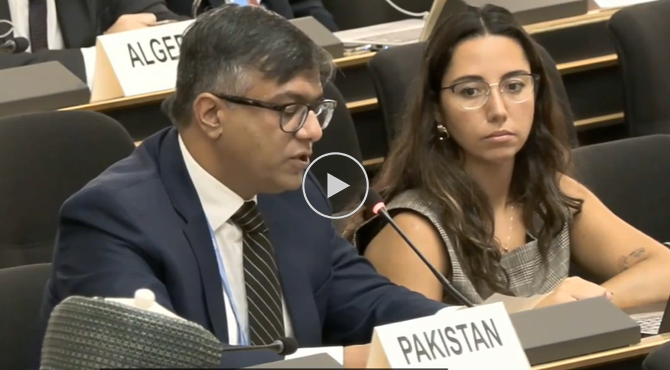
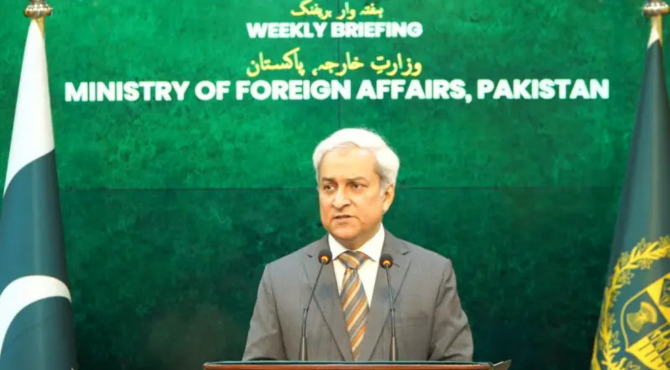
Addressing a weekly press briefing in Islamabad on Thursday, FO Spokesperson Tahir Andrabi noted that the discussions held during CDF Munir’s visit to Tehran “focused on regional de-escalation, breaking the military stalemate and exploring a negotiated settlement to restore peace and stability”.
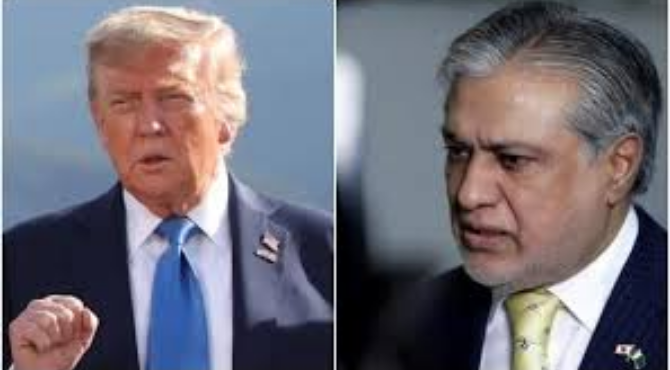
“I will also highlight that claims by certain quarters that the COAS and CDF visited Iran as envoy of President Trump or the US are misleading and factually incorrect, as his visit was undertaken purely in the context and backdrop of Pakistan’s role as a mediator,” he said.
Andrabi asserted that the visit underscored Islamabad’s “sincere and constructive role in bridging the difference between Washington and Tehran”. He noted that the Iranian leadership appreciated Pakistan’s efforts towards de-escalation and peaceful resolution of the conflict.
He stressed that Pakistan “remains engaged alongside our brotherly countries in sincere and concerted efforts towards resolving the crises in the Middle East and Gulf and with respect to the standoff between the US and Iran”.
“Pakistan will continue to actively pursue diplomatic engagement and support all sincere efforts aimed at reviving the peace talks and achieving a comprehensive, just and lasting resolution of the conflict,” he said.
Asked for a comment on the recent US plans for expansion of sanctions on countries doing business with Iran, Andrabi said Pakistan was “following international law and our bilateral trade agreements with Iran”.
“As such, our trade remains in consonance with our obligations,” he affirmed.
Asked about the US’s “economic war” against Iran, Andrabi expressed Islamabad’s hope that “all economic issues will also be settled in the long run” as part of a wider settlement of the US-Iran standoff.
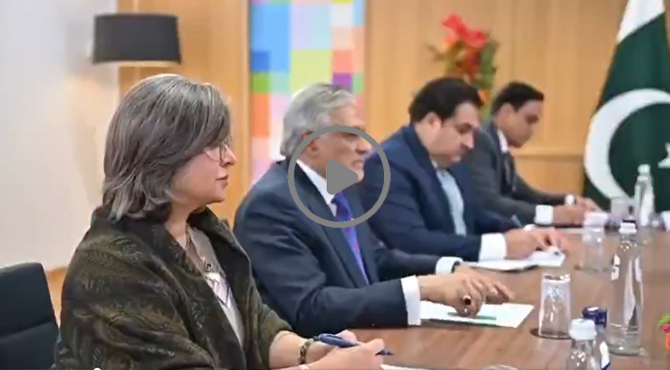
Besides the CDF’s visit, Deputy Prime Minister and Foreign Minister Ishaq Dar also remained engaged with his counterparts on regional developments, Andrabi pointed out. He added that over the past two weeks, Dar spoke with Turkiye’s Foreign Minister Hakan Fidan three times.
A Pakistan-mediated memorandum of understanding (MoU) signed between the US and Iran in mid-June provided for the reopening of the Strait of Hormuz, and left it up to Tehran and Muscat “to define the future administration and maritime services” in the waterway, in discussion with Gulf states and in line with international law.
But the deal, which was supposed to pave the way for talks on permanently ending the war, has since fallen apart.
Omani Foreign Minister Badr Albusaidi visited Tehran on Tuesday, where he discussed a framework agreement that would establish a “temporary corridor” for shipping and a project to clear mines in the strait.
Although there has been no clear breakthrough yet, and fundamental differences persist between Iran and the US, the latest diplomatic activity has brought the political and technical dimensions of the dispute back into focus.
The Iranian position, nevertheless, remains conditional as it continues to regard the Islamabad MoU as the appropriate framework, but wants Washington to demonstrate through concrete action that it is prepared to honour its commitments.
‘Tangible actions’ needed from Kabul rather than mere assurances: FO
Responding to a query on Afghan Interior Minister Sirajuddin Haqqani’s reported remarks on a proposed security mechanism, Andrabi said: “Pakistan notes the proposal by the interim Afghan government’s interior minister for a dedicated mechanism to address contentious issues.
“We remain open to state-level dialogue. However, the sustainability of any mechanism will depend on tangible actions rather than mere assurances.”
The FO spokesperson emphasised that for any dialogue to take place, the Afghan Taliban must ensure that Afghan soil is not used to perpetrate terrorism against Pakistan.
“Kabul must honour its international commitments, including those under the Doha framework and ensure that Afghan soil is not used by hostile proxies, particularly the Tehreek-i-Taliban Pakistan and the Baloch Liberation Army, against Pakistan,” he said.
Andrabi reiterated that Islamabad remained ready for “institutional coordination provided it results in tangible and verifiable counterterrorism measures and effective border management”.
In the past few years, Islamabad has repeatedly urged the Taliban administration in Kabul to dismantle terrorist sanctuaries on Afghan soil that are used for attacks in Pakistan. Officials say those appeals have gone unheeded.
FO rejects former Indian defence chief’s claims regarding 2025 conflict
Replying to another question, the FO spokesperson rubbished claims made by India’s ex-defence chief, Anil Chauhan, that an Indian Harop drone accidentally struck Kirana Hills near Sargodha during the May 2025 conflict after running critically low on fuel.
“We categorically reject the self-contradictory and retrospective claims made by the former Indian chief of defence staff regarding Kirana Hills,” Andrabi maintained.
He asserted that during the conflict, “Pakistan’s layered air defence network effectively thwarted India’s military objectives, while Pakistan’s subsequent response under Operation Bunyanum Marsoos demonstrated our ability to impose cost across the conflict spectrum”.
“No strategic asset or sensitive infrastructure was compromised in Pakistan. Attempts to retrospectively recast these events through selective narrative or dramatised production cannot alter the verifiable operational record of May 2025,” he said.
The FO spokesperson said that history is “established by facts and evidence, not by Bollywood-style retrospective claims”.
“These post-facto punches, if I may call them, 16 or 17 months after the war would be better directed at their faces,” he added.
Regarding a question about the removal of the structures outside Pakistan’s High Commission in New Delhi, Andrabi said Islamabad has “launched a strong protest” and termed the act a violation of the 1961 Vienna Convention on Diplomatic Relations.
The FO spokesperson noted that Indian “authorities used heavy machinery to demolish sheds, benches, and a walkway adjacent to the consular section” of the High Commission. He added that the facility was used by those seeking consular assistance and visas.
He pointed out that Indian actions against Pakistan’s High Commission in New Delhi were initiated “without prior notice, and therefore cannot be equated with the actions here in Islamabad”.
“Any attempt to link this incident to Islamabad’s ongoing non-discriminatory anti-encroachment drive in the Diplomatic Enclave is misleading,” Andrabi stated, noting that a notification was given to the Indian side but it “failed to remove such structures”.
He stressed that the drive “targets unauthorised structures outside all diplomatic missions, not just India, in the Diplomatic Enclave”.
Makkah pact an ‘evolving security architecture’
Asked about Bangladesh’s interest in joining the Makkah Joint Defence Agreement (MJDA) between Pakistan, Saudi Arabia and Turkiye, the FO spokesperson said: “As an evolving security architecture, the MJDA remains open to countries who share their commitments to collective obligations and common security interests.”
The joint defence agreement signed on August 7 aims to strengthen collective deterrence and empowers its signatory states to treat an attack against one of them as an attack against all of them.
Andrabi stressed that the pact is a “defensive framework aimed at safeguarding peace and promoting regional stability”.
He added that any formal request by another country to join the pact will be considered in consultation with Riyadh and Ankara.
“The operationalisation of the MJDA, however, remains at an early stage,” he said.