
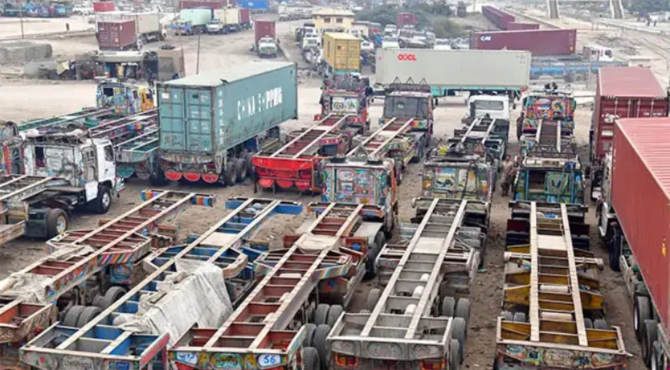
KARACHI(National Times)- A countrywide strike by goods transporters and oil tankers started affecting industrial and export supply chains on Saturday, with operators vowing to continue the protest until the outcome of talks with the government on Monday, while manufacturers warned that prolonged disruption could halt production and jeopardise export commitments.
Pakistan Goods Transporters Alliance Chairman Nisar Hussain Jafry told Dawn that “our countrywide strike will continue as our leadership intends to meet the ministers concerned with petroleum, transport and ports on Monday”.
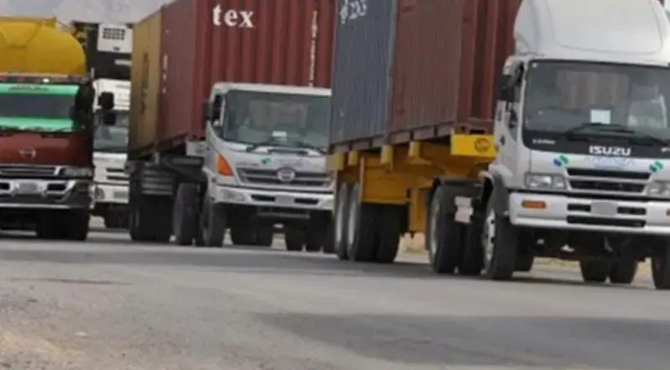
He said the movement of more than 400,000 goods-carrying vehicles, ranging from small to large, had been suspended from Saturday until the outcome of Monday’s meeting. “We have already unloaded our containers at the ports,” he said.
Mr Jafry said goods transporters were striking over multiple issues, including the government’s recently introduced daily fuel price mechanism.
“We are dissatisfied with the daily fuel price fixation introduced by the government, which is only creating problems,” he said.
Since intercity movement of vehicles takes between one and three days, transporters and industries cannot make firm commitments on transportation charges because of daily changes in fuel prices, he said.
Mr Jafry urged the government to restore the monthly fuel price mechanism and reduce withholding tax on transporters to 2pc from 7pc, noting that oil carriers were paying 2pc withholding tax on services.
He said the government and goods transporters had signed a charter of demands in December 2025, but the commitments made under it had yet to be fulfilled.
Mr Jafry also complained about the number of toll plazas, saying they had been established at intervals of around 30km and that transporters were perturbed over high toll rates.
Transporters were also facing issues related to parking of heavy vehicles in areas surrounding the ports and driving licences, he added.
Supply-chain disruption
Already struggling with high production costs, industrialists warned that the nationwide strike by goods transporters could further disrupt industrial activity if supplies of raw materials remained suspended.
They cautioned that prolonged disruption in cargo movement could paralyse factories, derail production schedules and jeopardise export commitments, ultimately affecting employment and the overall economy.
SITE Association of Industry President Abdul Rehman Fudda said the strike had created an alarming situation for manufacturers.
“The entire production system depends on timely supply of raw materials and delivery of finished goods. If factories fail to receive essential inputs, production will stall, while delays in dispatching finished products will worsen financial stress for industries,” he said.
The export sector was already grappling with multiple challenges, Mr Fudda said, warning that if export consignments failed to reach buyers on time because of the transporters’ strike, industries could face penalties, price cuts or claims for damages.
He urged the government to intervene urgently and resolve the dispute through negotiations with goods transporters.
“Authorities must act before the situation escalates to the point where the country’s industry and supply chain collapse entirely. If the strike prolongs, the damage will extend beyond manufacturers — affecting exports, jobs and overall economic activity,” he said.
Mr Fudda also called for immediate relief measures for the industrial sector, warning that rising production costs, expensive energy and policy uncertainty were putting the survival of industries at serious risk.
He said escalating electricity and gas tariffs, rising production costs, high financing expenses and the absence of consistent economic policies had significantly undermined industrial activity.
Despite these challenges, he said, the business community continued to keep the wheels of the economy moving, adding that further neglect of the industrial sector would be against the country’s economic interests.
He called on the government to ensure energy supplies at competitive tariffs, simplify the tax regime, expedite payment of pending refunds, improve the ease of doing business and introduce investor-friendly policies.