
KARACHI(National Times)- A Karachi court on Thursday allowed the exhumation of Institute of Business Administration (IBA) graduate Mir Raza Ali’s body, which was found last month with a gunshot wound to the chest in the bushes in Gulistan-i-Jauhar.
The court issued the order on an application filed by Ali’s father, after a controversy emerged between the Karachi police surgeon and investigators over alleged loopholes in the medico-legal report regarding the post-mortem examination.
In its order, the court directed the police surgeon and the Sindh health secretary to constitute a medico-legal board for the exhumation of Ali’s body “under intimation to this court at the earliest possible date and time”.
The court order, issued after the ruling by Judicial Magistrate Hameedullah, stated that Ali’s father, Mir Hussain Ali Khan, had filed an application seeking the exhumation of his son’s body in accordance with law.
He also requested the formation of a medico-legal board, comprising senior forensic experts and pathologists, under the Karachi police surgeon “to conduct a fresh and comprehensive” medico-legal examination and postmortem, as well as X-ray, DNA, forensic and chemical examination of the body to ascertain the actual cause of death.
The court observed that the prosecutor had not raised any objection to allowing the application, and permitted the exhumation of Ali’s body.
Moreover, the court office was directed to issue a letter to the Sindh health secretary and Karachi police surgeon for the formation of a medico-legal board for the purpose.
“The Ferozabad station house officer is also directed to make arrangements along with the investigating officer (IO) for such proceedings,” the order, a copy of which is available with Dawn read.
The court had earlier reserved its decision on the application after the counsel for the applicant, Jibran Nasir, and the prosecutor presented their arguments.
Nasir contended that police could not object to the exhumation.
But, the judge observed that a notice would have to be issued to police.
Nasir argued that the police surgeon and the medico-legal officer would have to conduct the exhumation, further stating that the police surgeon had identified loopholes in the postmortem report.
“No X-ray was done; the cause of the death has not been determined,” he said.
The judge then asked the prosecution how the court could issue an order for the body’s exhumation without issuing a notice to the IO. If the prosecution had no objection, the order would be issued, he added.
The prosecutor replied that they had no objection to the exhumation. “This is a matter involving a human life,” he said.
At that point, Nasir argued that issuing a notice to the IO would further delay the matter.
The court then reserved its ruling on the application and later allowed the exhumation of Ali’s body.
Controversy over autopsy
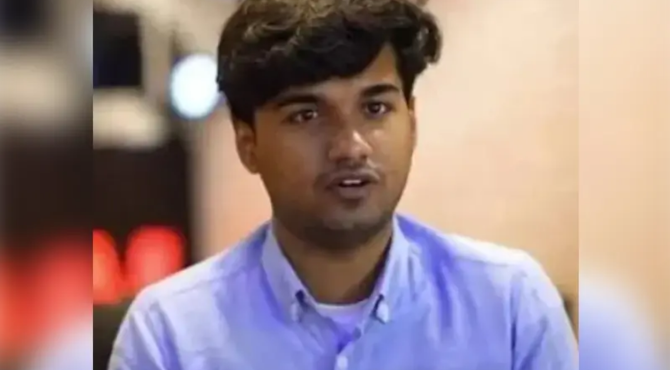
Raza, an IBA graduate and the owner of eatery Wafflix, had gone missing on July 28. The 25-year-old’s body was found a day later with a gunshot wound in bushes near Shahi Qila Ground in Gulistan-i-Jauhar.
Police maintain that the investigation has revealed that Ali had been facing financial difficulties and had asked his friends for money the night he died.
According to police, he had left his home in PECHS Block-2 and hired a taxi through an app. The taxi driver dropped him a short distance from the spot where his body was found, police said.
While Ali’s family is convinced that he was kidnapped, tortured and murdered, investigators probing the incident continue to build their case around the possibility that he died by suicide, claiming they have uncovered significant evidence that sheds light on the 25-year-old’s mental state.
The case took a new turn when Karachi Police Surgeon Dr Summaiya Syed told a private news channel on Tuesday that the postmortem findings of Ali’s body had raised several questions, as some observations in the report did not appear to match the available photographs.
She said the reported entry wound, bullet trajectory and exit wound did not correspond with one another. While it was scientifically possible for a bullet to enter through the back and exit from the front, she stressed that her assessment was based only on the postmortem report and photographs, as she had not examined the body herself.
The police surgeon noted that entry wounds were typically smaller than exit wounds in firearm cases. She also said that gunshot residue, commonly found on the hands in suspected suicides, was not tested for in this case.
Her interview prompted the police authorities to issue a statement, terming such observations as having the potential to adversely affect the ongoing investigation.
The statement, however, said that exhumation of the dead body could be done on the medical board’s recommendation for further clarification by a committee of medico-legal experts with the court’s permission.