
WASHINGTON(National Times)- A warning from one of America’s top military commanders has exposed a growing dilemma for Washington: The United States may no longer have enough naval forces to simultaneously defend Israel against Iranian missile attacks and protect its own interests across the Middle East.
General Alexus Grynkewich, commander of US European Command, has privately informed Pentagon officials that American naval assets are becoming stretched too thin as the conflict with Iran continues, according to reports by The Washington Post and other news outlets.
The general reportedly warned that without another US Navy destroyer assigned to the region, commanders could eventually face a difficult choice between protecting American forces and continuing missile-defence operations for Israel.
News outlets noted that the significance of the warning lies not only in the shortage itself, but in who delivered it.
Grynkewich is not an outside analyst; he is one of the senior officers responsible for managing US military commitments. His message reflects an internal military concern that America’s global commitments are exceeding available resources.
Navy destroyers equipped with the Aegis combat system have become a central part of Israel’s missile defence. These ships can track incoming ballistic missiles and launch advanced interceptors such as SM-3 and SM-6 missiles.
But these destroyers are also among America’s most valuable global military assets. They are needed in the Pacific to deter China, in Europe to reassure Nato allies, and in the Middle East to protect American bases and shipping routes.
His warning highlights a difficult military calculation: Every ship sent to defend Israel is a ship unavailable for another potential crisis. The warning comes amid reports that the United States has carried a substantial share of the burden in defending Israel from Iranian missile attacks.
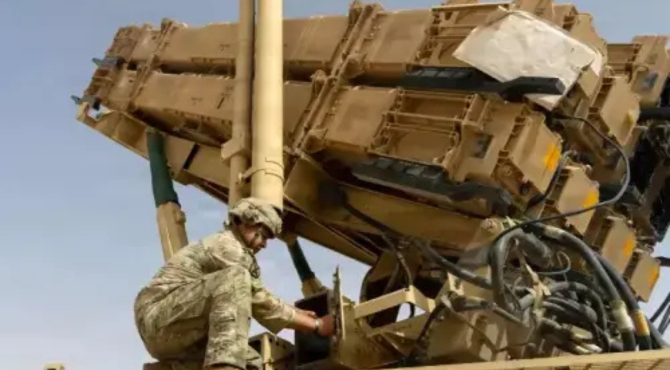
Pentagon assessments cited by The Washington Post indicate US forces fired more than 200 THAAD interceptors during the Iran conflict — roughly half the Pentagon’s reported inventory — along with over 100 interceptors launched from Navy ships.
Israel also used its own Arrow and David’s Sling systems but relied heavily on American support during the most intense missile exchanges.
The issue is not simply the number of missiles fired. Advanced interceptors are expensive, complex weapons that take years to manufacture and replace. Recent assessments have warned that prolonged combat could place pressure on US stockpiles of critical air-defence weapons.
For decades, American military strategy has rested on the belief that Washington can respond to multiple crises simultaneously. The United States maintains alliances in Europe, commitments in the Middle East, and a growing military focus on the Indo-Pacific.
The warning from US European Command suggests that this assumption is being tested. The problem facing Pentagon planners is not whether the United States has the strongest military in the world — it does.
The problem is whether even the strongest military has enough ships, missiles, and industrial capacity to sustain simultaneous commitments. A conflict with Iran may therefore be revealing a broader vulnerability: America’s military power is vast, but not unlimited.
According to an analysis by the Center for Strategic and International Studies cited by CNN, the military has used a significant portion of its advanced missile inventory in recent weeks of fighting.
The assessment estimates that American forces have consumed about 45pc of their Precision Strike Missiles, at least half of their THAAD interceptors, and around 50pc of their Patriot interceptors.
The analysis also indicates the US has used roughly 30pc of its Tomahawk cruise missiles, over 20pc of its Joint Air-to-Surface Standoff Missiles, and around 20pc of its SM-3 and SM-6 interceptors.
Either way, the message from inside the Pentagon is clear: Modern warfare is consuming advanced weapons faster than they can be replaced, and even the US military must make choices when several crises demand the same resources.