
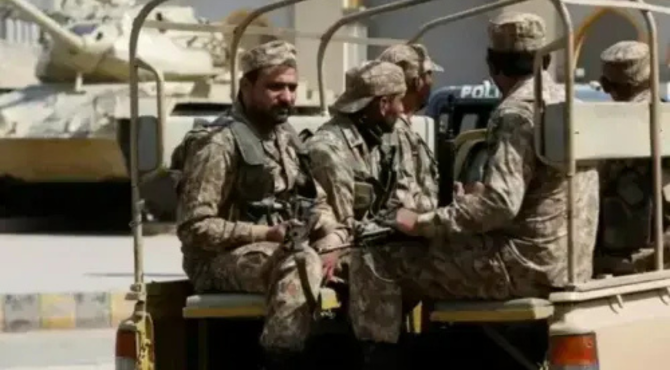
RAWALPINDI(National Times)- Security forces have killed 10 terrorists and apprehended two female suicide bombers, along with their facilitator, during operations carried out in Balochistan’s Surab and Mastung districts over the past 48 hours, the military’s media affairs wing said in a statement released on Wednesday afternoon.
According to the Inter-Services Public Relations (ISPR), seven terrorists were killed in Surab while three in Mastung, where the two suicide bombers and their facilitator were also apprehended.
The ISPR statement said that the operations in these two districts were in continuation of actions against the “terrorist nexus of India-sponsored Fitna-al-Hindustan and Fitna-al-Khawarij” in Balochistan to “weed out remnants of terrorists and their facilitators”.
The state uses the term Fitna-al-Khawarij for the banned Tehreek-i-Taliban Pakistan (TTP) and has designated Balochistan-based groups as Fitna-al-Hindustan to highlight India’s alleged role in terrorism and destabilisation across Pakistan.
The ISPR said that as part of actions targeting these groups, security forces had carried out multiple intelligence-based, area sanitisation and targeted operations in Mastung and Surab over the last 48 hours, killing 10 terrorists.
It further stated that the two suicide bombers and their facilitator apprehended during operations in Mastung belonged to Fitna-al-Hindustan.
“Weapons, ammunition and improvised explosive devices used by terrorists were also recovered,” the statement added.
It further stated: “Sanitisation operations are being conducted to eliminate any other India-sponsored terrorist found in the area.
“Relentless counter-terrorism campaign under vision ‘Azm-i-Istehkam’ — as approved by Federal Apex Committee on National Action Plan — by the security forces and law enforcement agencies of Pakistan will continue at full pace to wipe out the menace of foreign-sponsored and -supported terrorism from the country.”
The latest sweeps by the security in Mastung and Surab take place as Balochistan continues to face security challenges.
Earlier this month, security forces and law enforcement personnel jointly launched Operation Shaban in Balochistan in retaliation for a deadly attack on a police post at the Mangi Dam pumping station in Ziarat on July 6. During that assault, armed attackers kidnapped and killed 27 police officers.
A monthly security assessment released in early June by the Pakistan Institute for Conflict and Security Studies (PICSS) said that after two consecutive months of improvement, Pakistan’s security situation deteriorated sharply in May, driven primarily by escalating terrorist violence in Khyber Pakhtunkhwa and Balochistan.
The report said Balochistan emerged as the most affected province during the month. The province recorded 71 terrorist attacks, compared with 34 in April, representing a 109pc increase.
The deteriorating security situation was further reflected in a surge in kidnappings, it said. Of the 54 abductions reported nationwide during May, 52 occurred in Balochistan alone, highlighting the growing operational reach and confidence of terrorist groups in the province, it said.
On July 9, Prime Minister Shehbaz Sharif said that the country’s civil and military leadership had taken a “mutual and singular decision” to end terrorism after multiple major terrorist incidents in Balochistan.
He made the remarks at a meeting in Quetta of the Provincial Apex Committee on the National Action Plan, with Chief of Defence Forces (CDF) and Chief of the Army Staff Field Marshal Asim Munir also present.
PM Shehbaz’s statement came a day after the military Inter-Services Public Relations (ISPR) Director General Lt Gen Ahmed Sharif Chaudhry addressed a press conference, pointing the finger squarely at India and Afghanistan for being behind recent attacks in Balochistan.
He specifically mentioned “three major terrorist incidents” in recent days — an armed attack on the outskirts of Quetta on July 5, an assault on a police post in Ziarat on July 6, and an ambush of an army convoy in Bela on July 7.