
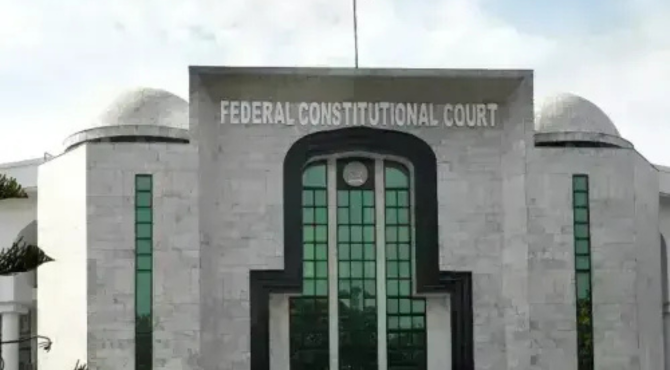
ISLAMABAD(National Times)-The Federal Constitutional Court on Friday overturned the Sindh High Court’s June 13, 2025 ruling that had invalidated faculty appointments at the University of Karachi, while cautioning that an unsuccessful candidate’s grievances cannot be elevated into a constitutional violation merely by citing allegations of unfairness, lack of transparency or procedural non-compliance.
Headed by Justice Syed Hasan Azhar Rizvi, a two-judge FCC bench, also comprising Justice Muhammad Karim Khan Agha, heard an appeal filed by the University of Karachi.
“The public sector universities are expected to act fairly and in accordance with their governing framework,” Justice Agha emphasised in the judgement he authored.
The judgement observed that constitutional jurisdiction is attracted only where the defect is patent, substantial and of such a nature as to affect the legality of the process itself. Justice Agha warned that any broader approach would risk converting the constitutional court into an appellate forum for academic selections, which was neither the object of Article 199 of the Constitution nor consistent with the autonomy of academic bodies.
The dispute arose when Dr Feroz Alam Jafri, an assistant professor in the Department of Food Science and Technology, challenged his non-selection for the posts of professor and associate professor, alleging procedural violations and bias in the university selection board’s recommendations made on Dec 21, 2023, which were subsequently approved by the university syndicate on April 5, 2024.
The university and its authorities challenged the SHC judgement primarily on the grounds that the constitutional petition before the SHC was not maintainable under Article 199 of the Constitution and that, in any event, the high court was not justified in setting aside the selection process and the syndicate’s approval.
The FCC judgement explained that Dr Jafri was an unsuccessful candidate whose case had been considered by the university’s selection board and approved by the KU syndicate. He had no vested right to recommendation or appointment, the judgement said, adding that the high court had treated mere allegations of violation of rules, bias and non-consideration as sufficient to invoke constitutional jurisdiction.
The law requires more than bare allegations, Justice Agha observed, adding that petitions could be entertained by the high court only if the record disclosed a patent violation of a mandatory rule, mala fide, bias, breach of natural justice or lack of lawful authority.
In the present case, no such jurisdictional defect was apparent on the face of the record, the judgement said, adding that Dr Jafri’s constitutional petition was, therefore, not maintainable under Article 199.
The FCC further observed that it is settled law that the mere fact that an institution is created by statute does not, by itself, make every dispute relating to its employees or candidates amenable to constitutional jurisdiction.
A university may be a public-sector institution established under an Act, but an unsuccessful candidate cannot invoke constitutional jurisdiction merely because he was not recommended or considers himself more suitable, the FCC emphasised.
The court added that, in its constitutional jurisdiction, it may interfere only where the record discloses a patent illegality, violation of a mandatory rule, mala fide, bias, breach of natural justice, lack of jurisdiction or any other defect of a public law character. In the absence of such a defect, the matter remains within the domain of the competent academic bodies.