
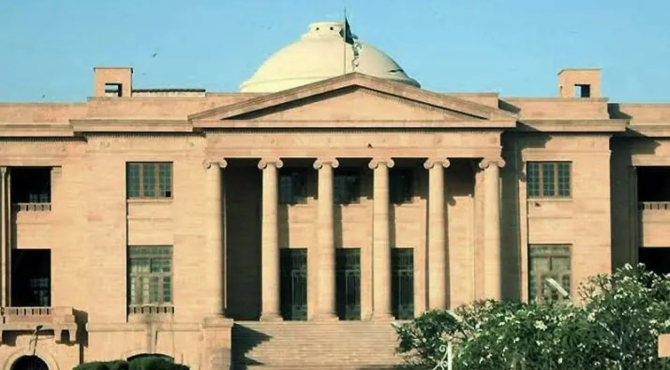
HYDERABAD(National Times)- The Sindh High Court (SHC) on Monday acquitted a man who was handed a life sentence three years ago in connection with a 2017 suicide case of a university student.
The body of Naila Rind was found hanging from the ceiling fan of her room in Sindh University’s Marvi Hostel in Jamshoro on Jan 1, 2017. She was a final-year student of the Sindhi department. Days later, police arrested Anees Khaskheli, a private school teacher, based on data retrieved from Naila’s mobile phone, which showed frequent communication between them.
In January 2023, an anti-terrorism court (ATC) had sentenced Anees under Section 7-A (acts of terrorism) of the Anti-Terrorism Act 1997, read with Section 321 [Qatl-bis-sabab (causing death to a person unintentionally)] of the Pakistan Penal Code (PPC).
He was also found guilty of committing offences under Sections 21(b) and (c) (cyberstalking) of the Prevention of Electronic Crimes Act (Peca) 2016.
The same year, Anees challenged his conviction before the SHC. On Monday, a division bench comprising Justice Amjad Ali Bohio and Justice Mohammad Hasan Akber announced the verdict in the appeal heard by a bench consisting of Justices Omar Sial and Mohammad Abdur Rahman.
The judgment was authored by Justice Sial after his bench partially heard the matter at the Hyderabad bench. With permission of the SHC chief justice, the case was transferred to the principal seat, where the bench completed the proceedings.
In the judgment, a copy of which is available with Dawn, the bench noted that an offence under the ATA had not been proven.
“No dissemination or public display of photos was proved. Blackmail was not proved,” it stated.
The court further said that no “unlawful act” on Anees’s part was proven, and that the prosecution “failed to prove its case beyond [a] reasonable doubt”.
Advocates Waqar Siyal, Zeeshan and Muhammad Faheem represented Anees, while Additional Prosecutor General Nazar Memon argued on behalf of the complainant, Naila’s brother Nisar Ahmed, who did not wish to engage private counsel.
Lawyers Mehmood Akhtar Qureshi, Faisal Siddiqui, Sara Malkani and Maliha Zia assisted as amicus curiae upon the court’s request.
The verdict noted: “While Anees and Naila shared a personal relationship marked by the typical ups and downs of such relationships, the existence of their private communication alone does not inherently tie him to her tragic decision to commit suicide.
“Personal communications including, but not limited to, electronic messages showing private interactions between a young couple cannot ipso facto establish legal or moral culpability for her death.”
It observed that objective evidence must be evaluated to determine whether there was any “actual instigation or legal wrongdoing, rather than relying on blame or assumptions”.
The order recalled that Anees had “professed innocence” in his statement recorded under Section 342 of the Code of Criminal Procedure (CrPC) before he was convicted.
The bench analysed a call data record showing contact between Naila and Anees, personal photos recovered from Anees’s phone, WhatsApp messages, and testimonies from Naila’s brother, father and uncle — on which the police had relied and the prosecution had based its case.
Justice Sial wrote there was no direct evidence found in the case, which “hinges on the investigating officer’s testimony”.
He noted that Naila’s brothers, father and uncle only testified that she appeared worried when she visited home about a week before her death and mentioned that someone from a specific phone number was bothering her.
“We find the account of events of the family members of Naila and of [her friend] Saima Hussain to be afterthoughts that seem to have been tailored to align with the investigating officer’s (IO’s) theory,” the judge wrote.
Noting there was “serious doubt” about the authenticity of the accounts related to the phone number, the judge stated, “In any event, even if the number were correctly identified, that fact alone would not establish that Anees had ‘killed’ Naila.”
Notably, the bench said it was “unable to comprehend how the trial court concluded this was a terrorism offence”.
It observed that the trial did not explain how the requisite intent and design to create fear and insecurity in the community was established. “Every serious crime causes trauma to those involved; that alone does not make it terrorism.”
While the bench noted that the police did not have the jurisdiction to investigate cybercrime offences, it did not issue a finding on the legal effect of a police investigation into an FIA-scheduled offence. This was because there “may have been some ambiguity” during the critical investigative period of 2016-2018 as the FIA was formally designated for it in 2018.
The verdict termed IO Tahir Mughal as the “most important” witness, noting that the prosecution’s entire case rested on his theory about what happened between Naila and Anees based on their messages from Dec 31, 2016.
“The prosecution’s entire case rests on Tahir’s theory that because Naila did not come out to meet Anees, Anees sent her private photos and threatened to disseminate them,” it read, adding that it was on record that “private photos of both Naila and Anees were recovered from Anees’s phone”.
The verdict said the IO acknowledged he did not pursue the matter of Naila’s communication with the then-dean of faculty at SU, which the order said was “an unusual relationship”.
The court noted that the mobile phone recovered from Anees, which was confirmed in the IO’s testimony, was of a different brand than the two phones sent for forensic analysis.
Rather, the prosecution said those two devices belonged to Naila, which meant “the private photos were on her phone, and there is nothing to show — other than photos solely of Anees — that Anees had sent them to her”.
The bench said the prosecution relied on two sets of WhatsApp messages, one of which appeared to be a genuine exchange between Anees and Naila from Dec 31, 2016 but did not “remotely suggest Anees threatened to disseminate any private photos”.
The other set of messages, shown in screenshots, had “oblique references appear to someone threatening to disseminate photos” but they referred to persons named Zain and Zainab and made “no connection to Anees or Naila”.
While forensic data recovery confirmed that personal photos were exchanged, the bench noted that the mere possession of such pictures — without their dissemination or their use for blackmail — was not an unlawful act.
In the verdict, Justice Sial said the Hyderabad deputy inspector general (DIG) at the time, Khadim Hussain, “recklessly and wholly inappropriately stated that this was not a case of suicide but of murder”.
“At that point, not a shred of evidence supported that conclusion – nor has any emerged since. Naila’s family deserved honest closure, not the prolonged emotional turmoil that followed,” the judge remarked.
About the application of PPC’s Section 321, the bench referred to a recent judgment of a lower court that “noted the absence in Pakistan’s law of any specific provision to punish a person who creates circumstances that compel another to take their own life”.
Furthermore, Justice Sial noted that the IO had produced photocopies of documents upon which the prosecution relied, stressing that trial courts must give reasons for admitting secondary evidence.
“We have not ruled on the admissibility of the secondary evidence produced here because we are satisfied that, even if it were admissible, it was insufficient to establish blackmail, harassment, or threats,” the order read.
‘Constitutional supremacy over majoritarian sentiment’
The SHC bench also issued seven directives to trial courts, which were of a general nature and not specific to Naila’s case.
The first being: “Objections raised during evidence should be decided there and then. If brief reflection is required, the objection should be resolved within one day, with the continuation of recording adjourned for that period.”
It was further instructed that where the prosecution relies on call data records, it should be required to identify the specific entries relied upon and which should be independently exhibited.
“The practice of producing hundreds of pages of call logs accompanied by a blanket assertion that ‘the record shows contact’ is insufficient,” the order read.
It emphasised that judgments must provide reasons if a trial court departs from the principles set by the Supreme Court on admissibility of call data records.
“A reproduction of the evidence, followed by a general statement that ‘the above proves the charge’, does not suffice. Evidence must be legally analysed, and specific findings given,” the order said.
The bench further ordered trial courts to “give careful attention to sentencing”, highlighting that the CrPC provided ample guidance.
It also directed trial courts to “remain current on the major principles enunciated” by the SC and the high courts.
The bench underscored that a person’s dignity was “constitutionally inviolable” and therefore, law enforcement agencies and the judiciary must handle material such as pictures with strict confidentiality.
“When ‘sensitive’ photographs are introduced as evidence, the trial court and the high court must place them in a sealed, non-transparent envelope. The envelope should only be opened on a strict need-to-know basis,” the judgment read.
Lastly, the bench noted that the judiciary was “bound to uphold constitutional supremacy over majoritarian sentiment”.
It stressed: “Defending constitutional rights — particularly when counter-majoritarian — is a cornerstone of institutional stability. Sacrificing legal consistency for public acclaim constitutes a structural violation of judicial duty.
“Judges must decide independently and must give reasons for their decisions, especially where sentences are severe.”