
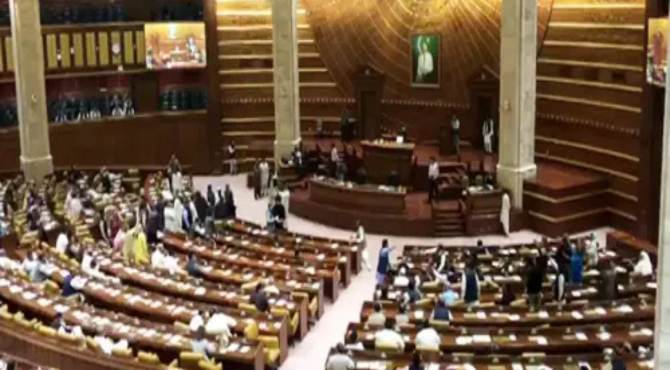
LAHORE(National Times)- The Punjab Assembly on Monday witnessed a heated exchange on the proposed Punjab Control of Habitual Offenders and Anti-Social Behaviour Bill, 2026 with the opposition describing the legislation as an assault on fundamental rights and freedom of expression while Speaker Malik Muhammad Ahmad Khan assured the lawmakers that their concerns about the bill would be addressed before being taken up for consideration.
Opening the debate, Opposition Leader Moin Riaz Qureshi alleged that the proposed law violated constitutional guarantees and democratic principles. He warned that the bill could become the final nail in the coffin for freedom of expression and accused the government of attempting to suppress dissent through legislation.
“The Punjab Control of Habitual Offenders Bill 2026 is being introduced to silence people,” Qureshi alleged, adding that the ruling PML-N had previously enacted accountability laws that eventually rebounded against its own leadership.
Responding to the opposition’s concerns, the speaker said he had not been presiding over the House when the bill was originally introduced or when the relevant committee’s report was presented.
Calls it a bid to suppress dissent; HRCP concerned at the proposed law
“I was not aware of the bill at that stage. It has already been referred to the committee and the report has been submitted,” the speaker said, explaining that the government had not yet put the bill on the Assembly’s agenda. He added that Parliamentary Affairs Minister Mujtaba Shujaur Rehman would respond to members’ concerns when the matter would come before the House.
The speaker also informed the assembly that he had received a formal letter from opposition member Rana Aftab Ahmad raising objections to the proposed legislation.
Rana Aftab Ahmad read out the contents of the letter in the House, urging the speaker to prevent the bill from being passed in its present form and to refer it for detailed constitutional and legal scrutiny. The letter argued that the proposed law posed a threat to citizens’ fundamental rights and freedoms, conflicted with constitutional guarantees of free expression, and would significantly expand executive authority while limiting judicial oversight.
The opposition further demanded that the legislation undergo comprehensive parliamentary debate and independent legal review before any final approval.
The controversy on the bill surfaced a day ago when the opposition raised the matter and the speaker expressed his ignorance that it had been introduced and sent to the relevant committee, which passed it a few days ago. The bill mandates electronic tracking devices like anklets or bracelets to monitor habitual criminals.
To reclaim the writ of the state and enhance public safety, the law establishes a specialised hierarchy of provincial, divisional and district intelligence committees tasked with tackling public nuisances, protecting minorities, and monitoring digital threats like cyber-bullying and online disinformation. But it gives edge to the district administration over judiciary as only representatives of the former have been made part of the committee that would report as well as take action against any individual.
The bill explicitly criminalises an extensive list of anti-social behaviours – ranging from running gambling dens and illicit liquor operations to online blackmail, displaying weapons on social media, and impersonating public servants.
The district intelligence committees are empowered to crack down on these activities by demanding surety bonds or recommending severe administrative actions, including blocking national identity cards and passports, freezing bank accounts, and removing digital profiles from cyberspace.
HRCP: The Human Rights Commission of Pakistan (HRCP) is deeply concerned at the recently proposed Punjab Control of Habitual Offenders and Anti-Social Behaviour Bill, which appears to confer sweeping powers on the executive to impose intrusive restrictions on individuals without adequate judicial oversight or due-process safeguards.
Measures involving surveillance, restrictions on movement, interference with property, and limitations on expression and speech, which thereby impinge on people’s fundamental rights, must meet constitutional standards of legality, necessity, and proportionality rather than echoing archaic and repressive colonial laws. The commission plans to hold a consultation with multiple stakeholders, including lawmakers, to highlight issues with the proposed law.