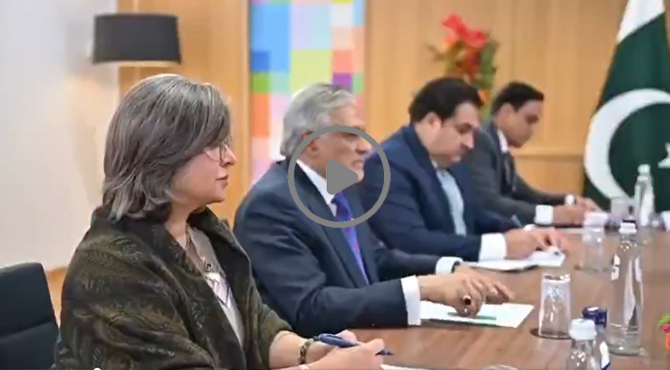

ISLAMABAD(National Times)- Deputy Prime Minister and Foreign Minister Ishaq Dar expressed hope on Wednesday that the indefinitely extended ceasefire between the United States and Iran could be made permanent.
US President Donald Trump has indefinitely extended what was initially a two-week ceasefire between the two countries, brokered with the help of Pakistan’s mediation, but the conflict — and its widespread economic fallout — remains unresolved.
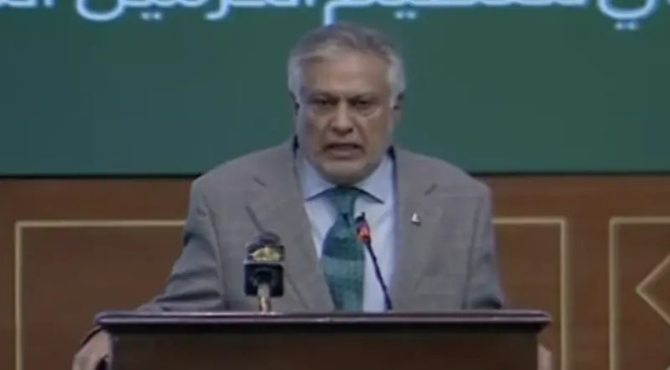
Addressing the second session of the Ulema Council Conference in Islamabad, the foreign minister said that Pakistan’s efforts had been directed towards securing direct negotiations and a ceasefire — “first it happened, then it was extended, then extended a second time, then a third time”.
“At least the deaths of several hundred people a day — with the toll going into the thousands — has stopped,” he added.
He called on the council to pray for Pakistan’s efforts, saying that they were now geared towards turning the ceasefire into a “permanent end to the war”.
Dar also called on Muslim states to unite in case they had developed any rifts between them, stressing his belief that they would be stronger in their efforts if they worked together.
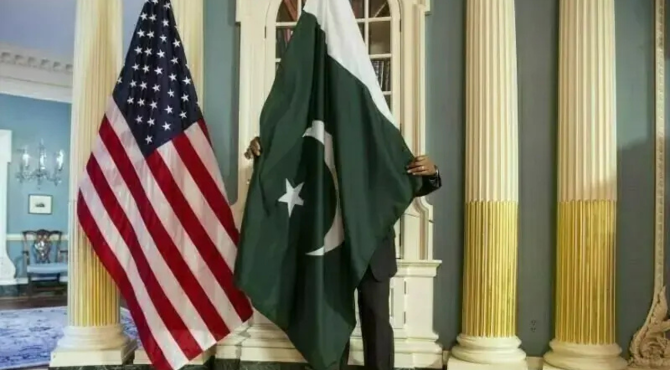
The deputy premier further noted Pakistan’s role in bringing the US and Iran to direct negotiations for the first time in 47 years. He said that Pakistan “played its full part” from February 28 until today in its response to the conflict.
“After 47 years, we brought the US and Iran to sit down at the same table,” he added, contrasting it with the indirect negotiations that had taken place previously, facilitated by Oman.
He highlighted that Pakistan had engaged with Iran on the issue of their strikes on US bases in other Middle Eastern countries that had heightened tensions in the region, stressing its part in the Muslim Ummah in an effort to halt the intra-regional hostilities.
US and Israeli forces launched the war against Iran on February 28, after which the Islamic republic closed the Strait of Hormuz — a vital route for oil and gas exports — while American forces later launched a blockade of Iranian ports.
The Islamabad Talks, which marked the highest engagement between the two sides since 1979, ended without an agreement, but also without a breakdown.
As the Pakistan-brokered two-week ceasefire agreed on April 8 neared its original deadline, Trump posted on social media that he had decided to extend it indefinitely “upon the request of [Chief of Defence Forces] Field Marshal Asim Munir, and Prime Minister Shehbaz Sharif”.
However, further efforts to secure more face-to-face talks have fallen through, with Trump stating that the two sides could negotiate by phone call if necessary. The Strait of Hormuz and Iranian ports both remain blocked.