
WASHINGTON(National Times)- Pakistan has reminded the UN Security Council that the “root cause of instability in the Middle East” remains the unresolved question of Palestine and urged renewed diplomatic momentum toward a two-state solution.
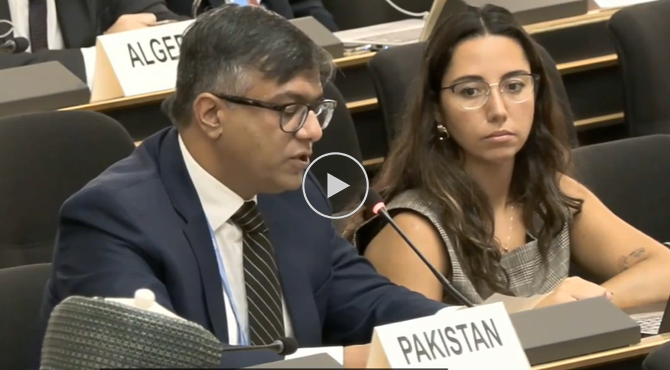
Delivering Pakistan’s statement in a high-level Council debate on the Middle East on Tuesday, Ambassador Asim Iftikhar Ahmad said the region remained “extremely volatile with multiple and interconnected crises”, warning that restraint, dialogue and adherence to the UN Charter were essential to prevent escalation.
Iran’s Ambassador Amir Saeid Iravani accused unnamed aggressors of “grave violations of international humanitarian law” and deliberate targeting of civilian infrastructure. He recalled that “a girls school in Minab, Iran, was destroyed, killing more than 168 students”.
And “at least 3,375 civilians” have been killed since the US invasion began.
He further asserted that “more than 700 educational institutions, along with healthcare and cultural facilities, have been attacked”, and demanded accountability from “the United States and the Israeli regime”.
The meeting brought together a wide range of regional and international actors, many of whom blamed Israel for the situation in Gaza, Lebanon, Syria and the occupied Palestinian territories.
Inadequate ‘humanitarian access’
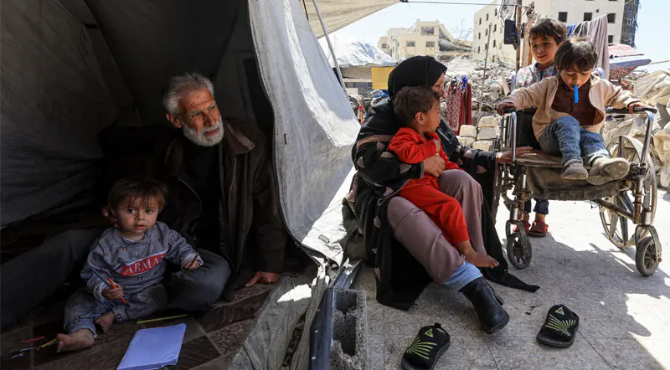
Ambassador Ahmad said the Gaza ceasefire had provided “relief, but remains fragile with violations ongoing”, adding that “more than 800 Palestinians have been killed by Israeli strikes since the announcement of ceasefire”.
He stressed that humanitarian access remained inadequate, calling for “sustained, unhindered and scaled up humanitarian assistance”.
On the diplomatic track, he reiterated support for efforts involving the United States, Arab states and the Organisation of Islamic Cooperation aimed at advancing a “time-bound political process” leading to a sovereign Palestinian state based on pre-1967 borders with East Jerusalem as its capital.
Turning to Lebanon, Ambassador Ahmad said Israeli military actions, particularly in the south, had resulted in “more than two thousand civilian casualties.” He welcomed the extension of the ceasefire brokered with US involvement but cautioned that violations continued.
Pakistan, he added, remained actively engaged in diplomatic efforts, including recent talks in Islamabad between the United States and Iran, which he described as part of Islamabad’s commitment to “fostering dialogue and stability across the region”.
Infringement of sovereignty
Lebanon’s Ambassador Ahmad Arafa, while welcoming mediation efforts including those attributed to US President Donald Trump, insisted that Beirut would not accept any infringement of its sovereignty.
“The Lebanese government will not compromise on a single metre of Lebanon,” he said, adding that it would “not accept any formal occupation.” He questioned ongoing Israeli actions despite ceasefire arrangements, asking: “How can such practices contribute to building the necessary trust required for any future negotiation process.”
Syria’s Ambassador Ibrahim Olabi reaffirmed Damascus’s position on the occupied Golan Heights, declaring: “The Syrian Golan is, and will remain, Syrian.” He accused Israeli forces of crossing the Line of Disengagement in southern Syria, alleging they were “kidnapping Syrians from their beds while sleeping” and threatening civilian livelihoods through raids and resource diversion.
Egypt, speaking on behalf of the Arab Group, said regional stability was inseparable from Palestinian rights, stating: “Security, stability, and peace remain contingent upon the end of the Israeli occupation.”
The European Union’s representative, Ambassador Stavros Lambrinidis, warned that “the approval of the Death Penalty Bill by the Israeli parliament marks a grave regression from that practice and from Israel’s own commitments”, urging Israel to return to its previous principled position.
On Gaza, he demanded the full withdrawal of Israeli forces and deployment of the temporary International Stabilisation Force”.
He also highlighted recent EU diplomatic engagement, noting that on April 20 the bloc co-hosted “two important meetings in Brussels, the Global Alliance for the Implementation of the Two-State Solution and the Ad Hoc Liaison Committee”.
“Both events demonstrated strong international consensus on safeguarding the two-state solution and strengthening Palestinian institutions as indispensable steps towards a sustainable peace,” he said.