
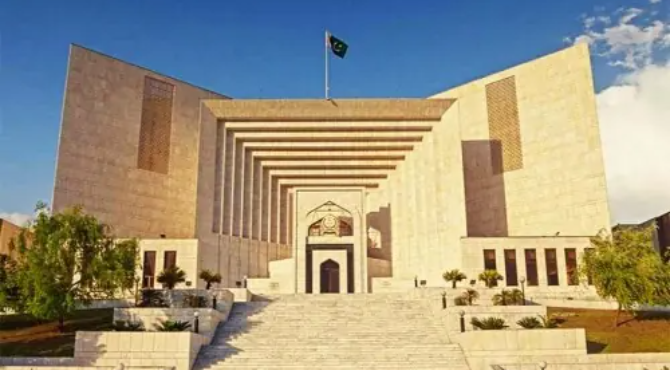
ISLAMABAD(National Times)- Human rights activists, political workers, lawyers and ordinary citizens meeting, convened by the Human Rights Commission in Pakistan (HRCP) on Tuesday appealed to the judges of the superior courts to uphold the 2015 Supreme Court stay order against summary evictions of katchi abadis, and thereby ensure the constitutional right to housing of the working poor in urban centres.
A statement issued by the HRCP said that the meeting was held in the face of an ongoing demolition drive launched by the Capital Development Authority (CDA) in contravention of the SC stay order, which had targeted Muslim and Christian katchi abadis across the federal capital, as well as historic villages like Saidpur, Malpur and Nurpur Shahan.
The HRCP, All-Pakistan Alliance for Katchi Abadis, National Commission for Justice and Peace, Awami Workers Party, Aurat March Islamabad and others noted that the CDA’s brazen anti-poor attitude in fact betrayed its failure to meet the shelter needs of the working poor.
However, the CDA had launched only one low-income housing scheme since the turn of the century, in the rural locality of Alipur Farash, which had accommodated only a few hundred households, and which paled in comparison to the approximately 500, 000 residents of katchi abadis in the capital.
The CDA’s inability to provide formal low-cost housing should engender an attitude of acceptance to informal settlements that had developed through the hard work and endeavour of working class families. Instead, the CDA continued to engage in reckless demolition drives which not only render thousands homeless but exacerbate what was already an acute shortage of affordable shelter for the poor, the statement said.
Islamabad remained the only city in Pakistan, which lacked a comprehensive framework for the recognition of informal settlements, governed by the globally accepted logics of regularization in the vast majority of cases with resettlement as a last resort. In the absence of parliamentary legislation to correct this major anomaly, it was up to the superior courts to ensure that Islamabad’s poor were not left to the whims of unelected bureaucrats.
The meeting participants insisted that the right to housing, enshrined under Article 9 of the constitution, was non-negotiable, and that the CDA along with all other state institutions must be held to account and end the practice of summary evictions, as well as the clear contempt of court decisions exemplified by repeated violation of stay orders. The meeting also called for an end to the arbitrary bulldozing of homes in Islamabad’s villages under the pretext that lands were acquired decades ago when the capital was being constructed. The participants noted that even in cases where the CDA claims to possess legal documents that gave it a right to claim land from village residents, there was no justification for violent evictions and due process must be followed.