
WASHINGTON(National Times)- As indirect diplomacy between the United States and Iran converges on Islamabad in the coming hours, the messaging from Washington has settled into a carefully managed tone of cautious optimism—tempered by clear acknowledgment that the process remains fragile.
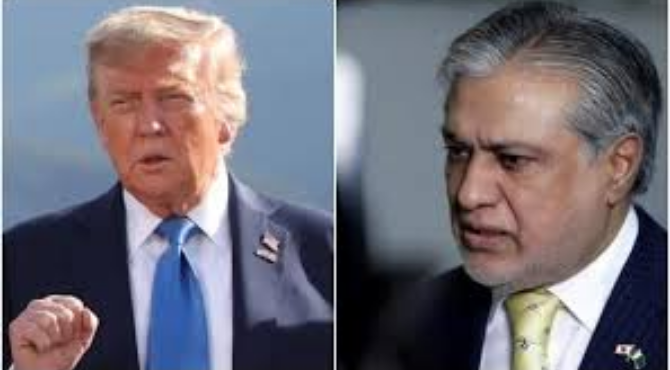
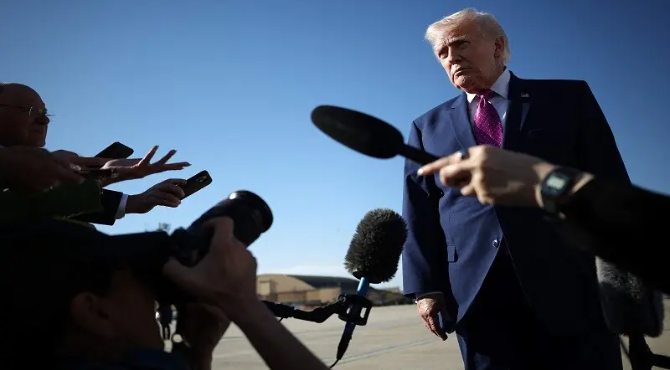
US President Donald Trump, speaking briefly before boarding Air Force One on Friday evening, projected guarded confidence in the American negotiating team while avoiding any suggestion that outcomes were pre-determined.
“We’ll see how it turns out. So it’s JD and Steve and Jared. We have a good team, and they meet tomorrow. We’ll see how it all works out,” he said, referring to the delegation led by Vice President JD Vance and senior aides.
At the same time, Trump framed the talks in explicitly strategic and transactional terms, suggesting that economic and geopolitical interests tied to regional chokepoints would ultimately shape outcomes.
“The strait will open up. If we just left the strait, …(it) is going to open,” he said, adding that the United States itself does not depend on it directly. “We don’t use the strait… other countries will help out.”
Pressed on whether he had a fallback option if diplomacy failed, Trump dismissed the premise outright: “It won’t be easy… but we will have that open fairly soon,” he said. Asked directly about contingency planning, he replied: “You don’t need a backup plan.”
His remarks underscored an approach that blends confidence with unpredictability—placing emphasis on outcomes while leaving the mechanics of negotiation deliberately open-ended.
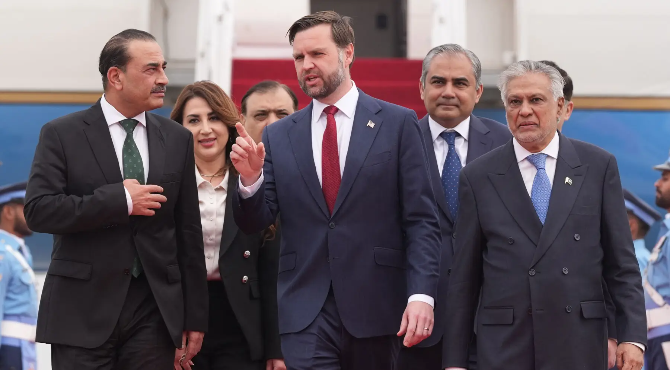
Vice President Vance, who is expected to lead the US delegation in Islamabad, struck a more conventional diplomatic tone, expressing optimism while warning against manipulation by the other side.
He said the talks were “going to be positive,” but cautioned Tehran not to “try to play us,” reflecting continued mistrust even as both sides enter the same negotiating framework.
Against this backdrop, Pakistan has presented itself not as a power broker but as an enabling platform—an intermediary that has helped create conditions for dialogue rather than dictating its direction.
In an interview with NBC’s Meet the Press, Pakistan’s ambassador to Washington, Rizwan Saeed Sheikh, described what he called an “intense diplomatic effort” that brought the process to its current stage.
“I think a lot of diplomatic efforts, an intense diplomatic effort has gone into bringing things to this good stage where it stands,” he said, crediting multiple regional actors alongside Pakistan.
He emphasised that Islamabad’s role is embedded in a broader multilateral effort: “Our partners, multiple partners, countries like Turkey, Saudi Arabia and Egypt have certainly made a lot of effort. Others have made a lot of effort.”
As delegations begin arriving, he said, “the talks are very much on the cards,” suggesting that the political groundwork has already been laid for substantive engagement.
A key condition for progress, he argued, lies in honoring what has already been informally agreed during preparatory discussions: “Whatever has been part of discussions going into these talks needs to be honored… and would certainly have a salutary impact on not just the optics… but the substantive discussions themselves.”
For Pakistan, however, the defining feature of the moment is not only preparation but process. Ambassador Sheikh stressed that the real test lies in the tone and conduct of negotiations once they begin.
“The most significant part of this whole episode that would start unfolding in Islamabad tomorrow is the constructive spirit with which both sides have approached it,” he said, framing atmosphere rather than substance as the immediate determinant of success.
He described the talks as inherently fluid: “So that is where it’s a work in progress. And if there are matters that need to be fine-tuned, the process itself, the talks themselves will address it.”
Pakistan’s role, he reiterated, remains deliberately limited to facilitation. “As a facilitator, the role is to bring the conflicting parties together and let them decide what satisfies them or what does not,” he said.
While Islamabad may offer input if requested, he stressed that responsibility rests entirely with the parties themselves: “We would be ready to afford maybe advice if it is solicited… because ultimately it is upon the conflicting parties themselves to strike a solution.”
He added that Pakistan’s effort has been reinforced by wider international attention: “We bring the good intentions of the entire international community because we have been receiving calls… Our leadership has been, I mean, 50 plus only yesterday of support.”
Yet even amid heightened diplomatic activity, he cautioned that expectations remain fundamentally uncertain. “Everybody is watching with bated breath… what is the result exactly that the two sides are looking for will only be known at the end of it,” he said.
Still, he suggested that the very fact of dialogue may be the most consequential outcome for now, pointing to signals from both Washington and Tehran.
“For now, the word of President Trump, the word of the Iranian leadership that they are ready to hold hostilities and go for a negotiated settlement, lend dialogue and diplomacy space and opportunity is more in play and should be focused on,” he said. “If we get this right, I think we would not have to go anywhere else.”
As the delegations settle into Islamabad, the process remains suspended between cautious hope and unresolved mistrust—its trajectory dependent less on declarations made before arrival and more on what unfolds once the doors close.