
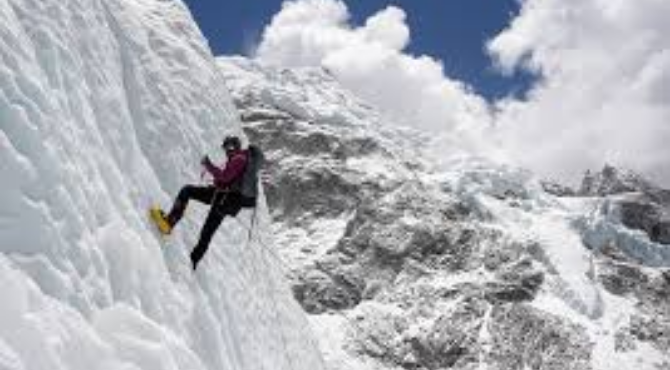
Pakistan(National Times)- PARIS: On May 16, 1975, Japan’s Junko Tabei became the first woman to climb to the top of Mount Everest. Half a century later, the world’s highest mountain is set to record its thousandth ascent by a woman. Scaling the 8,849 metre-high (29,032-foot-high) peak has mainly been a male achievement. By May 2025 women had reached the top 962 times, while men had got there 11,955 times, according to an AFP analysis of figures from the Himalayan Database.
Won´t be limited
When Tabei reached the peak of Everest in 1975, 38 men had preceded her. With her all-woman team, she had struggled to find sponsors for her expedition, often being told that they would be better off looking after their children. “All men limit our likes and I do not want to be limited,” Tabei wrote in her notebook upon her return. 11 days later, a Tibetan woman, Phantog, reached the peak from the opposite side. She believed she had got there first, only learning that she had been pipped at the post by Tabei after she completed her descent. In her notebook, Tabei laid out her next objectives: climb K2, the world´s second highest peak, and return to work for a scientific journal.
Few women sherpas
Since then, Everest has been climbed by 870 different women of 85 different nationalities, some having succeeded several times. After Nepali climbers, the United States, India and China have sent the most men to the summit — and sent 39 percent of the women. The sherpas, the Nepali guides who accompany their clients up Everest, are almost all men. Everest’s home Nepal accounts for half of the ascents by men, but only 9% of those by women: 90 ascents by 66 different women. Dawa Yangzum Sherpa, who climbed in 2012, is currently the only woman to be a certified Nepali guide who received an international diploma in 2018. “This is a challenging field, even more so if you are a girl. There were people who said this is not a girl’s job, that I won’t get work,” she told AFP. Before her, Pasang Lhamu in 1993 became the first Nepali woman to reach the top of Everest. During her descent she remained back with a colleague who was suffering from altitude sickness and both died of exhaustion. She became a national heroine and the trek from base camp at Everest today starts with an arch paying tribute to her. Her successor Lhakpa Sherpa, the second Nepali woman to reach the summit in 2000, has since claimed the female record for the number of ascents: by May she had done 10.
No oxygen
13 years after Junko Tabei, New Zealand´s Lydia Bradey became in 1988 the first woman to reach the summit without an oxygen bottle, a respiratory aid which compensates for the effects of altitude. As she made the ascent on her own, the other members of her expedition returned to the Nepal capital Kathmandu, where they publicly cast doubt on her success. Facing being thrown out for having taken another route than that allowed by her permit, Bradey decided not to claim her achievement at the Nepali tourism ministry, but it was recognised years later. When women and men are taken together, only 229 ascents, or less than 1%, succeeded without oxygen. Bradey and only nine other women are on the list.
Women better prepared
“This is a different ball game from climbing with supplemental oxygen. Maybe women are a little bit more aware of that,” Germany´s Billi Bierling, the director of the Himalayan Database which tracks expeditions to the top of Everest, told AFP. “Women are often better prepared and when it comes to taking risks on the mountain, they´re probably a little bit more conservative. So maybe a woman by herself says, ´you know what, this is too dangerous, I go down´, whereas a male climber, would still go,” the woman who climbed Everest in 2009 said. So while only 66% of the hundred or so women who make the attempt every year succeed, against 75% for men, their fatality rate is lower: a woman dies on the slopes of Everest every 153 tries, a man every 70 attempts. While women are still in a minority at the top of Everest, the ratio of women getting there is increasing: they were one to 16 men in the 2000s, and one to 10 two decades later. “I have now so many friends who are unmarried and without children, and also they earn more money, so they can go out and go to 8,000 peaks,” Bierling said. The cost of the ascent varies from $45,000 to $200,000.