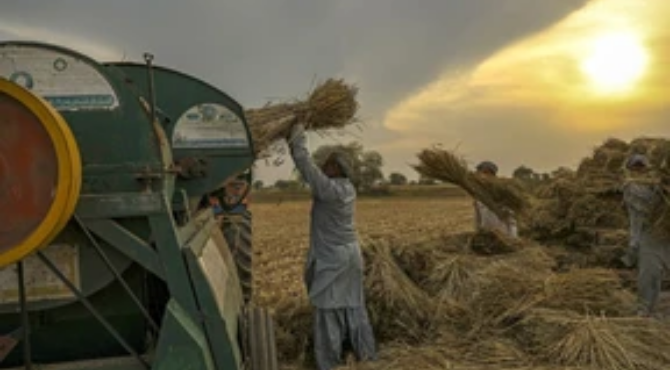

Pakistan(National Times)- India’s unprecedented decision to halt a long-standing water-sharing pact, the Indus Water Treaty, following a recent attack in Kashmir could impact Pakistan’s agriculture and energy production, particularly as the region heads into the intense pre-monsoon heat, a Bloomberg report stated. Experts in agriculture and diplomacy believe the effects may not be immediate, as India currently lacks the infrastructure to significantly divert water flows, The News reported. Pakistan, meanwhile, has rejected the move, calling it a violation of the 1960 accord, which it says does not permit unilateral alterations to the treaty. “There is a protocol in the treaty, an arbitration code, and there are guarantors” like the World Bank and the UN that mediate any issue between the two countries, said Syed Imran Ahmed, director at Panjwani Hisaar Water Institute in Karachi. But the impact on one of the largest irrigation systems in the world could still be significant. Any disruption to the flow of water, and even its timing, could upset planting schedules in Pakistan’s agriculture sector, which accounts for a quarter of GDP and employs nearly 40% of its people. The country also gets a third of its electricity from hydropower. India’s move also comes as the region moves into what is forecast to be a sweltering summer. The southern part of Pakistan is already experiencing higher-than-normal temperatures — hitting 41C (105F) in the port city of Karachi this week — and hot and dry conditions are expected to persist for days, according to the country’s meteorological department. “This is a larger political statement by India. Much would depend on how Pakistan responds to it,” said D Suba Chandran, a professor at India’s National Institute of Advanced Studies. “If India has to divert the water, India will have to invest in building dams, invest in building canals with an objective to divert the water. That will not take place immediately.” Still, the system was never built to be switched on and off at will, Hassaan F Khan, an assistant professor of Urban and Environmental Policy and Environment Studies at Tufts University, wrote in Pakistan’s Dawn newspaper. “The flows of the Indus, Jhelum and Chenab are the backbone of our agriculture, our cities, our energy system. At this moment, we simply do not have a substitute for these waters.” The Indus Waters deal gives New Delhi control of the Indus basin’s three eastern rivers, while downstream Islamabad controls the three western ones. Both countries are obligated to allow each other to use a portion of their waters and build infrastructure under certain conditions. India has previously called for a renegotiation of the treaty, arguing that Pakistan currently enjoys use of up to 80% of the basin’s water. Until now, the pact has withstood decades of animosity — including three wars — between the nuclear rivals. It has been wielded by India as a threat in the past, though, including in 2016, after an attack on an Indian army base in Kashmir. At the time, Indian Prime Minister Narendra Modi threatened to restrict water under upstream India’s control, saying “blood and water cannot flow together”. He did not follow through. “India’s suspension of the Indus Waters Treaty marks a dangerous escalation & an attempt to turn a lifeline into leverage,” Pakistani politician Umar Rehman Malik said on X. “Breaching it is not just a violation, but it is a hostile act that threatens regional stability and sets a perilous precedent.”
Pakistan’s crops at risk after India suspends water treaty: report