

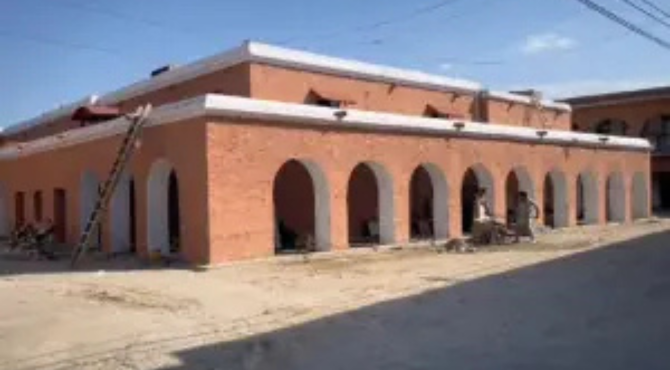
BANNU(National Times)- A significant landmark from the British colonial era, which had remained neglected and in a state of decay for decades, has now been restored to its former grandeur through an extensive conservation and renovation project.
Built in 1852, the historic British compound (deputy commissioner’s compound) in Bannu has regained its original identity and historical significance.
The compound was constructed during the tenure of British officer John Nicholson in 1852. At the time, it served as the principal administrative and judicial centre for the southern districts, where government affairs were conducted, court proceedings were held and tribal jirgas were convened.
Comprising courthouse, judicial buildings, jirga hall, guardhouse and other government offices, the historic complex remained the administrative heart of the region for nearly two centuries and stands today as one of the most important architectural legacies of the colonial period in the Indian subcontinent.
According to Bannu division commissioner Khalid Mahmood, the restoration project was completed at a cost of Rs138.4 million, fully funded by the Khyber Pakhtunkhwa government. He said that the objective of the project was to preserve the region’s historical heritage while restoring the buildings for official government use.
“The Bannu historic compound is far more than a collection of bricks and stones,” the commissioner said. “It represents an important chapter in the administrative history of the subcontinent. Its restoration is not only an effort to revive the past but also a practical step toward preserving our historical heritage for future generations,” he said.
Senior employee Kifayatullah from the commissioner’s office Bannu explained that during British rule, Bannu served as the administrative headquarters for what is now southern Khyber Pakhtunkhwa, from where the affairs of the entire region were managed.
Following the creation of Pakistan, the historic buildings suffered decades of neglect and inadequate maintenance. As a result, their condition steadily deteriorated, leaving much of the complex in ruins.
Several months ago, the divisional administration initiated a comprehensive restoration programme aimed at reviving the long-abandoned heritage site. The project included structural repairs, conservation work and extensive renovation while carefully preserving the compound’s original architectural character.
With the restoration now complete, the 19th-century buildings have been equipped with modern facilities without compromising their historic design.
Today, the harmonious blend of historic architecture and modern amenities has transformed the compound into an attractive destination for visitors, historians and heritage enthusiasts alike.
More importantly, it serves as a bridge connecting younger generations with their past, culture, and historical identity.