
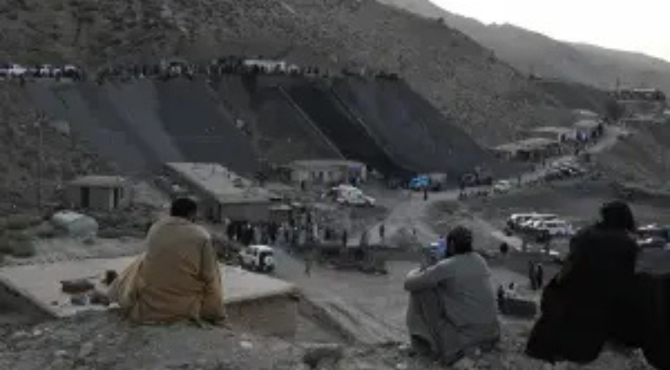
SHANGLA(National Times)- Residents and relatives of the coal miners killed in a deadly mine explosion in Quetta on Saturday blocked the Bisham-Swat Road, along with civil society members, demanding a transparent inquiry into the tragedy and employment opportunities for the local youth.
The protest, organised by Shangla Coal Mine Workers Association (SCMWA), coincided with the arrival of the victims’ bodies from Balochistan.
A number of people gathered at Bada Gata before accompanying the bodies to their native villages for burial.
The demonstrators accused the mining company of negligence and urged the Balochistan government to conduct a fair investigation into the incident that claimed 34 lives.
Carrying placards and chanting slogans, protesters criticised the area’s elected representatives, alleging that successive governments had failed to create employment opportunities in Shangla, forcing residents to seek work in hazardous coal mines in Balochistan.
They said unemployment had compelled generations of young men from the district to work under dangerous conditions to support their families, while recurring mining accidents continued to claim lives.
Twenty-six miners belonging to Shangla were laid to rest in their ancestral graveyards in the Mian Kalay, Kana and Bely Baba areas after their bodies were brought from Balochistan. Two others were likely to arrive on Saturday night. Emotional scenes were witnessed as several families buried more than one relative.
Addressing the gathering, SCMWA leaders Ali Bash Khan and former senator Rahat Hussain demanded that those responsible for negligence be held accountable.
They said repeated mining disasters had left dozens of families in Shangla without breadwinners and urged the federal and provincial governments to formulate policies to provide safer working conditions for miners and create alternative sources of employment in the district.
The speakers said Shangla remained one of the country’s most underdeveloped districts, where limited economic opportunities had forced a large number of residents to migrate to coalfields in Balochistan to earn a livelihood.
They also called for adequate compensation and long-term support for the families of the deceased miners.
Opposition Leader in the Khyber Pakhtunkhwa Assembly, Ibadullah Khan, MPA Abdul Munim and others, who were also present on the occasion, promised early compensation for the victims’ heirs.
Twenty-eight coal miners, who died in the mine incident in Quetta, were from the Shangla district, and 23 of them from Mian Kalay village.
Shangla has long been a major source of Pakistan’s coal mine workforce, with thousands of its residents employed in mines across Balochistan.
Fatal mining accidents have repeatedly claimed the lives of workers from the district, prompting recurring demands for improved safety standards and employment opportunities closer to home.