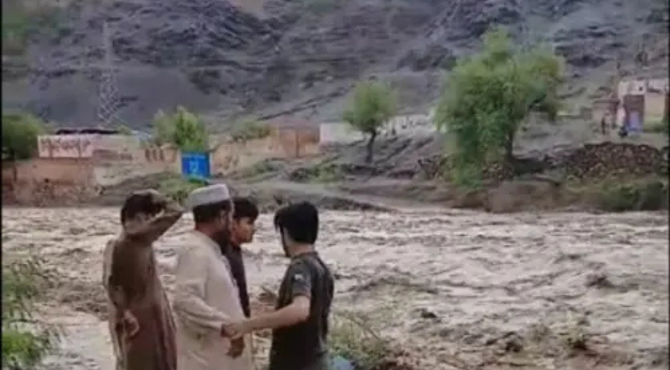

LAHORE/MUZAFFARABAD(National Times)- The River Chenab swelled to nearly 180,000 cusecs after torrential rains triggered flash floods in India-occupied Kashmir, killing at least 11 people, with the Flood Forecasting Division (FFD) of the Pakistan Meteorological Department forecasting low to medium flooding in the river at Marala and the River Ravi at Jassar over the next 24 hours.
Meanwhile, a woman and her two children were killed in the early hours of Sunday after a massive landslide triggered by heavy rainfall buried their house in a village in Kotli district of Azad Jammu and Kashmir (AJK).
The influx pushed the River Chenab into the medium flood category, according to a senior official of the Punjab Irrigation Department.
He said India had not provided Pakistan with prior information on upstream river flows.
The FFD warned that an approaching westerly wave, coupled with a strong monsoon system expected to remain active from July 20 to 24, could significantly increase flows in all major rivers. It forecast high flooding in the River Chenab at Marala, the River Jhelum upstream of Mangla, and in the associated nullahs of the Jhelum, Chenab and Ravi river systems.
The nullahs likely to be affected include Dora, Dotta, Dowara, Bhimber, Halsi, Aik and Palkhu in the Chenab basin, and Bein, Basanter, Deg and Sakki in the Ravi basin.
The FFD also warned of high flows in the River Kabul and its tributaries, flash flooding in the hill torrents of Dera Ghazi Khan, streams in Khyber Pakhtunkhwa and northern Balochistan, and urban flooding in several Punjab cities, including Rawalpindi, Jhelum, Gujranwala, Sargodha, Khushab, Sialkot, Gujrat, Narowal, Lahore, Okara, Sahiwal, Bahawalnagar and Faisalabad.
“Sunday was a surprising day for us, as we unexpectedly received a massive volume of water from India due to torrential rainfall in India-occupied Kashmir, raising the Chenab’s flow to around 180,000 cusecs for nearly two to three hours,” a senior Punjab Irrigation Department official told Dawn.
“Even at around 9pm, the river was still carrying about 155,000 cusecs, which means it remains in the medium flood category,” he added.
Responding to a question, the official said Pakistani authorities had received no information from India regarding upstream water flows or expected rainfall. “We were expecting rainfall there from July 21 onward, but the surge came unexpectedly,” he said.
According to the Wapda daily report, inflows and outflows at Tarbela Dam on the River Indus were recorded at 196,300 cusecs and 195,500 cusecs, respectively.
On the River Kabul at Nowshera, both inflows and outflows stood at 31,700 cusecs, while at Khairabad Bridge, inflows and outflows were 216,500 cusecs each.
At Mangla Dam on the River Jhelum, inflows were 29,400 cusecs and outflows 14,000 cusecs. At Head Marala on the River Chenab, the report recorded inflows of 74,000 cusecs and outflows of 50,000 cusecs at 6am on Sunday, before the later surge.
The report recorded inflows and outflows at major barrages, with Jinnah Barrage receiving 228,400 cusecs and releasing 220,400 cusecs, while Chashma Barrage recorded inflows of 227,000 cusecs and outflows of 225,000 cusecs. At Taunsa Barrage, inflows stood at 212,700 cusecs and outflows at 186,200 cusecs, whereas Guddu Barrage recorded 163,800 cusecs inflow and 122,900 cusecs outflow. Sukkur Barrage received 111,300 cusecs and released 54,500 cusecs.
Meanwhile, Kotri Barrage recorded inflows of 43,200 cusecs with no outflow, while Trimmu Barrage and Panjnad Barrage recorded inflows of 14,000 cusecs and 13,200 cusecs, respectively, with no outflows reported.
The report also noted reservoir levels, stating that the Tarbela Dam was at a present level of 1,505.11 feet against its minimum operating level of 1,402 feet and maximum conservation level of 1,550 feet, with live storage recorded at 3.204 MAF.
The Mangla Dam stood at 1,174 feet, compared with a minimum operating level of 1,050 feet and maximum conservation level of 1,242 feet, with live storage of 2.777 MAF. The Chashma Reservoir was at 641.60 feet, against a minimum operating level of 638.15 feet and maximum conservation level of 649 feet, with live storage of 0.055 MAF.
“The inflows and outflows at Tarbela, Jinnah and Chashma on the River Indus, the River Kabul at Nowshera, and the River Jhelum at Mangla represent the mean flows over the previous 24 hours, whereas the remaining river flows were recorded at 6am on Sunday,” the Wapda report said.
AJK landslide kills three
A woman and her two children were killed in the early hours of Sunday after a massive landslide triggered by heavy rainfall buried their house in a village in Kotli district of Azad Jammu and Kashmir.
Khaleeq Masood, an official in Nakyal, told Dawn by telephone that incessant rainfall triggered the landslide, sending a huge mass of earth crashing onto a house in Hitli village and trapping all six members of a family beneath the debris.
Residents launched a rescue operation and, after nearly one-and-a-half hours of efforts, managed to pull all six family members from the rubble, he said. However, Nasreen Akhtar, 40, wife of Muhammad Shafiq, and their two children — Afza Shafiq, 14, and Ayan Shafiq, 12 — died in the incident.
Shafiq and the couple’s two other children sustained injuries and were shifted to the Tehsil Headquarters Hospital, where doctors said their condition was out of danger.
In Neelum Valley, a cloudburst-triggered flash flood caused widespread damage to houses, shops, vehicles and public infrastructure, although no casualties were reported.
Deadly floods in held Kashmir
In the meantime, at least 11 people were killed, and seven others remained missing after torrential rains triggered flash floods and landslides in India-occupied Jammu and Kashmir on Sunday, officials said.
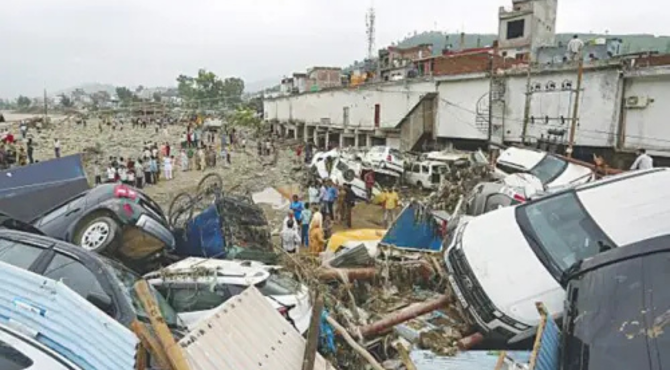
According to TRT World, the worst-hit area was Surankote, near the Line of Control in Poonch district, where a landslide buried a house, killing five people, while rescue teams searched for survivors. Four members of another family remained missing after floodwaters swept away their home.
Heavy rain also caused houses to collapse and rivers to overflow, while dozens of vehicles were swept away or submerged in Poonch and neighbouring Rajouri district, forcing residents to evacuate low-lying areas.