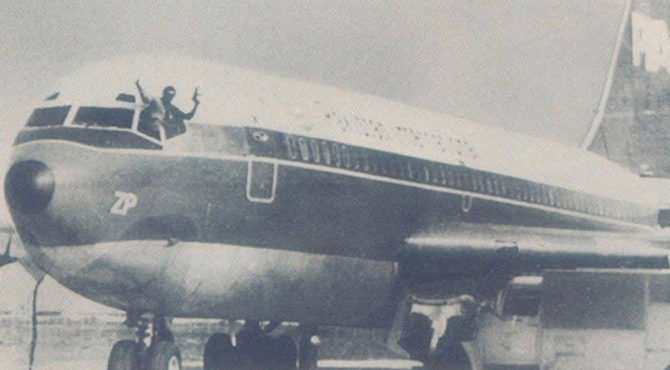

“The plane will appear any minute,” my brother said excitedly, glancing at his watch and scanning the skies over Peshawar. For a 13-year-old boy growing up in 1981, my older brother seemed unusually well-informed about current events, thanks largely to the pocket AM radio he carried everywhere. This time, however, his excitement was more personal, tied to a dramatic and chilling episode that had captured national attention: the hijacking of a PIA flight by members of the Al-Zulfiqar Organisation.
I remember it vividly. A bulky Boeing 707 appeared, descending through the gloomy and overcast skies of a rainy Peshawar evening as it made its final approach to land. Clutching our bicycles, we watched from the top of the double-decker barracks near the old CSD overlooking Khyber Road. My brother had chosen this vantage point, convinced it offered the best view. Our home on Qasim Road, near the U.S. Consulate, was just a minute’s ride away.
“Do you know it’s taken fourteen days for this flight from Karachi to reach Peshawar?” he said, slipping into his habit of explaining everything to me.
Indeed, Flight PK-326 had been hijacked en route to Peshawar and diverted to Kabul. Negotiations with the hijackers dragged on for two excruciating weeks. The tragedy that unfolded stayed in my memory from childhood. It connected me to the events in a strange way.
Just a week before the hijacking, my family had travelled to Karachi for my uncle’s wedding. My mamoo, Khalid Khan a PIA pilot, had among his closest friends First Officer Junaid Yunus, the co-pilot of the ill-fated flight. He was son of late Dr Yunus, an eye specialist of Peshwar. I was a little kid at the time, and Junaid Yunus, a jovial and friendly presence at the wedding, had been especially kind to me. When news of the hijacking broke on PTV’s ‘Khabarnama’, I was thrilled to recognise his name. But my brother quickly shushed me, explaining the seriousness of the situation.
In those days, information was tightly controlled. The Zia-era censorship ensured that only fragments of news trickled out. While PTV gave some information, my brother’s reliable AM radio became our lifeline, delivering updates as the drama unfolded.
The hijackers had singled out Major Tariq Rahim, a former ADC to Prime Minister Zulfikar Ali Bhutto, mistakenly believing him to be the son of General Rahimuddin Khan, a key figure in Zia’s administration. Their demands for the release of PPP activists were initially rejected, and in a tragic escalation, Major Tariq Rahim was executed, his body callously thrown onto the tarmac at Kabul Airport.
Major Tariq Rahim’s death hit close to home, literally. He lived in the Qazis’ compound on Fort Road, and his family was acquainted with ours. I accompanied my parents to his funeral, a sombre and surreal experience that brought the gravity of the hijacking into sharp focus for my young mind.
As the crisis continued, another family connection emerged. My khalu, Capt M. Ahmad, a senior PIA pilot, was also involved, though briefly, in the negotiations from the air traffic control room in Karachi. These personal ties made the national tragedy feel close — too close.
When the hijacking finally ended, images of First Officer Junaid Yunus emerged in the media. He looked unkempt, sporting a beard that hinted at the ordeal he had faced. His interviews turned him into an unlikely celebrity, and his resilience inspired admiration.
A few weeks later, my brother and I attended the APWA Fun Fair held at the PAF grounds inside the Peshawar Air Headquarters base. Among the crowds, we spotted a smartly dressed young man. It was none other than Junaid Yunus, who recognised us. Within moments however, he was surrounded by a crowd of admiring women, quickly vanishing from view in the crowd. That fleeting encounter remains in my memory as the last time I saw him.
The ill-fated Boeing was eventually grounded and decommissioned and placed on display at the FunLand amusement park in Karachi, where I saw it months later. Somebody mentioned that its identification initials, Z.P., were grimly referred to as “Zalim Parinda” within PIA circles
About Major Tariq Rahim
Major Tariq Rahim, son of Maj Gen Kazi A Rahim of Peshawar, and an alumnus of Edwardes College and the College of Engineering, University of Peshawar, was a man of exceptional talent. A gold medallist in his first year of electrical engineering, he left his studies to join the 39th PMA Long Course, graduating as a JUO from the Royal Military Academy Sandhurst in UK, where he earned the prestigious Overseas Cane. He later became ADC to PM Zulfikar Ali Bhutto and was selected for a one-year course in International Law & Diplomacy at Harvard in order to join Foreign Service. However, the political upheaval following General Zia’s coup altered his trajectory, and caused him to cancel his US course. He joined the Foreign Service directly in 19 grade and was later appointed First Secretary to Tehran.
On 6 March 1981, the fifth day of the hijacking, Tariq Rahim’s life was tragically cut short. His sacrifice remains a sad reminder of the human cost of political strife. A road in Peshawar Cantonment, formerly known as Willcocks Road, was renamed Tariq Road in his honour.
Reflecting on that rainy evening in 1981, I realise how these events shaped my understanding of the world around me- – a world where personal stories intertwined with history in ways that felt both profound and emotional. It was an era when radios crackled with news, and state-run television offered glimpses of distant events. But for a boy standing atop a barracks roof, watching a hijacked plane descend against the dark rainy skies of Peshawar, it was also a moment that became unforgettable.
Peshawar 1981: PIA Hijacking – A Childhood Memory