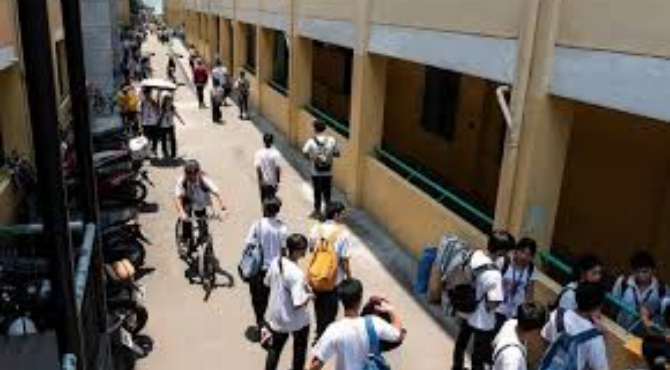

Pakistan(National Time)- Soaring temperatures shut down schools in nearly half the Philippine capital on Monday, local officials said, as the torrid dry season started in the tropical Southeast Asian country. A national weather service advisory warned the heat index, a measure of air temperature and relative humidity, was set to reach “danger” levels in Manila and two other areas of the country. “Heat cramps and heat exhaustion are likely” at that level, the advisory said, warning residents in affected areas to avoid prolonged exposure to the sun. A heat wave struck large areas of the Philippines in April and May last year, leading to almost daily suspensions of in-person classes, affecting millions of students. Manila’s temperature hit a record 38.8 degrees Celsius (101.8 degrees Fahrenheit) on April 27 last year. While temperatures were only expected to hit 33°C on Monday, local governments in Manila and six other districts ordered classrooms closed as a precaution. The capital region has a student population of more than 2.8 million according to education department data. In Manila’s Malabon district, education department official Edgar Bonifacio said the suspensions affected more than 68,000 students across 42 schools. “We were surprised by the heat index advisory,” Bonifacio told AFP, adding: “We cannot feel the heat yet outside.” However, due to protocols adopted during last year’s heat wave, the district’s school superintendent recommended suspending in-person classes. “Our main concern is we’re near the end of the school year (in mid-April),” Bonifacio said. “This would mean a reduction of the number of school days available.” In Valenzuela district, school official Annie Bernardo told AFP its 69 schools had been instructed to shift to “alternative” learning models, including online classes. Global average temperatures hit record highs in 2024 and even briefly surpassed the critical 1.5°C warming threshold. In January, UN children’s agency Unicef said extreme weather disrupted the schooling of about 242 million children in 85 countries last year, including the Philippines, with heat waves having the biggest impact. Human activity, including the unrestricted burning of fossil fuels over decades, has warmed the planet and changed weather patterns. That has meant wetter wet periods and dryer dry periods, intensifying heat and storms and making populations more vulnerable to disasters.
Heat wave shuts down schools in nearly half Philippine capital