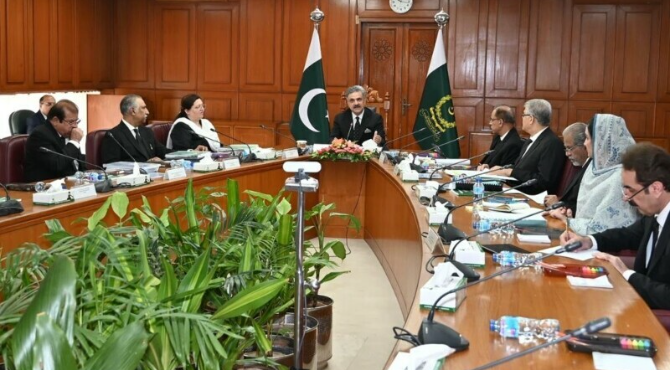

ISLAMABAD(National times)- The National Judicial Policy Making Committee (NJPMC) has agreed to establish an effective institutional response to cases of enforced disappearances. The Committee unanimously reiterated its resolve to strengthen institutional capacity, accelerate access to justice, and ensure efficient and effective justice delivery. Chief Justice of Pakistan Yahya Afridi chaired the 56th meeting and it was attended by all chief justices of high courts and Chief Justice of the Federal Constitutional Court, Justice Amin-ud-Din Khan, discussed important measures aimed at improving the country’s legal system. A new mechanism was also decided upon to ensure that individuals arrested are presented before a magistrate within 24 hours. This move aims to strengthen accountability and safeguard human rights. The NJPMC also decided to introduce a Commercial Litigation Corridor to speed up the resolution of commercial cases. Additionally, the formation of a screening committee within the Federal Board of Revenue (FBR) was agreed upon, along with measures to eliminate unnecessary cases. The meeting emphasized strict adherence to established timelines for case resolutions. According to the committee’s statement, Lahore High Court set a record by disposing of over 465,000 cases. Furthermore, the committee praised the Peshawar High Court for its handling of inheritance cases and recommended that all pending inheritance cases dating back to 2019 be resolved within 30 days. The committee also acknowledged the positive performance of Model Trial Courts, with Lahore High Court being commended as a leader in this regard. Recommendations for reforms in district judiciary were set to be completed within 30 days. Moreover, discussions were held on prison reforms, with a decision to consult with provincial governments for implementation. Regarding technological advancements, the NJPMC approved the development of national guidelines for the use of artificial intelligence (AI) in the judicial system. The committee also authorized the immediate commencement of e-filing across all district courts. The Sindh High Court’s efforts in e-filing were specifically praised. The meeting gave a nod to the establishment of Women and Family Facilitation Centers and the allocation of over Rs2.58 billion for the Access to Justice Fund. Furthermore, it was decided that provincial governments would be tasked with securing additional funds for the solarization of courts across the country.
Top judicial body resolve to strengthen institutional capacity, accelerates access to justice