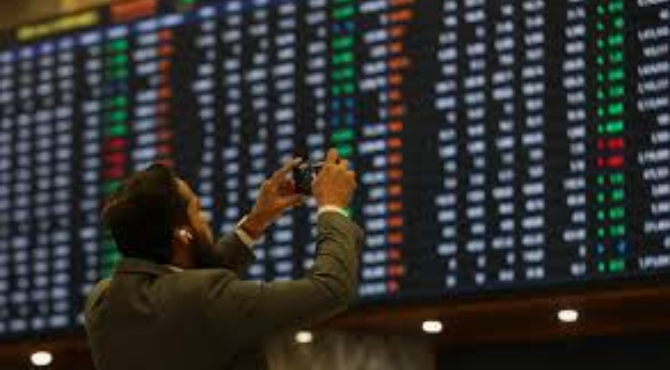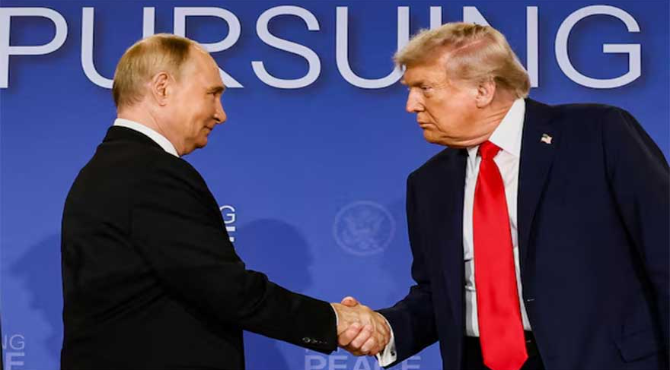

Web Desk(National times)- Pakistan has claimed the top spot globally for equity market performance in US dollar terms over the past year, a standout economic achievement, The News reported. India, meanwhile, has slipped behind regional and emerging market peers as tariff hikes triggered sector-wide sell-offs, foreign investor withdrawals and weaker market confidence. The Sensex delivered only a 3.2% return in USD during FY25, far short of Pakistan’s strong gains. If the Alaska summit falters, US President Donald Trump vows to further intensify tariffs beyond 50%, which could slow India’s real GDP by 0.3-0.6 percentage points. This would heighten export losses, particularly in textiles and apparel, widening trade imbalances and straining weaker export-oriented sectors. The risks to employment and small and medium enterprises (SMEs) viability would also increase. “Pakistan’s equity market indeed led globally in USD terms, especially when considering the two-year cumulative returns. During fiscal year 2024-25 (FY25), Pakistan’s benchmark KSE-100 Index delivered a 55.5% return in US dollar terms and 58.6% in Pakistani rupee terms,” the bourse experts said while quoting fact-based data. Pakistan ranked third globally behind Ghana and Slovenia and was eighth-best in FY25 alone, according to Bloomberg — as a single year’s performance. But over the two-year period (FY24 and FY25), Pakistan emerged as the world’s best-performing equity market in USD terms. “So yes, especially looking at the two-year cumulative picture, Pakistan did top the global charts in USD terms,” they said. Pakistan’s performance outpaced many markets, including India’s. For FY25, Pakistan significantly outperformed India’s BSE Sensex, which returned just 3.2%, as per AHL data. In Asia, the KSE-100 beat regional markets like China (+14.8%) and India (+6%) in terms of returns. Indian markets have been under pressure due to concerns like tariffs, foreign investor outflows and slowing earnings, leading to multi-week losing streaks and cautious sentiment. India performed modestly and faced headwinds in 2025 — and trailed Pakistan in USD-based equity performance. India, while underperforming and showing signs of stress, was not necessarily at its lowest ebb. Domestic investment and some forward-looking optimism suggest there’s still potential for recovery. According to Indian newspapers, when India’s export tariffs began increasing — from 25% initially to a total of 50%—Indian equity markets reacted sharply. On August 7, 2025, Sensex fell 492 points ( 0.61%) and Nifty dropped 156 points ( 0.64%). Later that day, Sensex slid 671 points ( 0.84%) to 79,867, and Nifty declined 208 points ( 0.85%) to 24,362 — with all sectors in the red. Moody’s warned that the tariff hike could derail India’s manufacturing ambitions, hurt its ability to attract investments, and weigh on growth—citing over $900 million in FII outflows in August alone, after $2 billion in July. Sensex and Nifty dropped ~2.9% in July. However, amid US support during tariff tensions, on July 31, following Trump’s announcement of increased tariffs on Indian goods, Pakistan’s equity market rallied as the KSE-100 rose by about 1.3% (roughly 1,800 points). This was driven by investor optimism around a US pledge to help develop Pakistan’s massive oil reserves. The latest credible analysis indicates potential economic losses India may face if the Alaska summit between Trump and Putin fails — leading to further US tariff escalation against India (already at 50%) — along with broader economic implications. Moody’s Ratings warns that the 50% tariffs could slow India’s real GDP growth by around 0.3 percentage points, reducing forecasts from ~6.3% for FY2025–26. Barclays estimates slightly smaller effects: a 30 basis point (0.3 percentage point) drag on GDP growth, highlighting the economy’s resilience due to its strong domestic demand. Other economic studies suggest national GDP could be reduced between 0.1% to 0.6%, depending on the duration and breadth of the tariff measures. Tariffs now affect 55% of US-bound Indian shipments, hitting vital export sectors like textiles, jewelry, apparel and footwear. This could lead to up to 70% reductions in these goods’ competitiveness in the US market. The apparel sector alone could lose around $5 billion over seven months in export revenues. Analysts warn that labor-intensive manufacturing and MSMEs will be especially vulnerable — potentially leading to job losses, weakened foreign exchange inflows and dampened investor sentiment. India’s merchandise trade deficit rose to an eight-month high of $27.35 billion in July 2025, ahead of tariff enforcement—signaling rising import bills and sluggish export growth.
Pakistan tops global equity rankings in US dollar returns