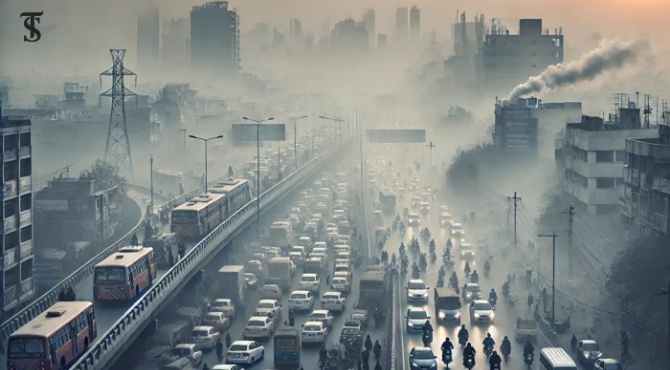

Pakistan(National Times)- The Chinese capital Beijing has drastically reduced its air pollution in 10 years by cutting its PM 2.5 pollution by 64%, harmful nitrogen dioxide by 54% and toxic sulphur dioxide by 89% in 2013, as per a report by the World Economic Forum. Considering its effective efforts, many countries are following Beijing’s lead. Amid this, the same air pollution curbing step guide may assist neighbouring Pakistan as well considering that the South Asian country is dealing with this extreme crisis since the past month. It is worth noting that Beijing has increased the number of “good air days” from just 13 in 2013 to more than 300 in 2023. The Chinese capital has come a long way since the first decade of the 21st century when its smog level was highest in the world. According to the United Nations, no other city has achieved such a rapid shift. Pakistan, especially Punjab’s capital Lahore, on the other hand, has been shrouded in a dense layer of hazardous smog for much of November, intensifying health concerns for its residents. The pollution peaked on November 14. Data from the Swiss air-quality monitoring organisation, IQAir, revealed the city’s Air Quality Index (AQI) skyrocketed to an unusually high and hazardous 1,110, and tiny particulate matter, or PM2.5, reached a staggering 632 micrograms per cubic metre of air. Stubble burning has been a significant contributor to this year’s smog in Pakistan. Farmers set fire to the stubble of harvested crops to clear fields for the next planting season. The practice, combined with unfavourable meteorological conditions, unleashed smoke and pollution over the region. Additionally, authorities reported thousands of fire incidents in Punjab’s areas, adding to already alarming pollution. While authorities vowed to take relevant and effective measures to tackle the air pollution and smog dilemmas in Lahore and other cities, certain help can be taken from the Chinese capital. In order to tackle the air pollution problem, Beijing built a high-density three-dimensional air-quality system, which combines 1,500 PM2.5 sensors throughout the city with high-res satellite remote sensing and laser radar. In addition to this, it also introduced strict emission controls on coal-fired power plants as well as phased out older, more polluting vehicles from the roads and expanded the public transport system. All of these measures were taken while the city continued to boom economically growing its GDP 6.8% a year.
What steps can Pakistan learn from China to tackle air pollution?