

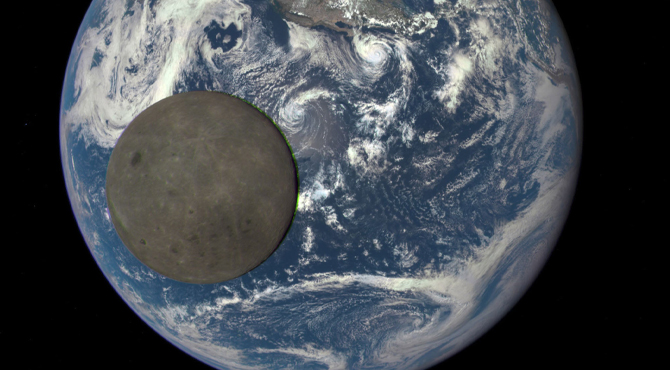
Beijing (National Times) China’s unmanned Chang’e 6 spacecraft has successfully landed on the Moon in a landmark mission to collect soil and rock samples from the far side of Earth’s natural satellite, the China National Space Administration has announced. The probe landed in a pre-selected area in the northeastern part of the South Pole-Aitken basin at 6:23am Beijing time on Sunday.
The lander is expected to go through initial checks and then start gathering samples from the lunar surface using its robotic arm. If successfully returned, it would provide scientists with the first samples from the Moon’s little-explored dark hemisphere, which always faces away from the Earth.
The mission is expected to last around 53 days, the Chinese space agency said in a statement. It also shared stunning footage filmed by the spacecraft during the final moments of landing.
The probe, which was launched on May 3, is the sixth in the Chang’e Project – the Chinese Lunar Exploration Program – and the second intended for bringing back samples. Its predecessor, Chang’e 5, brought back rocks from the Moon’s near side in 2020, which led to surprising findings about the celestial body as the samples turned out to be much younger than those retrieved by the US Apollo and Soviet Luna missions 50 years ago.
Scientists say the samples gathered by the Chinese probe could lead to important discoveries about the Moon’s history and evolution, especially as its two hemispheres greatly differ from each other, at least on the surface. For instance, the near side is covered in volcanic seas, which are rare on the far side for reasons that remain unknown.
“First-hand, direct samples from the Moon’s far side are essential to giving us a deeper understanding of the characteristics and differences of the two sides of the Moon, and to revealing the secrets of the Moon,” Zeng Xingguo, a scientist at the National Astronomical Observatories of the Chinese Academy of Sciences, told Xinhua upon the launch of Chang’e 6 last month.
Quentin Parker, an astrophysicist from the University of Hong Kong, noted that the specifics of the landing location could also provide additional clues into the Moon’s history.
“Samples from the South Pole-Aitken basin may also contain ancient materials ejected from deep within the mantle by the enormous impact that created the basin itself, which may tell us about the state of the Moon when it was first formed around 4.5 billion years ago,” he told the South China Morning Post.