

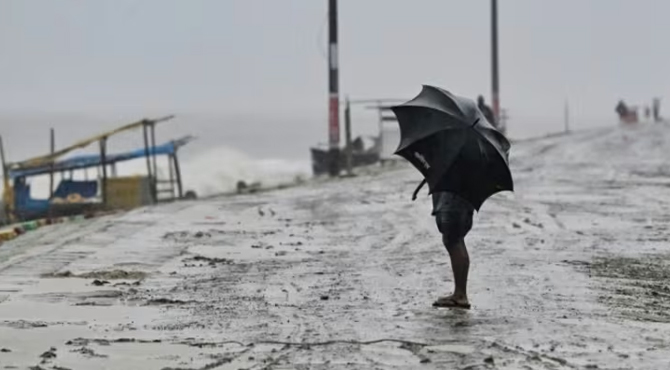
Dhaka (National Times) An intense cyclone smashed into the low-lying coast of Bangladesh on Sunday, with nearly a million people fleeing inland for concrete storm shelters away from howling gales and crashing waves.
“The severe Cyclone Remal has started crossing the Bangladesh coast,” Bangladesh Meteorological Department Director Azizur Rahman told AFP, adding the raging storm could continue hammering the coast until at least the early hours of Monday morning.
“We have so far recorded maximum wind speeds of 90 kilometres per hour, but the wind speed may pick up more pace.” Forecasters predicted gusts of up to 130km/h, with heavy rain and winds also lashing neighbouring India.
Authorities have raised the danger signal to its highest level.
Cyclones have killed hundreds of thousands of people in Bangladesh in recent decades, but the number of superstorms hitting its densely populated coast has increased sharply, from one a year to as many as three, due to the impact of climate change.
“The cyclone could unleash a storm surge of up to four metres above normal astronomical tide, which can be dangerous,” Bangladeshi senior weather official Muhammad Abul Kalam Mallik told AFP.
Most of Bangladesh’s coastal areas are a metre or two above sea level and high storm surges can devastate villages.
“We are terrified,” said 35-year-old fisherman Yusuf Fakir at Kuakata, a town on the very southern tip of Bangladesh along the predicted route of the storm, speaking just before its arrival. While he had sent his wife and children to a relative’s home inland, he stayed put to guard their belongings.
At least 800,000 Bangladeshis fled their coastal villages, while more than 50,000 people in India also moved inland from the vast Sundarbans mangrove forest, where the Ganges, Brahmaputra and Meghna rivers meet the sea, government ministers and disaster officials said.
“We want to ensure that a single life is not lost,” said Bankim Chandra Hazra, a senior minister in India’s West Bengal state.
As people fled, Bangladeshi police said that a heavily laden ferry carrying more than 50 passengers — double its capacity — was swamped and sank near Mongla, a port in the expected path of the storm.
“At least 13 people were injured and were taken to a hospital,” local police chief Mushfiqur Rahman Tushar told AFP, adding that other boats plucked the passengers to safety.
A young man drowned in rough seas at Kuakata on Sunday afternoon, district government administrator Nur Kutubul Alam told AFP.
Bangladesh’s disaster management secretary Kamrul Hasan said people had been ordered to move from “unsafe and vulnerable” homes. “At least 800,000 people have been shifted to cyclone shelters,” Hasan said.
The authorities have mobilised tens of thousands of volunteers to alert people to the danger but local officials said many people stayed home as they feared their property would be stolen if they left.
He said around 4,000 cyclone shelters have been readied along the country’s lengthy coast on the Bay of Bengal.
In addition to the villagers and fishermen, many of the multi-storey centres have space to shelter cattle, buffaloes, goats and pets.
On the low-lying island of Bhashan Char, home to 36,000 Rohingya refugees from Myanmar, 57 cyclone centres were opened, deputy refugee commissioner Mohammad Rafiqul Haque told AFP.
The country’s three seaports and the airport in the second-largest city Chittagong were closed, officials said.
India’s Kolkata airport closed Sunday, while the Indian navy readied two ships with aid and medical supplies for “immediate deployment”.
While scientists say climate change is fuelling more storms, better forecasting and more effective evacuation planning have dramatically reduced the death toll. In the Great Bhola Cyclone in November 1970, an estimated half a million people died — mostly drowned by the storm surge.
In May last year, Cyclone Mocha became the most powerful storm to hit Bangladesh since Cyclone Sidr in November 2007. Sidr killed more than 3,000 people and caused billions of dollars in damage.
Last October, at least two people were killed and nearly 300,000 fled their homes for storm shelters when Cyclone Hamoon hit the country’s southeastern coast.