
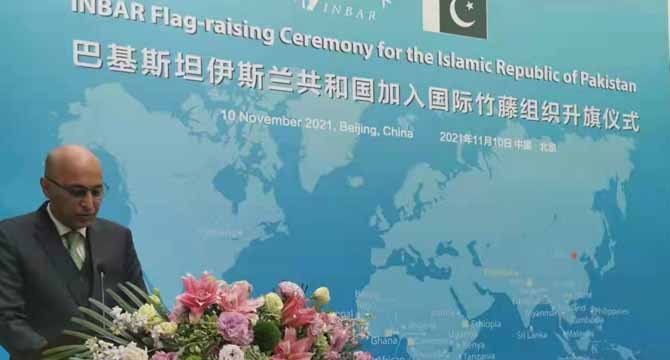
BEIJING, Feb 23 (National Times)- China and the International Network for Bamboo and Rattan (INBAR) are willing to help Pakistan develop its bamboo industry and expose to more advanced technology and programmes, said Wu Junqi, Director of Communications and Outreach of INBAR. He said joining INBAR would expose Pakistan to more advanced technologies and programme opportunities to develop its bamboo sector.
“China has been sending bamboo charcoal masters from Zhejiang to Ethiopia and Africa for four years. Now the local people have their bamboo charcoal factories. Compared with normal charcoal, bamboo charcoal is much more environmentally friendly.
China and Pakistan can also try to cooperate in this aspect,” Wu Junqi added. Lu Wenming, Deputy Director General of INBAR, believes that the bamboo industry is a labour-intensive industry that suits Pakistan, and its characteristics of low-carbon and environmental protection are also in line with its current national strategy.
“China and INBAR are willing to help Pakistan research suitable bamboo species and share relevant technologies, equipment and experience. We are confident to help Pakistan in poverty reduction and prosperity in the future.” Bamboo in Pakistan is of good quality and sells well in the United Arab Emirates, Afghanistan, Iran, Iraq, Malaysia, Indonesia and other countries, China Economic Net (CEN) reported.
“We have bamboo business in Kasur, Dera Ghazi Khan, Sargodha, Kot Momin, Mandi Bahaud Din. It is a billion-rupee business,” said Akbar Ali, a bamboo dealer in Chunian, Kasur. “One farmer there told us that they had earned Rs 60 million in the last three years with three hectares of bamboos.”
In Pakistan, bamboo production is considered economically viable and has market potential. However, due to the lacking of processing technology, Pakistan still stays in the primary stage of bamboo utilization.
“In Pakistan, bamboo is mainly used in the production of roofing materials, scaffolding and bamboo curtains. It is not a business for the rich in Pakistan. It is mostly used by the poor,” said Kalim Ullah, a bamboo businessman from Lahore.
With the unremitting efforts of China and the International Network for Bamboo and Rattan (INBAR), people all over the world have significantly improved their understanding of bamboo from “wood of the poor” to “green gold”. The exhibition hall of INBAR headquarters is full of innovative bamboo products.
“After high-pressure, cold pressing and hot pressing, bamboo becomes square-edged timbers. You can cut it and make it into USB flash disk, keyboard and mouse,” said Wu Junqi.
“This technology can help reduce wood consumption, and bamboo products are very popular in the European market,” he added.